|
 |
 | | | | | | ||||||||||||||||||||||||||||||||||||||||||||||||||||||||||||||||||||||||||||||||||||||||||||||||||||||||||||||||||||||||||||||||||||||||||||||||||||||||||||||||||||
| | | You are in: Business | ||||||||||||||||||||||||||||||||||||||||||||||||||||||||||||||||||||||||||||||||||||||||||||||||||||||||||||||||||||||||||||||||||||||||||||||||||||||||||||||||||||||
|
| | Friday, 25 October, 2002, 12:54 GMT 13:54 UK Q&A: The EU's farm deal
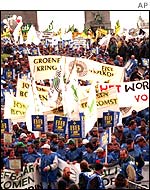
But the deal only skims the surface of a potentially vast problem, as BBC News Online explains. So France and Germany have agreed on farm subsidies. What does this have to do with the enlargement of the European Union? Everything, potentially. After a decade of negotiation about expanding the EU into eastern Europe, no one has much political objection to allowing in the likes of Hungary, Poland and Slovenia. With 10 new would-be members on the EU's doorstep, however, the talk has turned to the financial nitty-gritty. The toughest pre-expansion issue was how relatively underdeveloped agrarian economies such as Poland and Slovakia could be shoehorned into the EU's generous system of farm subsidies, the Common Agricultural Policy (CAP). The CAP already costs around one-third of the EU budget. Applying the system without change to countries in even greater need of subsidy would literally bankrupt Europe. 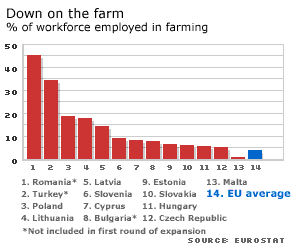 A deal between Germany and France, almost certain to be ratified by the rest of the EU, more or less saves the EU budget. More or less? What exactly have France and Germany agreed? They have not gone the whole hog.
But the French and Germans have merely decided to put an upper limit on subsidies in 2006-13, while only slowly phasing in aid to new EU members. This, they argue, preserves enough of the cream for west European farmers, while allowing newcomers a fair portion. And those who argue the deal does not go far enough should bear in mind that the French and Germans were at opposite poles until recently - the Germans arguing for full reform, the French wanting everything left unchanged. So what does this mean for farmers? This remains to be seen. EU ministers will no doubt be at pains to claim that not a single Italian olive-grower or Irish dairy farmer will lose a cent. But it is hard to see how that can be. Payments to farmers in new member states will be phased in, rising from 25% of current member levels to equal levels in 2013 - and where will the money come from? Instead, the European authorities may have to learn to apportion some of that aid a little more intelligently - something reformers have long argued for. If the need to make money stretch further achieves this, it will be no bad thing. And consumers? Nothing much to crow about here. Many free marketeers argue that the only way to truly benefit the consumer would be to liberalise markets as far as possible - in other words, eradicate subsidies for all but the most obviously needy cases. This would encourage farmers to adjust their production more towards market demand, rather than to where the juiciest subsidies lie - and therefore, they say, give us not just cheap food but good food. Ideas roughly along these lines have been floated from time to time in recent years, most recently by the EU's commissioner for agriculture, Franz Fischler. But achieving governmental consensus, especially when up against a ticking clock, has proved impossible. So is that it, or are there more reforms to come? To coin a phrase, this is not the beginning of the end of CAP reform - just the end of the beginning. The Franco-German deal has been reached under sever time pressure, with the EU expansion procedure due to start formally in December. But the pressure for reform, driven largely by rich, industrial north European countries, is not going to let up. The proposals outlined by Mr Fischler in July, which aim somewhat vaguely to link subsidies to quality of produce, not quantity, seem to be the most realistic way forward. But the entry of 10 hungry new countries will be a complete wild card. The idea of throwing them a fixed percentage of the budget five years hence, plus a one-off aid package, sounds convincing enough now, but may not satisfy anyone in the longer term. Experience of doling out generous subsidies shows that money is rarely received with gratitude, only with demands for more. With some 19% of Poles working in farming, compared with an EU average of just 4%, the thirst for subsidy in the east is a potential budgetary black hole. | |
See also:  25 Oct 02 | Europe 25 Oct 02 | Business 24 Oct 02 | Europe 22 Oct 02 | Europe 21 Oct 02 | Business 21 Oct 02 | Europe 20 Oct 02 | Europe 10 Oct 02 | Europe 08 Oct 02 | Europe Internet links: The BBC is not responsible for the content of external internet sites Top Business stories now: Links to more Business stories are at the foot of the page. | ||||||||||||||||||||||||||||||||||||||||||||||||||||||||||||||||||||||||||||||||||||||||||||||||||||||||||||||||||||||||||||||||||||||||||||||||||||||||||||||||||||
| |
|  E-mail this story to a friend E-mail this story to a friend |
| |
| Links to more Business stories |
| | | ||
 | ||||
 | | Back to top
| ||
| ---------------------------------------------------------------------------------- To BBC Sport>> | To BBC Weather>> | To BBC World Service>> ---------------------------------------------------------------------------------- © MMIII | News Sources | Privacy |