We meet Homer, famous writer of Ancient Greece, who introduces us to the Olympians - twelve of the most important gods and goddesses of Ancient Greece - and also Ancient Greek beliefs about the afterlife.
The video
HOMER:
Religion is a very important part of Ancient Greek life. I should know - people give me credit for telling a few of the best-known stories about the gods, goddesses and heroes. The Iliad, The Odyssey - just two of my epic works. I’m a pretty impressive guy. Homer is my name. You may have heard of me? Homer?
No, not that Homer! Oh well. Anyway, enough about me. Back to religion.
We Ancient Greeks believe in many different gods and goddesses, all of them related to Gaia - the Creator the Earth - and Ouranos - the God of the sky and the stars.
Twelve of the most import gods are called The Olympians, named after Mount Olympus, the highest mountain in Greece. Most of them live there too. They look just like ordinary people, and they do a lot of the things that ordinary people do as well - like fall in love, get married, have parties, argue, fight. But they’re also immortal - they live forever - and they have some rather wacky magical skills.
That big guy with the white beard - he’s Zeus. King of the Olympians and God of thunder. He can get pretty angry and throw lightning bolts.
He’s married to Hera - Goddess of marriage and children. To be fair she can get pretty angry too. Especially when Zeus starts falling in love with other gods or humans.
The other main gods and goddesses are:
Poseidon: God of the sea.Athena: Goddess of wisdom and war.Dionysus: God of wine and fruitfulness.Aphrodite: Goddess of love.Demeter: Goddess of the harvest.Ares: God of war.Artemis: Goddess of hunting.Apollo: God of light, music and healing.Hephaestus: God of fire and sculpture.
And lastly Hermes: Messenger of the gods - who delivers us all the news and guidance from Mount Olympus.
Phew. There we go - a quick rundown. We believe that the gods control every aspect of the world and our lives. For example, every day Apollo drives his magnificent chariot across the sky pulling the sun behind him…and Poseidon creates the waves and storms at sea with his trident.
There are many other lesser gods and goddesses who all have a role to play in the way the world works, and worshiping the gods is essential if you want to stay healthy, safe and prosperous.
We build temples to them, make statues of them, make offerings of food and drink to them. And every Greek city has its own calendar of festivals during which people make sacrifices to them. And every four years we hold a sporting contest - called the Olympic Games - in their honour. All to keep the gods and goddesses happy, so life will be good.
Many of the stories we tell or write about in our plays are all about the gods and goddesses and the humans they control. The very same stories that have passed down through the generations and you call Ancient Greek myths.
Finally, there is the afterlife. We believe that when people die it is by no means the end. In fact, they start a weird and wonderful journey to a new existence in the Underworld.
Hermes - the messenger of the gods - leads your spirit to the entrance of the Underworld. Then Charon rows you across the River Styx in his boat, before you pass through a gate guarded by a three headed dog, called Cerberus. Then Hades - the God of the dead - decides where you get to spend eternity.
If you’ve been good, you’ll relax in the paradise of Elysium; but if you’ve been bad, you’ll end up being tortured in the burning pits of Tartarus.
So, there we go. Best to be good, I say.
Anyway, I want to recite some of my epic masterworks to you. I’m sure you’re excited to hear the stories of Odysseus… Oh… What, we’ve run out of time…? How disappoint…

2. Gods, goddesses, myths and magic
Synopsis
We meet Homer, a famous writer from Ancient Greece, believed to be the author of both The Iliad and The Odyssey. Homer introduces us to the Olympians - twelve of the most important gods and goddesses of Ancient Greece - and explains how the gods and goddesses control every aspect of Ancient Greek life.
Homer goes on to describe Ancient Greek beliefs about the afterlife, including crossing the River Styx and the three-headed dog, Cerberus. Finally Hades will decide if the deceased will enjoy the afterlife in the paradise of Elysium or burning in the fires of Tartarus.
Teacher Notes
Taken from the complete Teacher Notes. See Resources.
Before watching the video
Do children know the names of any Greek gods or goddesses? Explain that children are going to learn a little about the 12 Olympian gods and goddesses and that they will probably have heard some of their names, even if they don’t realise who they are! Challenge them to listen carefully during the video and to note down the names of the gods and goddesses they hear in preparation for one of the activities. They don’t need to worry about the spelling at this stage!
After watching the video
- It’s all in the name. Which names did pupils hear in the video and which did they recognise? Where do they know them from? They may know them from stories, or they may know them from brand names or famous projects - eg Hermes or Apollo. Put children into small groups and invite them to choose one name of a gods or goddess and to use it to create a new product or service, in the style of The Apprentice. They should write a product or service description, create a tagline and design an advertisement. They could even create a TV advert on iPads.
- Playing God. Children should imagine they are a god or goddess. What would their name be? What would they represent? (God/Goddess of …) What would their character be like? A template is provided for pupil’s notes, which they will also need for the next activity.
- Class elections. Time to elect a new god or goddess! Children take the role of their newly imagined god or goddess and make a case to the class to elect them as Class God/Goddess!
- I want to live forever … Gods and goddesses were immortal. But how desirable is immortality? Task children with writing a balanced argument for and against immortality. A template is provided for this.
- Party time! The Ancient Greek calendar was full of festivals in honour of the gods and goddesses. Invite children to design a flyer for a festival for a god or goddess of their choosing. What will they eat and drink? What sort of entertainment will be provided? Who or what will be sacrificed?
Resources - Teacher Notes from Teachit
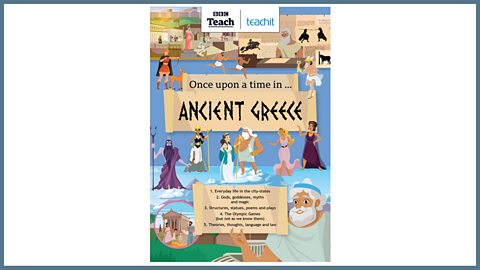
Once upon a time in Ancient Greece. document
Comprehensive Teacher Notes covering episodes 1 to 5, including worksheets and activities.
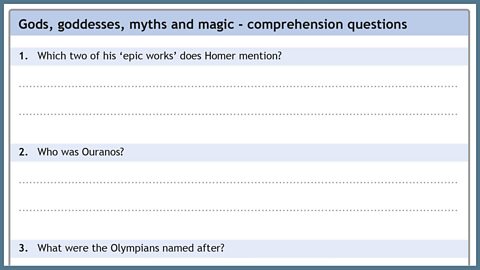
Comprehension questions. document
Click to display the worksheet full-size or print it (taken from the Teacher Notes).
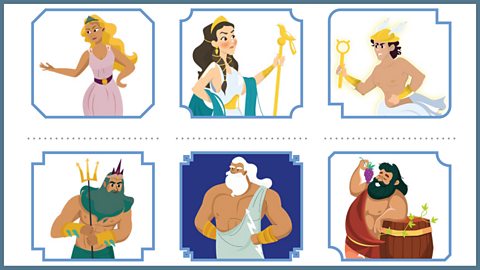
Who's who? Identify the 12 Olympians. document
Click to display the worksheet full-size or print it (taken from the Teacher Notes).
The Teacher Notes for this series have been prepared in partnership with Teachit.
Other resources
Episode transcript
BBC Teach: Tales from Ancient Greece - audio versions of more popular Ancient Greek myths
