Leonidas of Rhodes is our guide to the Olympic Games, as held in Ancient Greece.
The video
4: The Olympic Games (but not as we know them)
LEONIDAS:
Running. Jumping. Throwing. Wrestling. Boxing. Horse racing. We’ve got it all going on!
Welcome to Olympia, the site of the original Olympic Games.
My name is Leonidas. I can run. Really fast. I’ve pretty much dominated the running events at four consecutive Olympic Games. One day they’ll make a statue of me with the inscription ‘He had the speed of a god.’
The Olympic Games are a massive deal for us. They’re held every four years to honour the King of the Gods - Zeus. So they’re as much a religious festival as a sporting event. The statue of Zeus here is one of the seven wonders of the Ancient World, and on the third day - the middle day of the Games - 100 oxen are sacrificed in his honour.
The games are so important that a truce - or ekecheiria - is called across the city-states of Greece. Meaning all wars or disputes must be paused so that athletes and spectators can travel safely to and from Olympia.
And this is the stadium where it all happens. Now these guys are just training so they’re allowed to wear pants. But when they perform during the Games they’ve got to be naked and covered in olive oil. Yep…
So, let’s start with running. As I said, I’m the best…of all time. All the races take place on a straight track in the stadium that’s about 185 metres long. The stadion race was one length; the diaulos was two lengths; and the dolichos was…erm…longer. I didn’t do that race so I have no idea how long it was, and people can’t seem to agree how long it actually was anyway.
I’ve won the stadion, the diaulos and another race called the hoplitodromos, when we run in full military armour. In 40-degree heat. Pretty tough.
There are combat sports - wresting, boxing and pankration, which is a mix of boxing and wrestling where pretty much anything is allowed…except biting and eye-gouging. No one needs that.
The throwing events are discus: athletes hurl a heavy diskos made of bronze, iron or stone as far as they can. And javelin: athletes hurl a wooden spear as far as they can. Fun if you like that kind of thing.
In the long jump athletes jump as far as they can, using weights in their hands to gain momentum, rather than a long run up. There’s also a man playing a flute to help them get into a swinging rhythm for the jump. Strange, I know…
The pentathlon is a five-event contest combining running, jumping, discus, javelin and wrestling.
Now you may have noticed there aren’t any women here. That’s because women are not allowed to take part in the Games. Except in one capacity: training the horses for the equestrian events.
The first woman to win an event - as a trainer that is - was Cynisca of Sparta. She won the four-horse chariot race with her team in two consecutive Olympics. Her victories have inspired women all over Greece to start taking part in the horse events.
The other events are a two-horse chariot race and a horse-riding contest. The chariot races are pretty violent, with everyone bashing into each other as they race. Oh, and the chariot drivers are the only ones who aren’t naked. Guess it might spook the horses.
If you win your event - or multiple events like me - you’re given a wreath of leaves, and you become a legend in your home city. ‘Touched by the gods’ as they say. I’m not one to disagree.

4. The Olympic Games (but not as we know them)
Synopsis
Our guide to the Olympic Games is Leonidas of Rhodes, a runner and a hero of the original Olympic Games. Leonidas describes the main events of the Games and we also learn that the purpose of the Games was to honour the god Zeus.
Leonidas describes the running events that he excelled in, including the hoplitodromos - a running race undertaken in full armour. He then describes the combat sports - wrestling, boxing and pankration, a combination of both in which almost anything is permitted - and the throwing and jumping events. He offers some interesting facts along the way, including that the athletes had to compete completely naked.
Teacher Notes
Taken from the complete Teachers Notes. See Resources.
Before watching the video
Show pupils an image of the Olympic rings. Do they recognise them? Do they know what the rings represent? Why only five rings and not seven, do they think? Invite them to share some knowledge about the modern-day Olympics and explain that they are going to find out more about how they began.
After watching the video
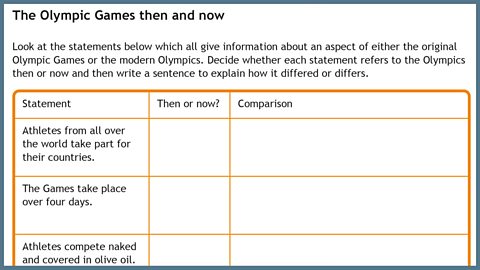
- Then and now. As the title of the film suggests, the Olympic Games are not quite the same now as they originally were. Ask children to complete the worksheet provided, which gives statements about the Games and asks children to write a sentence explaining the difference, either then or now.
- Create an Olympic event! Invite children to make up their own Olympic event and to write a set of instructions for it. They should remember to include all the features of instructional texts, including numbering and command words.
- Design a poster. Explain that you are going to hold your own class Olympics - possibly featuring some of the children’s new events - and that the children need to advertise it. They should design an eye-catching poster giving all the information required and enticing people to attend.
- Class Olympics! Hold your Olympics in the playground, the hall or on the school field. Where possible, recreate the original events such as discus and javelin, with plastic cones and sponge javelins. You could even try a form of chariot racing if children are willing to race on all fours!
- Sports reports. After the class Olympics, ask children to write a recount of one of the events you held. A worksheet is provided to support children’s thinking.
Resources - Teacher Notes from Teachit
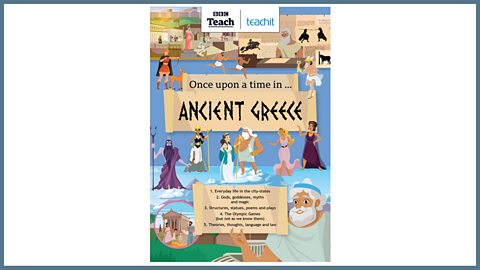
Once upon a time in Ancient Greece. document
Comprehensive Teacher Notes covering episodes 1 to 5, including worksheets and activities.
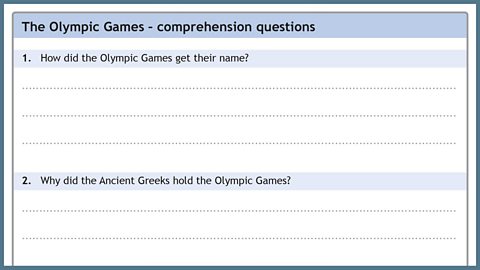
Comprehension questions. document
Click to display the worksheet full-size or print it (taken from the Teacher Notes).
Olympic Games - comparing then and now. document
Click to display the worksheet full-size or print it (taken from the Teacher Notes).
The Teacher Notes for this series have been prepared in partnership with Teachit.
Other resources
Episode transcript
BBC Teach: Tales from Ancient Greece - audio versions of more popular Ancient Greek myths
