The playwright Euripides introduces us to the various forms of Ancient Greek architecture, theatre and culture.
The video
EURIPIDES:
Art. Theatre. Architecture. We Ancient Greeks are very, very creative. Take me for example. Euripides. I am one of the great Classical Athenian tragedian dramatists. Put simply: I write plays.
The people love going to the theatre for a good story, told well. We have drama competitions that take place every year during the ‘Festival of Dionysus’, the God of wine. I’ve won four times by the way.
We write tragedies - more serious plays, often based on epic stories about our gods, goddesses, heroes, kings and queens. And comedies - more light-hearted plays.
One of our very first theatres was called the Theatre of Dionysus. It was cut into the cliff face below the Acropolis in Athens.
Our plays are watched by thousands of people, so the theatres have tiered seating, so everyone can see…and the actors wear masks, to show which character they are and to make their voices louder, so that everyone can hear.
Our architects and builders are pretty impressive too and they don’t just build theatres. Some of their most amazing buildings are temples built to honour the gods and goddesses. It’s always good to keep them happy.
Perhaps our greatest temple is the Parthenon at the centre of the Acropolis, in Athens. Inside was a 12-metre-high gold and ivory statue of the goddess Athena.
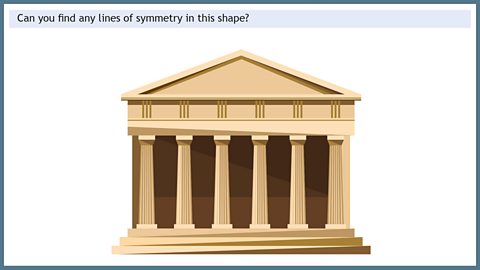
All of our important buildings have perfect proportions: symmetry…harmony…and lots of columns!
They’re built from vast stone blocks that are carved on site with chisels and hammers. The columns are made in sections and then lifted into place with ropes and pulleys. The workforce is made up of skilled craftsmen and slaves.
And let’s not forget the wonders in and around these amazing buildings. Statues and sculptures made of gold, marble, wood and stone - showing gods, goddesses, and the great people from our history. And friezes - which are pictures carved in stone.
And there are pictures on our wonderful pottery as well. Local clay is used as it has a marvellous reddish-brown colour. Our potters make all manner of pots: pots for wine, for oil, for perfume, for food. They’re often decorated by silhouetted figures showing things like scenes from famous stories, or the daily lives of ordinary people.
Oops…best be on my way…
But it isn’t just potters. We have expert metal workers, jewellers, and other artists. We also created a lot of mosaics - the art of using tiny pieces of coloured glass or stone to create pictures on floors or walls. Stunning.
You can find out a lot about Ancient Greece from the buildings, sculptures, and works of art. They show the places we lived and worked and worshipped; and the type of items we used in our daily lives, and how we entertained ourselves. And, most importantly, how very, very, clever and creative we were.

3. Structures, statues, poems and plays
Synopsis
We meet the dramatist Euripides who introduces us to the various forms of art and architecture enjoyed by the Ancient Greeks and explains how their artwork reveals details of how the Ancient Greeks lived.
Euripides explains the importance of Greek drama and how the theatres were designed with tiered seating to enable the audience to see, and how the actors wore special masks to amplify their voices so that everyone could hear. He describes the features of Ancient Greek architecture including symmetry, and Greek ceramic art which has provided historians with so much evidence of how the Ancient Greeks lived.
Teacher Notes
Taken from the complete Teacher Notes. See Resources.
Before watching the video
Show children some images of Ancient Greek pottery. What do they notice about it - eg the pictures that decorate it? Why might this feature be helpful to historians now?
After watching the video
- Playtime! As we saw in the video, the Ancient Greeks loved watching plays. Explain that children are to think of a scene or chapter from a favourite film or book and turn it into a playscript. Ask them to complete the worksheet provided to remind them of the features of a playscript. Invite children to choose classmates to perform their plays to the rest of the class. They could even make masks for the occasion.
- Meaningful mosaics. Like the Romans, the Ancient Greeks created mosaics - pictures made of tiny pieces of stone or glass. Ask children to make a simple drawing, just an outline and a few simple details, of an object or symbol that represents something meaningful in their lives - eg a football or a musical instrument. Then provide children with plenty of coloured paper - either already cut into small pieces or to be cut up - and glue sticks to complete their mosaic.
- Perfect symmetry. As Euripides informed us, a key feature of Greek architecture was its symmetry. Ask children to complete the worksheet provided which begins by exploring lines of symmetry. It goes on to ask children to design their own, symmetrical, Greek temple ready for the following activity.
- Build a temple. Provide a range of recycled materials and invite pupils to follow their designs to build their own Greek temples. Children should remember to include plenty of columns and to make sure their temples are symmetrical! These make for a great display.
- Frieze! On long strips of paper or card, children should draw or paint a scene, or scenes, depicting an aspect of their daily life. Alternatively, if you have access to clay, children could create a pot, bowl, plate or vase to be decorated with objects, symbols or scenes that represent an aspect of their life.
Resources - Teacher Notes from Teachit
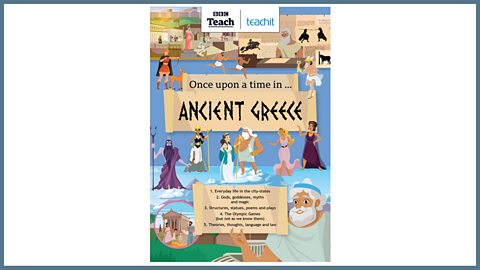
Once upon a time in Ancient Greece. document
Comprehensive Teacher Notes covering episodes 1 to 5, including worksheets and activities.
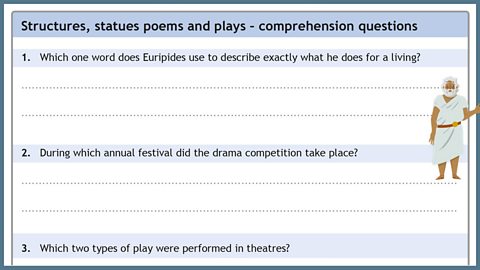
Comprehension questions. document
Click to display the worksheet full-size or print it (taken from the Teacher Notes).
Greek architecture - lines of symmetry. document
Click to display the worksheet full-size or print it (taken from the Teacher Notes).
The Teacher Notes for this series have been prepared in partnership with Teachit.
Other resources
Episode transcript
BBC Teach: Tales from Ancient Greece - audio versions of more popular Ancient Greek myths
