We meet the female philosopher Arete of Cyrene, who explains how so many aspects of Ancient Greek civilisation are still relevant to us today.
The video
ARETE:
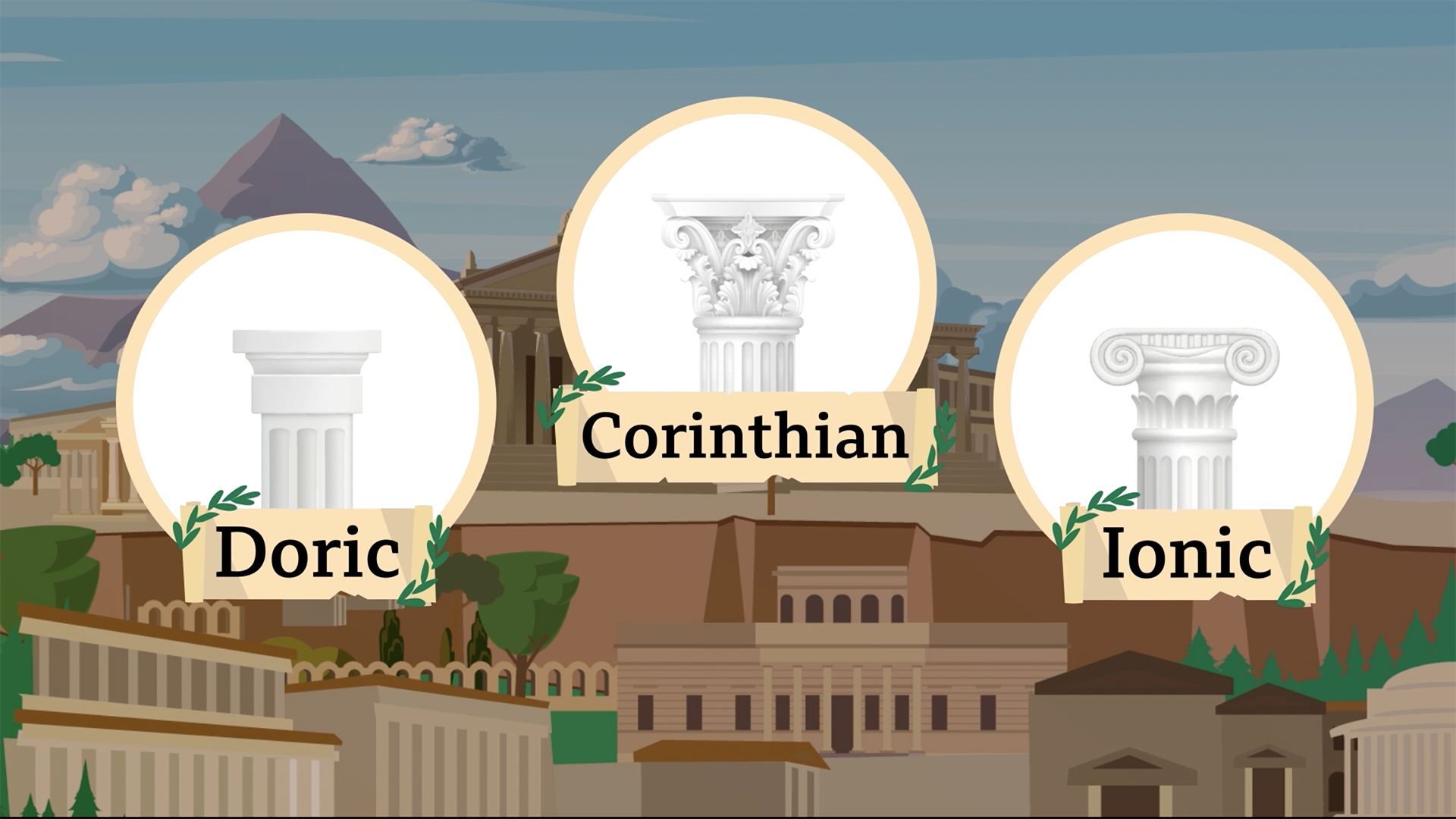
Welcome to Ancient Greece! Now I’m not going to blow our trumpet too much but… Well, actually I am! We are a pretty impressive civilisation! Just look at some of the details on these wonderful buildings. Timeless! The architectural style we created for our buildings is still used by you for many of your buildings. So, we must be getting something right!
So many of the things we do in our time are still relevant to you in your time. It’s our legacy you might say.
My name is Arete of Cyrene. I study and teach philosophy. I am a philosopher. And, wow, there are a lot of us in Ancient Greece. We spend our time thinking about what it means to live a good life…
Perhaps our most famous philosopher is Socrates. He never writes anything down. A bit lazy maybe, eh, Socrates? Or maybe too busy thinking… To be fair he does spend hours discussing everything with his students, helping them learn by asking open-ended questions. Sound familiar? Thought so! His ‘Socratic’ methods are still used by teachers and many others in your time.
Luckily some of his students - me included - do write things down, so all our hard work and brainy thoughts can be read by you lot. And writing is something else we’re great at. We have famous writers - like Herodotus - who record historical events, like wars. So, if you love history you can thank us for being the first to write about it. And if you don’t like history you can thank us for…well, being the first to write about it!
And many of our words are still used in your time, either exactly the same, or very similar. ‘Galaxy’, ‘Europe’, ‘Democracy’, even ‘Acrobat’ - they’re all based on Ancient Greek words. There are thousands of others! It’s worth looking up a few more, if only to understand quite how linguistically brilliant we are!
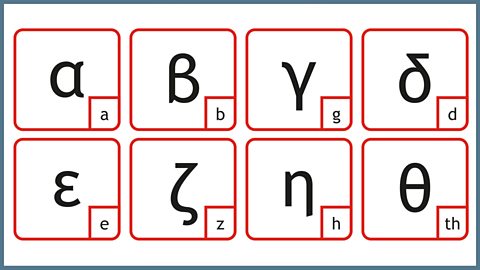
‘Alpha’, ‘Beta’, ‘Gamma’, ‘Delta’ - you’ve probably heard of a few of our letters. They’re so great you still use them in your time to name stuff, or as symbols in maths and science. For example, ‘Pi’ is used for that number that never ever ends…you know the one: 3.14159265359… I could go on…
Which leads me neatly onto science. Yep, we’re rubbish at that… Ha! Just kidding! We’re great at that too! You probably take for granted that the earth revolves around the sun and that the moon is lit up by the sun. But our astronomers are the ones who said it first.
Then there’s Pythagoras and mathematical concepts like infinity. A few of us have been grappling with that one. But don’t think about it for too long or you may never stop… Get it?
A few centuries ago, we used to believe that illness was caused by the gods and you could just pray it away. Then my good friend Hippocrates changed all that. He realised that illness has natural causes and that patients should be treated by studying their symptoms. Many doctors in your time take the ‘Hippocratic Oath’, which means they promise to look after all people well.
People. The word ‘democracy’ comes from two of our words that mean ‘people’ and ‘power’: ‘people power’. It’s the form of government that allows people to vote on who gets to be in charge. Only…not all. Slaves can’t vote. And as a woman I can’t vote either. But that’s something you’ll put right with your own form of democracy.
I may be wrong…as I live here…not there with you… But am I really alive at the moment? Or am I just on the screen? Oops. Sorry. There I go philosophising again!

5. Theories, thoughts, language and law
Synopsis
We meet the philosopher Arete of Cyrene, who explains how so many aspects of Ancient Greek civilisation are still relevant to us today. The topics she covers includes architecture, philosophy, science, mathematics, medicine and democracy.
Arete indicates how many of the most important buildings in the present day copy the features of Ancient Greek architecture. She shows how Ancient Greek letters and symbols have been adopted by modern science; how Ancient Greek astronomers were the first to postulate that the Earth moves around the sun; how Hippocrates was the first medic to presume that illness came from natural causes.
Teacher Notes
Taken from the complete Teacher Notes. See Resources.
Before watching the video
Over the course of the last few sessions children have been introduced to different aspects of Ancient Greek life. Which of them are still relevant? Are there any other elements of our way of life that they think may have come from Ancient Greece?
After watching the video
- Junior philosophers. Stage a class discussion entitled What does it mean to live a good life? What makes children feel content? Note down ideas and create a class action plan to help children lead a happy and fulfilled life. This could take the form of a list of tips or a weekly calendar of actions, such as reading to younger children every Monday.
- Democracy in action. As we know, the Ancient Greeks were governed by democracy, a form of government that allows people to vote on who should be in charge. Hold a class election in which children can put themselves forward for a particular role. This could be a role relevant to your school or, for example, a 'Happy Life Leader' who decides on a weekly action to help everyone lead a better life (see the previous activity). Candidates should prepare a speech and then each child has a ballot slip on which to cast their vote. A template is provided for this.
- Greek words. In the video we heard how many of the words we use today come from Ancient Greek. Using the cards provided, ask pairs of children to sort the words into those that come from Greek and those that don’t. (Note the only words that do not come from Greek are ‘medicine’, ‘play’, ‘dance’, ‘lizard’ and ‘honey’.) Then play a game in groups: children have 30 seconds to describe one of the words on the list without actually saying it and the others must guess which it is.
- Learn the alphabet! The Greek alphabet looks quite different to our own. Give children a copy of the Greek alphabet provided. Then give each child one of the 30 sentences provided to write in Greek. They must then swap their sentence with a friend to translate. (Sentences vary in length to allow for different attainment levels.) Who will translate their message first?
- Time for a quiz! Pupils will have learned a lot about Ancient Greek civilisation from this set of videos and activities and it’s time to put that new knowledge to the test. However, it’s up to the children to test one another. Challenge each child to write a question for a class quiz. Sort children into teams and invite each team to read out their questions to the other teams. You may wish to elect a spokesperson in each team to avoid lots of shouting out. Teams win a point for a correct answer but if nobody answers correctly, the team posing the question wins the point. The team with the highest number of points at the end wins.
Resources - Teacher Notes from Teachit
Once upon a time in Ancient Greece. document
Comprehensive Teacher Notes covering episodes 1 to 5, including worksheets and activities.
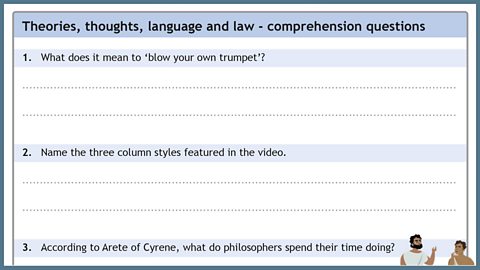
Comprehension questions. document
Click to display the worksheet full-size or print it (taken from the Teacher Notes).
Ancient Greek alphabet. document
Click to display the worksheet full-size or print it (taken from the Teacher Notes).
The Teacher Notes for this series have been prepared in partnership with Teachit.
Other resources
Episode transcript
Image showing Doric, Ionic and Corinthian pillars (from the video)
BBC Teach: Tales from Ancient Greece - audio versions of more popular Ancient Greek myths