The myth of King Midas - who wished that everything he touched should turn to gold.
The video
8: King Midas
King Midas was the ruler of Phrygia.
One day, Midas found a satyr - a creature with the body of a man and legs of a goat - in need of help. So Midas took the satyr home and looked after him.
The satyr was a good friend of Dionysus, the God of wine and merriment. When Dionysus saw how well treated his friend had been he granted Midas a wish.
Midas dreamt of being very rich. He asked that everything he touched should turn into gold.
Dionysus knew it was a stupid wish, but granted it anyway.
Midas touched a tree, his palace, the grass - everything instantly turned into gold.
Midas was delighted and organised a huge party to celebrate. But as soon as Midas tried to eat the delicious food, it turned into gold. As soon as he reached out to his daughter, she too turned into gold.
Midas realised how stupid he had been and begged Dionysus to take back the wish.
The god told Midas to wash his hands in a nearby river and then he would be free.

King Midas
Synopsis
King Midas is the ruler of Phrygia. One day he finds a satyr (upper body of a man, legs of a goat) in need of help and provides assistance. The satyr is a favourite of the god Dionysus, who rewards Midas by allowing him any wish to come true.
Midas' greed gets the better of him and he wishes that everything he touches should turn to gold. It turns out to be a very foolish wish - Midas' food, his palace, even his daughter turn to gold. Midas returns to Dionysus and begs him to reverse the wish.
Teacher Notes
Taken from the complete Teacher Notes. See Resources.
Before watching the video
If possible, play the song ‘Midas Touch’ by Midnight Star to pupils. Have they heard of King Midas? Does this song give them any clues as to the story of King Midas?
After watching the video
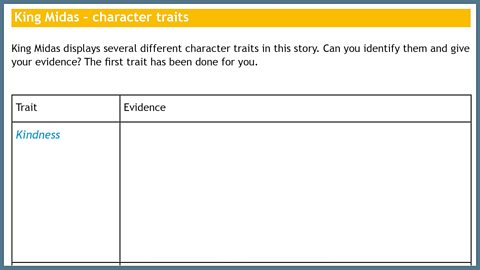
- Character traits. Which character traits, good and bad, does King Midas show? Children should use the worksheet provided to consider the different traits Midas reveals in this story and what evidence we have - eg care and compassion for the satyr but greed and foolishness in his wish. They are then asked to consider which other fictional characters display these traits and how these traits are revealed.
- Be careful what you wish for! Ask pupils ‘What would you wish for if you had the chance and why?’ Ask them to write down their wish anonymously and to put them into a container. Pick out the wishes at random and read them aloud. After each one, invite children to consider the pros and cons of the wish and to take a vote to decide whether it’s a wish worth asking for or not. If possible, sort the wishes into categories: wishes that benefit others and wishes that benefit just oneself. Agree a final class ‘wish list’. Is there anything children could do to achieve it?
- We all make mistakes. King Midas made a big mistake, but he was lucky because it was easily resolved. Hold a Circle time and ask children ‘What mistakes have you made?’ Share a mistake of your own and invite children to share ideas for how to resolve it. Invite confident children to share their mistakes and discuss how they could have been resolved.
- Colour poetry - using similes. Explain that pupils are to write a colour poem based on gold. A colour poem describes a colour using the five senses - eg:
Orange looks like the setting sun.
Orange sounds like a bouncing basketball.
Orange smells like mango.
Orange feels like the skin of a pumpkin.
Orange tastes like a sweet pepper.
Ask children what type of figurative language this poem features (similes). Share ideas using different colours, then give children the template provided to write their poem. - Colour poetry - using metaphors. Ask pupils ‘What is the difference between a metaphor and a simile?’ A metaphor is a word or phrase used to describe something as if it is something else - eg:
Green is the grass that sways in the wind.
Explain that pupils are now going to write another colour poem - one based on metaphors about gold. A template is provided for this.
Resources - Teacher Notes from Teachit
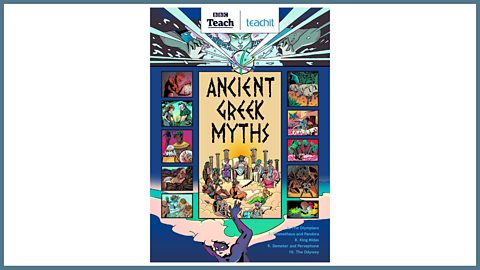
Ancient Greek myths. document
Comprehensive Teacher Notes covering episodes 6 to 10, including worksheets and activities.
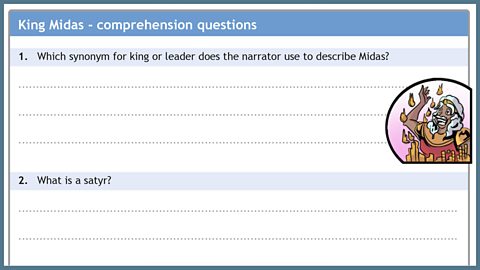
Comprehension questions. document
Click to display the worksheet full-size or print it (taken from the Teacher Notes).
King Midas' character traits. document
Click to display the worksheet full-size or print it (taken from the Teacher Notes).
The Teacher Notes for this series have been prepared in partnership with Teachit.
Other resources
Episode illustrated transcript
BBC Teach: Tales from Ancient Greece - audio versions of more popular Ancient Greek myths
