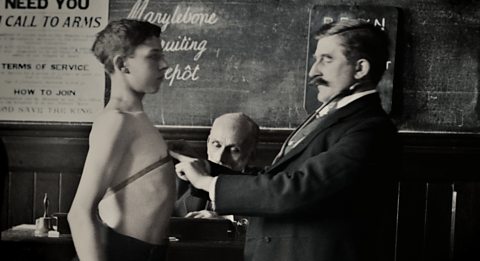
Over the course of the Great War, the British Army developed new tactics and new weapons that would eventually enable Britain and her allies to defeat the Germans. The most important new weapon was a machine that was initially called His Majesty's Land Ship. The tank was designed to withstand machine-gun fire and break through trench defences. Horace Leslie Birks was put in charge of one of these early tanks at Passchendaele.
HORACE LESLIE BIRKS: This was the first time I had actually commanded a tank in action, and I was petrified. I hoped the whole way up that I should sprain my ankle or something like that, that we should never get there, or the whole thing would be called off. We had no luck at all. And the ghastly hour got nearer and nearer, and the worst moment of all was when we started up our engines and they would backfire, and you got a sheet of flame out of the exhaust, everybody calling each other a bloody fool and waiting to know what was going to happen. However, nothing did happen and we climbed into the tank. We had to close down because we were within very comfortable machine-gun range and once we were shut down, we were completely isolated from the world. We had no means of communication at all. The thing got hotter and hotter and hotter. The only ventilation was concerned with the engine and not for the crew. You could only see forward through a little slit in the front visor, and if you wanted to see out the side, you looked through steel periscopes, which gave you a sort of translucent outside light, all distorted. The noise inside was such that you could hear nothing outside at all, and people made little gestures to you, rude or otherwise, and that was all you could… your sole means of communicating.
We went off line ahead and my own tank was the fourth. We had only got about another ten minutes along the road when I thought the world had come to an end. We ran straight into the counter-barrage of the Boche. He had evidently seen our leading tank, which was somewhere ahead, and we caught it. SHELL EXPLODES And I had never been so frightened in my life. Everybody was. There were blues and reds and yellows, all the pyrotechnic colours in the world, and then, there was a most almighty crash, and a sheet of flame came up from the starboard side, and we had had a direct hit. SHELL EXPLODES The shelling was still going on - if anything, more intense - and we were being machine-gunned. I had three men wounded. One had got his leg blown off and he died later on that night. And we got the whole lot out, with the tank between us, and the Germans, and then sat down to take stock, cos we didn't know what to do exactly. Ten tanks were written off. None were recovered, and nothing was achieved at all.
NARRATOR: Appalled by the debacle at Passchendaele, the British High Command was on the point of abandoning these clumsy contraptions… but the tanks were given a last chance to prove themselves at the Battle of Cambrai in November 1917. ENGINE PURRS Here, there was no mud, and tanks were deployed in much larger numbers. Almost 500 tanks took part in the battle.
HORACE: We got in, shut down our tanks and we set course for the enemy line… and then we got into this belt of wire. It was quite terrifying because it was about seven feet high, very, very thick wire and it was over 120 yards deep in places. And of course, if we had stopped in that or got our tracks ripped off, then we should have been for it. Instead of that, the tanks made great swathes in the wire, and the Jocks who were playing with us, they came through the gaps we had made. The Germans had just finished breakfast. They were completely taken by surprise. They were running about, with their hands up, hands down, hands everywhere. My crew got out for a smoke and to have a look around, and when the time came to go on, I found I had no crew at all. They were all looting. However, we got them back. I had two men from Scotland in the crew. They came back with pistols, binoculars and all sorts of things. I was furious with rage so they presented the best pair to me and off we went again.
NARRATOR: Cambrai was the first battle where tanks took on a decisive role. Tanks and new tactics involving tanks would eventually play their part in winning the Great War. Horace Birks stayed in the Army. He spent all his military career with his beloved tanks. In the Second World War, he commanded an entire tank corps and retired with the rank of major general.
Video summary
The tank was a supposed miracle weapon intended to overcome the advantages of the German defences.
However, as tank commander Horace Birks describes, they did not have the desired impact in the first two years of service; indeed they arguably posed more of a danger to their crews than the enemy.
Only at the battle of Cambrai in November 1917 did their potential really become evident, and they were to play a decisive role in the defeat of Germany in 1918.
This is from the series: I Was There: The Great War Interviews.
Teacher viewing recommended prior to use in class.
Teacher Notes
This clip could be used as an introduction to an investigation into the role played by new technologies in the defeat of Germany.
Students could be divided into two groups, with one half focusing on information from the clip which supports the view technology played little part, with the other half of the group using the information to make a counter argument.
This clip will be relevant for teaching History at KS3, KS4/GCSE, in England and Wales and Northern Ireland.
Also at Third Level, Fourth Level, National 4 and National 5 in Scotland.
This topic appears in OCR, Edexcel, AQA, WJEC, CCEA GCSE and SQA.
John Willis Palmer interview. video
John found it difficult to cope with the violence and apparent pointlessness of the war.
Attrition. video
The strains of war drove soldiers to desert their post or inflict a wound on themselves.
Life as a munitionette. video
Mabel was one of many women who put their lives at risk working in munitions factories.
Life as an officer during WW1. video
Charles talks about coping with looming shellshock and aspects of an officer's life.
One woman's loss. video
Katie describes what the war was like from a young woman’s perspective in Manchester.
Recruiting soldiers in WW1. video
The different pressures which were applied to persuade young men to join up to fight.