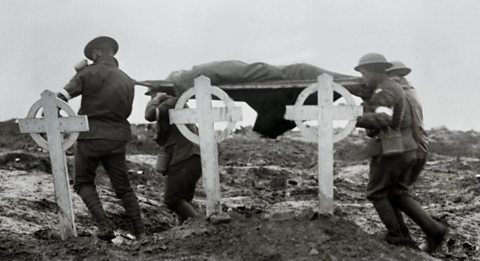
NARRATOR: When Britain went to war in 1914, it had less than 250,000 battle-ready troops. It desperately needed volunteers to build a whole new fighting force. One man willing to sign up was Katie Morter's husband.
KATIE MORTER: We was very happily married. Very, very happy. Because we were very much in love. He thought the world of me and I thought the world of him. And then it came to be that the war started. We had a friend over in Canada that had enlisted over there and he came over here and he came one night and asked us, would we go to the Palace? He had booked seats for the Palace and would we go? We didn't know what was on, of course, and it was a great treat for us. So we went. When we got there, the Palace, everything was lovely. And Vesta Tilley was recruiting, which we never knew until we got there. I wouldn't have gone if I'd have known, of course. She was dressed on the stage beautifully. She also had a big Union Jack wrapped around her and she introduced that song, We Don't Want To Lose You But We Think You Ought To Go.
SONG: We don't want to lose you but we think you ought to go For your King and your country both need you so…
KATIE: We were sat at the front and she walked down and she hesitated a bit and she put her hand on my husband's shoulder. He got up and he went with her.
SONG: We shall cheer you, thank you, kiss you when you come back again.
KATIE: I was terribly upset and I said I didn't want him to go and be a soldier because I didn't want to lose him. I didn't want him to go at all. But he said, 'We have to go.' He said, 'There has to be men to go and fight for the women, otherwise where should we be?'
NARRATOR: Private Percy Morter was posted to France in September 1915.
KATIE: During the time that he was away, I was very, very lonely. All the thoughts I had was for my husband. I used to try to do a bit of reading or a bit of sewing with my hands, to pass the time away like that. But it was very, very hard and at times I did wonder what he was doing or if he was thinking about me. And wondering how he was going on. When I should see him again.
NARRATOR: By the start of 1916, Katie was living back at her mother's and working in a local leather factory. One January morning, as she was getting ready for work, she had a surprise visitor.
KATIE: There was a loud knocking on the door, such a big knocking on the door, and this voice shouted, 'Open the door, the Jerries are here.' See? My mother said, 'Oh, it's Percy, I can tell his voice.' And in he came, all mucky and what have you, right from France. He only got six days' leave and he had two days travelling out of that. Had to be taken off the six days, so he didn't have very long. He said, 'Now, Kitty…' He called me Kitty. He said, 'Now, Kitty, what would you like for a present? I'm going to buy you a present while I'm home.' I said, 'Oh, I don't know.' I said… I'm afraid I was rather vain in those days and I was a rather attractive girl. And I said, 'I've seen a beautiful hat down the street. Oh, it is a lovely hat.' I said, 'I would like it.' It was in a shop window and I'd looked at this hat several times but it was such a terrible dear hat. He said, 'Come on, we'll go down and have a look at it.' And I'll never forget that hat. It was white felt and it turned up all around, and with me being dark… And it had a big mauve feather all the way in the brim and it hung over, oh, it was gorgeous. We got dressed up after I got this hat. He bought it me. I took him to the Noblett's leather works, where I worked, and I introduced him to Mr Noblett himself. They all shook hands with him. How pleased and proud I was when he went in the leather works and everybody could see him.
SONG: Brother Bertie went away to do his bit the other day…
KATIE: He went back about the Thursday night, I should think. I didn't go with him to the tram but one of my brothers went with him… and a friend of his. And he told his friend, it seems - afterwards he told me - he said, 'I'm afraid I shall never come back again.' Anyway, he went, and then I found out that I was pregnant.
NARRATOR: Kitty continued to work at Noblett's. Then, in July 1916, there was another early-morning knock at her door.
KATIE: I heard the postman come. I knew that it would be a letter for me so I ran down in my nightdress and opened the door and snatched the letter off the postman. I ran in and shut the door, in my nightdress and my bare feet. I opened the letter and it was from his sergeant and it just said, 'Dear Mrs Morter, I'm very sorry to tell you of the death of your husband.' Well, that was as far as I could read, you see, I couldn't read anything else. So I didn't know, just for a few minutes, what happened but I ran out of the house, as I was, in my bare feet, and I banged on the next door. The next-door neighbour. It was a Mr and Mrs Hurst. They let me in. 'Whatever is to do?' she said. I said, 'Will you read this letter, Mrs Hurst? Read this letter.' And she said, 'Oh, you poor child.'
NARRATOR: Lance Corporal Percy Morter was killed on the Somme on 7th July 1916.
KATIE: Eventually the baby came to be born. It was born at home but I don't remember it being born at all. I had a very bad time, I had two doctors and I don't remember the baby being born. I felt I didn't want to live, I had no wish to live at all. Because the world had come to an end then, for me, cos I'd lost all that I'd loved.
NARRATOR: Katie named her son Percy Edward. He, too, christened his son Percy Edward, after the father he had never met. Katie married three more times. She survived all of her four husbands.
Video summary
Katie Morter describes what the war was like from a young woman’s perspective in Manchester.
The decision of her husband to volunteer changed her life, as she was forced to move back in with her mother, and move to a better paid jobs as she would now be the sole bread winner.
She recalls her delight when her husband came home on leave and despair when she received the dreaded letter informing her of his death at the Somme in July 1916.
This is from the series: I Was There: The Great War Interviews.
Teacher viewing recommended prior to use in class.
Teacher Notes
This clip could be used as a starter to an activity exploring the ways that the role and status of women changed during the war.
Students could be asked to list the different ways the role of women changed during the course of the clip.
This clip will be relevant for teaching History at KS3, KS4/GCSE, in England and Wales and Northern Ireland.
Also at Third Level, Fourth Level, National 4 and National 5 in Scotland.
This topic appears in OCR, Edexcel, AQA, WJEC, CCEA GCSE and SQA.
The Christmas truce, 1914. video
Henry describes his reaction to being called up and his experiences in the trenches.
The Gallipoli campaign. video
Frank talks about fighting in the disastrous Gallipoli campaign in 1915.
War in the air. video
Pilots identify the different experiences of men in the air, recalling the realities of combat and the tactics used to down an enemy aircraft.
Being a pilot in WW1. video
Cecil Lewis’ experiences reflect how the role of aircraft changed in the course of WW1.
Fighting in the trenches. video
Stefan Westmann presents two contrasting experiences of the war.
Death and survival. video
The experiences of a disillusioned soldier and the widow of a soldier killed in action