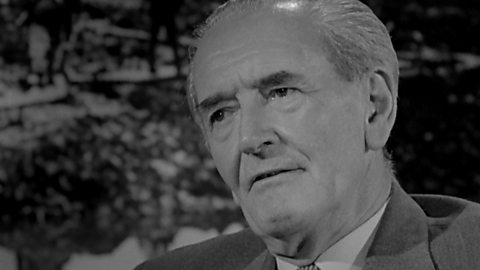
NARRATOR: Technological progress not only created trench warfare, it also opened up a new battlefield… the air. Aeroplanes were crucial for reconnaissance of enemy positions, and the British Royal Flying Corps fought to gain air supremacy from the German Air Service. Cecil Arthur Lewis joined the Royal Flying Corps in 1915. He was barely 17 years old and he lied about his age. He had his baptism of fire at the Battle of the Somme in the summer of 1916.
LOUD BLASTS
The British prepared for the battle with a massive bombardment of the German lines, which lasted a whole week. Reconnaissance planes had to report on the effect of the bombardment.
CECIL A. LEWIS: When they begin to build up towards the main bombardment, we used to go out and photograph, and these jobs were among the most terrifying that I ever did in the whole war. When you had to go right over the lines, you see, you were midway between our guns firing and where the shells were falling. They had orders, we were told, you know, the artillery, not to fire when an aeroplane was in their sights. They cut it pretty fine, you know, because, really, one used to fly along the front on those patrols, and that lasted for two or three days, and the aeroplane was flung up, you know, with a shell which had just gone underneath and missed you by two or three feet. Or flung down when it had gone over the top. And this was continuous, so the machine was continually bucketed and jumping as if it was in a gale, but in fact, it was shells. And you didn't see those, they were going much too fast, but this was really terrifying. One had the sort of feeling, 'They're firing at us! It's us they want to get!' You know? So many of the boys, my best observer and many of my friends, were just hit by this barrage, you know, and destroyed… (HE SNAPS HIS FINGERS) …by a direct hit from a passing shell.
NARRATOR: Young Lewis was awarded the Military Cross for his actions over the Somme. He was moved to 56 Squadron and joined the ranks of the elite fighter pilots. It was their job to shoot down enemy planes.
CECIL: Our eyes were continually focusing, looking, craning our heads round, looking for those black specks which would mean enemy aircraft at a great distance away. Clinging close together, about 20, 30 yards between each machine, swaying, looking at our neighbours, keeping our throttles, setting ourselves just right so that we were all in position, as it were. And then sooner or later, we would find the enemy. The whole squadron would enter the fight in good formation, but within half a minute, the whole formation had gone to hell. There was nothing left except just chaps wheeling and zooming and diving and on each other's tails, perhaps four in a row even, you know. A German going down, one of our chaps on his tail, another German on his tail, another Hun behind that. Extraordinary glimpses one got of people approaching head-on, firing at each other as they came and then, just at the last moment, turning and slipping away. The fight would come down from 15,000 feet right down almost to ground level. You had to fight as if… there was nothing but you and your guns, you had nobody at your side, nobody who was cheering with you, nobody who'd look after you if you were hit. You were alone. You fought alone and died alone. But those who died weren't there when we came back.
NARRATOR: After the war, Cecil Lewis became one of the four founders of the BBC. And he wrote a memoir of his wartime experiences, Sagittarius Rising, a bestseller that was turned into a movie.
Video summary
The role of aircraft changed during the course of the war, and Cecil Lewis’s experiences reflect these changes.
Gaining a baptism of fire as a reconnaissance pilot over the Somme battlefield in 1916, he was later posted to a fighter squadron, where he saw incredible feats of daring and courage in the loneliest form of warfare.
This is from the series: I Was There: The Great War Interviews.
Teacher review prior to use in class is recommended.
Teacher Notes
This clip will demonstrate the changing role of aircraft during the war, and their contribution to the Allied victory.
This contributor in this clip uses language that could be offensive when describing the Germans. It may be worth acknowledging this and discussing why this language was used at the time with your students.
This clip will be relevant for teaching History at KS3, KS4/GCSE, in England and Wales and Northern Ireland.
Also at Third Level, Fourth Level, National 4 and National 5 in Scotland.
This topic appears in OCR, Edexcel, AQA, WJEC, CCEA GCSE and SQA.
Fighting in the trenches. video
Stefan Westmann presents two contrasting experiences of the war.
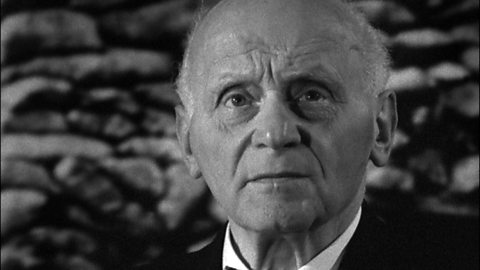
Death and survival. video
The experiences of a disillusioned soldier and the widow of a soldier killed in action
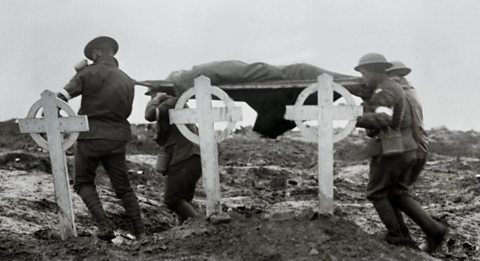
Going over the top. video
Infantrymen recall the tense hours in the trenches prior to an attack.
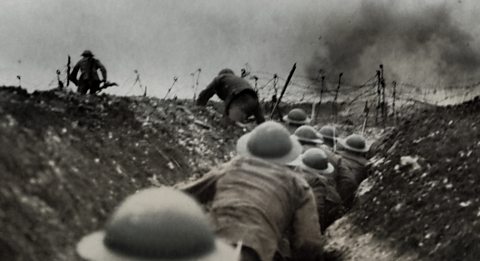
Life as a munitionette. video
Mabel was one of many women who put their lives at risk working in munitions factories.
Attrition. video
The strains of war drove soldiers to desert their post or inflict a wound on themselves.
Life as an officer during WW1. video
Charles talks about coping with looming shellshock and aspects of an officer's life.