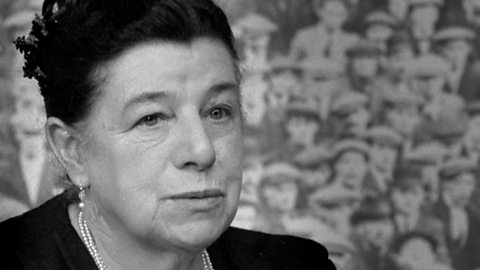
JOSEPH MURRAY: We stood there packed like sardines, unable to even stand up in comfort. Men were fast asleep on their feet. Others just stood staring into the clouds in the sky. The laddie next to me checked his rifle and his ammunition over and over again, but apparently still not satisfied. Others just stood and stared. Silent as the grave. Maybe looking forward. And we still had another hour to wait.
RICHARD H. TOBIN: I remember those lads standing there. Dead silent, couldn't make a noise. The fellow next to you, he was your best friend. You loved him. You probably didn't know him the day before. Then, an hour to go - they were the longest, those hours, and the shortest hours in life.
JOSEPH: I never dreamt that even borrowed time could go so slowly. I'd advanced before, many times. I wasn't afraid of the advance, I didn't like it, but I wasn't afraid of it. But I was afraid. I was afraid of myself. I wondered if I would live long enough to get out of the trench and, if I did, would I have enough puff left in me to cover that 400 yards or so in one mad rush and, if not, would I have enough courage left to rise again and face that rain of lead.
EDWARD W. GLENDINNING: As soon as it was light, we were issued out with a big ration of rum. You could drink as much as you wanted of it. We were told that we were to be prepared to receive orders to advance at any moment.
JOSEPH: Lieutenant Commander Parsons - my company commander. In a most confident smile, turned round and says, 'Five minutes to go, men. Four minutes. Three minutes. Two minutes. One minute to go, men. Are we ready? Come on, boys. Off we go.'
RICHARD: Then five minutes to go, and then zero - and all hell lets loose. There's our barrage, the Germans' barrage, and over the top we go.
JOSEPH: I asked God to help me as I scrambled over the top into that withering fire. Many, many men were killed as soon as they showed their heads, and fell back into the trench. Poor old Lieutenant Commander Parsons only got a few yards.
RICHARD: As soon as you get over the top, fear has left you and it's terror. You don't…look, you see. You don't hear, you listen. Your nose is filled with fumes and death. You taste the top of your mouth. Your weapon and you are one. Until you're back, the veneer of civilisation has dropped away.
EDWARD: Those first 200-300 yards, there wasn't a great deal of machine gun or any kind of fire, but all of a sudden, they open on us with terrific machine gun fire.
JOSEPH: I felt as though someone kicked me in the chest, and down I went. Later on, I found myself crawling about on the bottom of the trench trying to find my rifle. My face was stiff and I could only see out of one eye. I eventually got to my rifle and I realised that all my equipment had been torn to shreds. Apparently a machine gun caught me and blew the lot up, and down I went.
ROBERT BELL: The shells were falling left, right and centre. On my left, there was one of our platoons got a direct hit. The next shell was to the back, and I said, 'Here goes, it's ours next.' I was looking out in front, and to this day yet, I can remember seeing a 9.2 falling in front of me, say about 20 yards. I saw the end of that shell going into the ground and I just thought, 'We've had it.' But after a pause, all eyes were turned round and all we heard was, 'Attack.'
ALAN E. BRAY: We all stopped and laid down, trying to get what shelter we could from the tremendous rifle fire which was coming over. Then a sergeant just in front of me jumped up and said, 'Come on, men, be British.' We jumped up and followed him. He ran about six yards and he went down. Well, we ran on about another 20 yards toward the German trenches. The German trenches were literally packed. They were standing about four deep, firing machine guns and rifles straight at us. They were gradually picking us off. There was only myself and one other chap that weren't hit.
EDWARD: As we withdrew over the ground that had been captured that day, the sight was incredible. It was just like a flock of sheep lying asleep in a field. It became evident that the regimental stretcher bearers, who one time had been bandsmen, had been unable to cope with such a huge number of casualties. Quite a number of the men were still alive, and they were crying out and begging for water. They plucked at our legs as we went by. One hefty chap did grab me round both legs and held me. I was going to take the cork out of my water bottle to give him a drink, and I was immediately prodded on by someone behind saying, 'Get on, get on, we're going to lose touch with those in front. We shall get lost.' In the years that have past, that man's pleadings have haunted me.
CHARLES CARRINGTON: We had no sooner withdrawn ourselves from this shambles and got together what we could than we began to build up the regiment again and get ready for the next time. This seems to be extremely difficult to explain. Now, erm, I had lost both my officers and all my sergeants and two-thirds of my men. And, erm, here I was. I was 20 years old, young acting captain, and I had to begin to form a new company. Well, to begin with, I was in a state of complete physical and mental prostration. I think for a few days after the battle, I was getting nearer to having a nervous breakdown. But when one is young, physical rest very quickly puts that right. In quite a few days, I was almost as good as ever. This seems to be very strange. We got a draft of 100 very good men up from the base. Then we started all over again and had a new company. At the end of a month, we were ready to do it again. This seems to me the strangest thing of all when I look back on it.
Video summary
Infantrymen recall the tense hours in the trenches prior to an attack.
As they went over the top, anxiety was replaced by terror as bodies fell all around.
Machine guns, rifles and shells all presented a serious threat to soldiers advancing towards enemy lines.
But even after suffering heavy casualties, units regrouped, reformed and got ready for the next attack.
This is from the series: I Was There: The Great War Interviews.
Teacher viewing recommended prior to use in class.
Teacher Notes
Key Stage 3:
Students are asked to identify the main obstacles which would prevent a soldier reaching the enemy trench and decide which would be most difficult to overcome.
Key Stage 4:
This is used as part of a starter activity into an investigation into why the war got bogged down in the trenches.
This clip will be relevant for teaching History at KS3, KS4/GCSE, in England and Wales and Northern Ireland.
Also at Third Level, Fourth Level, National 4 and National 5 in Scotland.
This topic appears in OCR, Edexcel, AQA, WJEC, CCEA GCSE and SQA.
Horace Leslie Birks interview. video
Tank commander Horace Birks describes the impact of the supposed miracle machines.
John Willis Palmer interview. video
John found it difficult to cope with the violence and apparent pointlessness of the war.
Attrition. video
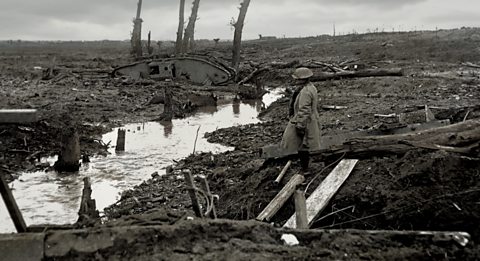
The strains of war drove soldiers to desert their post or inflict a wound on themselves.
Life as a munitionette. video
Mabel was one of many women who put their lives at risk working in munitions factories.
Life as an officer during WW1. video
Charles talks about coping with looming shellshock and aspects of an officer's life.
One woman's loss. video
Katie describes what the war was like from a young woman’s perspective in Manchester.