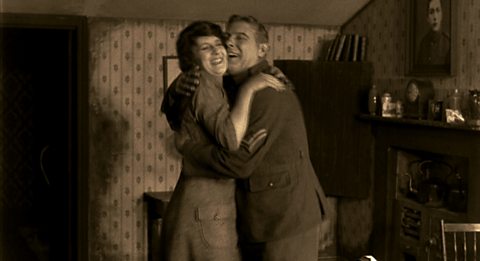
JOHN W. PALMER: After the Germans had stopped shelling a little while, we heard one of their big ones coming over. My pal shouted and threw himself down. I was too damned tired even to fall down. I stood there. Next, I had a terrific pain in the back and the chest and I found myself face downwards in the mud. My pal came to me. He tried to lift me up. And I said to him, "Don't touch me, leave me, I've had enough. Just leave me." The next thing, I found myself sinking down in the mud. And this time, I didn't worry about the mud. I didn't hate it any more. It seemed like a protective blanket covering me. And I thought to myself, "Well, if this is death, it's not so bad."
KATIE MORTER: I heard the postman come. And I knew that it would be a letter for me. So I ran down in my nightdress and opened the door and snatched the letter off the postman. And gone in, shut the door, in my nightdress, in my bare feet. And I opened the letter. And it was from this sergeant. And it just said, "Dear Mrs Morter, I am very sorry to tell you of the death of your husband." Well, that was as far as I could read. I couldn't read anything else. So I didn't know, just for a few minutes, what happened, but I ran out of the house, as I was, in my bare feet, and I banged on the next door. The next door neighbour. And it was a Mr and Mrs Hurst. And they let me in. And, "Whatever's to do?", she said. And I said, "Will you read this letter, Mrs Hurst? Read this letter." And she said, "Oh," she said, "you poor child."
JOHN: I found myself being bumped about. And I realised that I was on a stretcher. And I thought, "Poor devils, these stretcher bearers. I wouldn't be a stretcher bearer for anything." And then something else happened. I suddenly realised that I wasn't dead. I realised that I was alive. I realised that, if these wounds didn't prove fatal, that I should get back to my parents, to my sister, to the girl that I was going to marry. The girl that had sent me a letter every day, practically, from the beginning of the war. And I must, then, have had that sleep that I so badly needed. For I didn't recollect any more until I found myself in a bed with white sheets, and I heard the lovely, wonderful voices of our nurses. English, Scotch and Irish. And I think, then, I completely broke down.
KATIE: I thought, "Well, perhaps it's just an error." I wasn't sure what had happened. I thought it was perhaps just an error. But later on, I, er, I wrote to the sergeant. I wrote in answer to his letter. And I found out later on that I had another letter to say that the man that had sent me word had also been killed.
JOHN: Next, the padre was sitting beside the bedside. He was trying to comfort me. He told me I'd had an operation. And he told me that he had some relatives out there, that had been out there right from the beginning. And, by God's grace, they hadn't had a scratch. And he said, "They've been lucky, haven't they?" And I thought to myself, "Lucky? Poor devils!"
KATIE: After I found that it was officially known that he had been killed, I used to pass my time away trying to make little baby clothes for my baby. And eventually, the baby came to be born. It was born at home, but I don't remember it being born at all. I had a very bad time. I had two doctors, and I don't remember the baby being born. And I felt I didn't want to live. I had no wish to live, at all. Because the world had come to an end, for me, because I'd lost all that I'd loved.
Video summary
The threat of death hung over the soldiers and their families at home.
For some men, a serious injury could provide a ticket out of the war, whilst the arrival of a letter from the Front could signal terrible news back in England.
This clip features the contrasting experiences of a disillusioned soldier and the widow of a soldier killed in action.
Teacher viewing recommended prior to use in class.
This is from the series: I Was There: The Great War Interviews.
Teacher Notes
Key Stage 3 and Key Stage 4:
The two perspectives are used to introduce an exploration of living and fighting and fighting in the trenches, contrasting the differing perspectives from Britain and the front line.
Half the class are asked to focus on the perspective from home, whilst the rest of the group focus on the soldier’s perspective.
Both groups then have to explain the different viewpoints.
This clip will be relevant for teaching History at KS3, KS4/GCSE, in England and Wales and Northern Ireland.
Also at Third Level, Fourth Level, National 4 and National 5 in Scotland.
This topic appears in OCR, Edexcel, AQA, WJEC, CCEA GCSE and SQA.
Life as an officer during WW1. video
Charles talks about coping with looming shellshock and aspects of an officer's life.
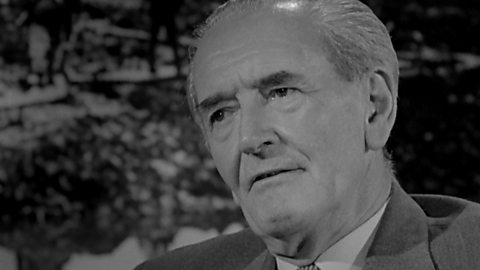
One woman's loss. video
Katie describes what the war was like from a young woman’s perspective in Manchester.
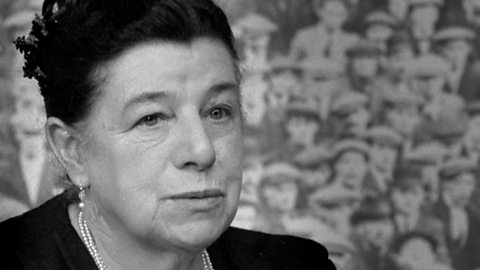
Recruiting soldiers in WW1. video
The different pressures which were applied to persuade young men to join up to fight.
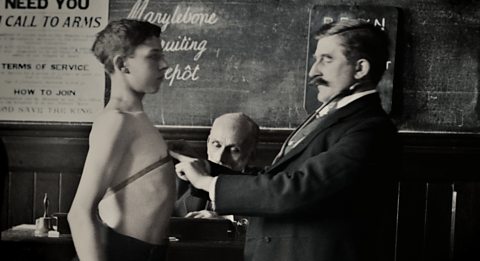
Respite. video
How men could relax and forget about life on the front line when behind the lines and get some respite from the war.
How did shell shock affect soldiers? video
Soldiers from both sides describe their experience of shell fire and the physical and psychological effects it had on them and their colleagues.
Changes on the home front during WW1. video
Relatives left at home describe what it was like coping whilst the men were away at war.