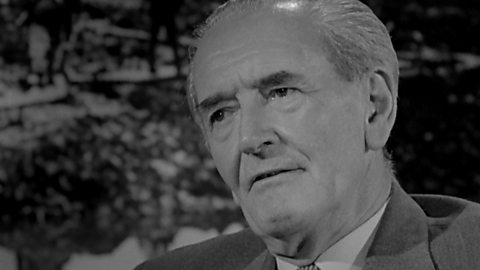
KATIE MORTER: We was very happily married. Very, very happy, because we was very much in love. And he thought the world of me and I thought the world of him. And then it came to be that the war started. Well, we had a friend over in Canada, that had enlisted over there, and he came over here, and he came one night and asked us, would we go to the Palace? He'd booked seats for the Palace and would we go? We didn't know what was on, of course, and it was a great treat for us. So we went.
When we got there, the Palace, everything was lovely. Vesta Tilley was recruiting, which we never knew till we got there. I wouldn't have gone if I'd have known, of course. Anyway, she is dressed, on the stage, beautifully. Beautiful gown - either silver or gold, I'm not quite sure, but it was an evening gown. She also had a big Union Jack wrapped round her. And she introduced that song "We Don't Want To Lose You But We Think You Ought To Go."
SEBASTIAN C. LANG: I was walking down the Camden Town High Street when two young ladies approached me and said to me, "Why aren't you in the Army with the boys?" So I said, "Well, I'm sorry, but I'm only 17." "Oh, we've heard that one before." She put her hand in her bag and pulled out a feather. I raised my hand thinking she was going to strike me when this feather was pushed up my nose.
KATIE: We were sat at the front, and she walked down and she hesitated a bit, and she put her hand on my husband's shoulder. And all the place was full of boys following her down, and they couldn't really get on the stage. Not all of them couldn't. He was with one of them. He got up, and he went with her.
SEBASTIAN: A sergeant came out of one of the shops and said to me, "Did she call you a coward?" I said, "Yes", and I felt very indignant at the time. He says, "Well, come across the roadway to the drill hall and we'll soon prove that you're not a coward." And then the sergeant said to me, "How old are you?" I said, "I'm 17." He said, "What did you say, 19?" He took my height and he said, "Now we'll go round to the doctor for a medical exam." I got round to the doctor and I was told to take all my clothes off, which embarrassed me very, very much. Any rate, I got back to the drill hall and there were six of us. And the sergeant called out, "Mr Lang!" I walked forward and I thought, "Oh, that's good. I'm not in." And he says, "You're the only so-and-so that's passed out of this six." And, to my amazement, I found that I was being called Private SC Lang.
KATIE: I was terribly upset. I said I didn't want him to go and be a soldier, because I didn't want to lose him. I didn't want him to go at all. But he said, "We have to go." He said, "There has to be men to go and fight for the women, otherwise," he said, "where should we be?"
Video summary
Through interviews and archive footage, we hear about the different pressures applied to persuade young men to join up.
One woman recalls her husband being called on to enlist at a cinema, despite her misgivings that he would be killed.
A man who was 17 at the time recalls being given a white feather in the street, and a recruiting officer enrolling him despite knowing he was underage.
This is from the series: I Was There: The Great War Interviews.
Teacher viewing recommended prior to use in class.
Teacher Notes
Key Stage 3:
Students are asked to list the different pressures put on young men to join up at the start of the war.
They are then asked to think of other reasons why men volunteered.
Key Stage 4:
Students use this as part of an investigation into how far men volunteered for patriotic reasons.
This clip will be relevant for teaching History at KS3, KS4/GCSE, in England and Wales and Northern Ireland.
Also at Third Level, Fourth Level, National 4 and National 5 in Scotland.
This topic appears in OCR, Edexcel, AQA, WJEC, CCEA GCSE and SQA.
Respite. video
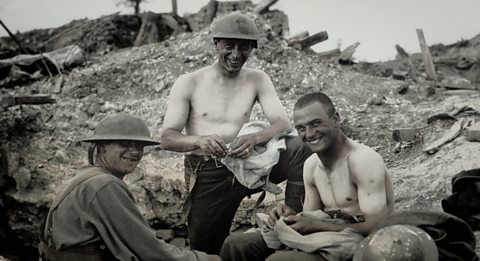
How men could relax and forget about life on the front line when behind the lines and get some respite from the war.
How did shell shock affect soldiers? video
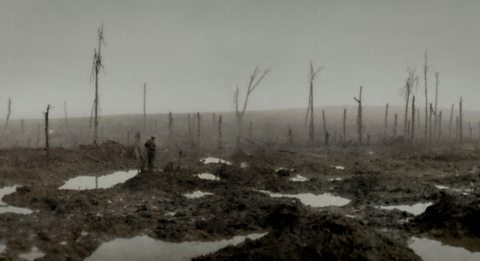
Soldiers from both sides describe their experience of shell fire and the physical and psychological effects it had on them and their colleagues.
The Christmas truce, 1914. video
Henry describes his reaction to being called up and his experiences in the trenches.
The Gallipoli campaign. video
Frank talks about fighting in the disastrous Gallipoli campaign in 1915.
War in the air. video
Pilots identify the different experiences of men in the air, recalling the realities of combat and the tactics used to down an enemy aircraft.
Life as an officer during WW1. video
Charles talks about coping with looming shellshock and aspects of an officer's life.