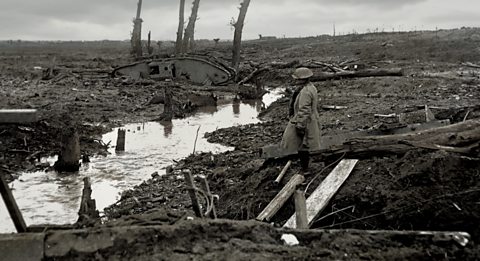
NORMAN MACMILLAN: In the trenches, on the ground, one had the comradeship of men all about one. One knew they were there at a moment ready to support one. They were a moral support as well as a physical support. In the air, things were different. We were far more individualistic. Spiritually and emotionally we were shut-in, we were self-contained individuals. We did not have the feeling of the community spirit that we had known on the ground and everything had to be thought and actioned on the part of the one individual. He was entirely and inseparably alone.
CECIL ARTHUR LEWIS: You had to fight as if there was nothing but you and your guns. You had nobody at your side, nobody who was cheering with you, nobody who'd look after you if you were hit, you were alone, you know, and you fought alone and died alone.
NORMAN: There was, undoubtedly, a sense of chivalry in the air. We did not feel that we were shooting at men. We did not want to kill men, we were really trying to shoot down the machines. Our enemies were not the men in the machines, our enemies were the machines themselves.
CECIL: The whole squadron would enter the fight in good formation but within half a minute the whole formation had gone to hell. There was nothing left except just chaps wheeling and zooming and diving and on each other's tails perhaps, or four in a row even, you know. A German going down, one of our chaps on his tail, another German on his tail, another Hun behind that. I mean, extraordinary glimpses one got of people approaching head on, firing at each other as they came and then just at the last moment turning and slipping away.
NORMAN: We flew like goldfish in a bowl in all directions, swimming around the sky, sometimes standing on our tails, sometimes with our heads right down, sometimes over on our backs, sometimes at right angles to the ground.
CECIL: Of course, the dogfight wasn't the only way of bringing down Huns. In fact, probably the great aces of the war brought down more Huns in other means than they did in actual dogfights which was, after all, a dangerous operation, so to speak. The favourite method was to stalk. You would wander up and down the lines looking for a likely chap who was too preoccupied doing artillery observation or photography to notice there was anybody else about and you'd be very cunning, you'd perhaps go a mile or two away and stalk him slowly, coming up just under his tail where he couldn't see, you see? There's a certain angle below the tail of the plane at which you could stalk a man and he wouldn't know you were there at all. And then having got up close to that position or just within range, then if your guns were well synchronised and you held the machine steady, you were on for a certain kill.
RALPH SILK: I felt my machine lurch and then I turned and looked over to my pilot and found that he had slumped on his controls. The next thing I remember was having a sledgehammer blow on my head. And I put my hand to my helmet and I found it all jagged and torn and a certain amount of blood. And then I had a blackout. And I fell through the air and I think… Like a falling leaf or a wounded or injured bird. And I think it was the upward rush of the air that brought me to my senses. And by the grace of God, I had presence of mind to pull on the joystick to break the fall. And the machine staggered and stalled and fell on some trees. Then I lost consciousness again. And when I did wake up, I found that I was lying in a little French church just behind the lines on a litter of straw with many other wounded German prisoners.
NORMAN: The air was boiling with the turmoil of the shells flying through it. We were thrown about in the aircraft, rocking from side to side, being thrown up and down. Below us was mud, filth, smashed trenches, broken wire. Broken machinegun posts, broken limbers, rubbish, wreckage of aeroplanes, bits of men and then in the midst of it all when we were flying at 400 feet, I spotted a German machinegun post and went down. My companion came behind me and as we dived, we fired four machineguns straight into the post. We saw the Germans throw themselves on the ground. We dived at them and sprayed them and I felt that never, at any time, had I passed through such an extraordinary experience and as we came out of it, I felt that we had escaped from one of the most evil things I had ever seen at any time in any of the flying that had occurred to me during that war.
Video summary
Pilots identify the different experiences of men in the air, recalling the greater individualism amongst pilots compared to the comradeship of soldiers on the ground, yet maintaining a chivalrous attitude towards their enemies.
They describe the realities of combat, the failed attempts to keep in formation and various other tactics used to down an enemy aircraft.
We hear about the experience of being shot down, and the view of the battlefield from the air.
This is from the series: I Was There: The Great War Interviews.
Teacher review prior to use in class is recommended.
Teacher Notes
Key Stage 3 and Key Stage 4:
The teacher uses this to stimulate a piece of writing on the impact of technology on the war.
Students are asked to identify the different ways aircraft contributed to the development of the war, and then to weigh up these roles against the contribution of men on the ground.
This contributor in this clip uses language that could be offensive when describing the Germans. It may be worth acknowledging this and discussing why this language was used at the time with your students.
This clip will be relevant for teaching History at KS3, KS4/GCSE, in England and Wales and Northern Ireland.
Also at Third Level, Fourth Level, National 4 and National 5 in Scotland.
This topic appears in OCR, Edexcel, AQA, WJEC, CCEA GCSE and SQA.
The Gallipoli campaign. video
Frank talks about fighting in the disastrous Gallipoli campaign in 1915.
Fighting in the trenches. video
Stefan Westmann presents two contrasting experiences of the war.
Death and survival. video
The experiences of a disillusioned soldier and the widow of a soldier killed in action
The Gallipoli campaign. video
Frank talks about fighting in the disastrous Gallipoli campaign in 1915.
Respite. video
How men could relax and forget about life on the front line when behind the lines and get some respite from the war.
Attrition. video
The strains of war drove soldiers to desert their post or inflict a wound on themselves.