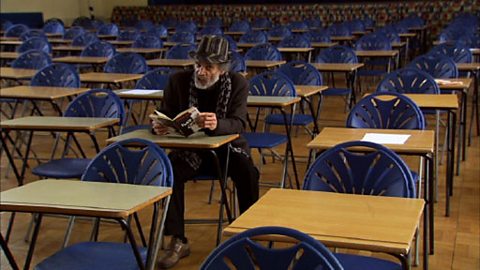
JOHN AGARD:What's that fluttering in a breeze? It's just a piece of cloth that brings a nation to its knees.
JOHN AGARD:When you think about Flag, that very simple but yet iconic thing that every country has. It's associated with nationhood. It's associated with jubilation. You might think of the Olympics. But there is another dimension, when imperialistic attitudes and blinded, shall we say, power becomes attached to that flag.
JOHN AGARD:So there are various residences pertaining to a flag. And I think the poem is just a little journey of questions. It gets you to rethink what you take for granted.
JOHN AGARD:What's that unfurling from a pole? It's just a piece of cloth that makes the guts of men grow bold.
JOHN AGARD:Is humanity waving the flag? Or is the flag waving humanity? In other words are we at a point where you become controlled by your own ideology? These are questions which the poem is asking without necessarily stating exactly how to think.
JOHN AGARD:I wanted to explore that - all the traditional sense of riddling and through riddling you are rethinking the obvious.
JOHN AGARD:What's that rising over a tent? It's just a piece of cloth that dares the coward to relent.
JOHN AGARD:You have so many endless ideas that may come floating into your head at any given time. So keeping that chaos of ideas within a structured vessel is a measured sort of beat. There's no rule for endless waffling, in a poem. And there's an offering of your most intense personhood. The dreaming part of you. The subconscious part of you.
JOHN AGARD:So in a way the poem is a revelation to you as well.
JOHN AGARD:What's that flying across a field? It's just a piece of cloth that will outlive the blood you bleed. How can I possess such a cloth? Just ask for a flag, my friend. Then blind your conscience to the end.
JOHN AGARD:Different things can inspire you, it can be something as straightforward as a photograph. You might be on a train and you glimpse a funny headline. It can be anything that begins to nibble at you. I think poets have not only got their ears open, they've got their eyes open to words around them.
JOHN AGARD:And if you get the right words in the right order, something magical could happen. And I think those who go on to be poets have got that lasting love affair with language.
John Agard dictates excerpts of his poem ‘Flag’ and the ‘journey of questions’ the poem invokes.
He discusses the symbolism of flags, from a simple piece of cloth to Imperialism, and asks if humanity waves a flag or if we are controlled by our own ideology.
Inspiration for poetry writing and a lack of rules is also considered.
This is from the BBC series, Poets in Person.
Teacher Notes
This short film could be used as an introduction to the central themes of the poem.
Agard asks, 'Is humanity waving the flag, or is the flag waving humanity?'.
Students could be asked to note down the different images used in this short film, and discuss these in relation to Agard's premise.
Which images and ideas in the film could be described as the flag controlling peoples' ideas or people's own ideas controlling the flag?
Is there any overlap between these two ideas?
Curriculum Notes
This short film will be relevant for teaching English literature at KS3 and KS4/GCSE in England and Northern Ireland. Also English language at KS3 and English literature at GCSE in Wales.
This topic appears in OCR, Edexcel, AQA, WJEC in England and Wales and CCEA GCSE in Northern Ireland.
More from the series: Poets in Person
English Literature KS3 / GCSE: 'Praise Song for My Mother' by Grace Nichols (analysis) video
Grace Nichols reads and explores the writing of her poem, 'Praise Song For My Mother'.
English Literature KS3 / GCSE: 'Praise Song for My Mother' by Grace Nichols (poem only) video
Grace Nichols performs her poem 'Praise Song for My Mother'.
English Literature KS3 / GCSE: 'Flag' by John Agard (poem only) video
A performance of the poem 'Flag' by the poet, John Agard.
English Literature KS3 / GCSE: 'The Right Word' by Imtiaz Dharker (analysis) video
Imtiaz Dharker reads and explores the background to her poem, 'The Right Word'.
English Literature KS3 / GCSE: 'The Right Word' by Imtiaz Dharker (poem only) video
A performance of the poem 'The Right Word' by the poet, Imtiaz Dharker.
English Literature KS3 / GCSE: 'Ghazal' by Mimi Khalvati (poem only) video
A reading of 'Ghazal' by the author, Mimi Khalvati.
English Literature KS3 / GCSE: 'Ghazal' by Mimi Khalvati (analysis) video
Mimi Khalvati reads and explores the writing of her poem 'Ghazal'.
English Literature KS3 / GCSE: 'Singh Song' by Daljit Nagra (poem only) video
Daljit Nagra performs his poem 'Singh Song'.
English Literature KS3 / GCSE: 'Singh Song' by Daljit Nagra (analysis) video
Daljit Nagra explores and performs his poem 'Singh Song'.
English Literature KS3 / GCSE: 'Checking Out Me History' by John Agard (analysis) video
Poet John Agard describes the process of writing his poem 'Checking Out Me History'.
English Literature KS3 / GCSE: 'Checking Out Me History' by John Agard (poem only) video
John Agard performs his poem 'Checking Out Me History'.