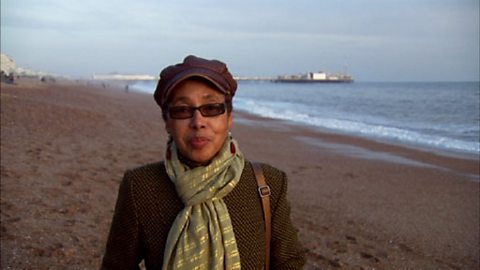
A ghazal was a form I became interested in partly because it's Persian and I'm from Iran, and it's a way of sort of trying to understand a bit more about the literature, the poetry of Iran particularly.
If I am the grass and you the breeze, blow through me. If I am the rose and you the bird, then woo me…
A ghazal is from sort of 12th century onwards. It's really like a little song lyric. It's very much associated with Sufi poets, so it's a form of mystical love poetry.
If I am the rhyme and you the refrain, don't hang on my lips. Come and I'll come too when you cue me…
I think inasmuch as the sonnet was also…it's a little song, a sonetto, and it's the same in the east. It's the ghazal.
If mine is the venomous tongue, the serpent's tail, charmer, use your charm, weave a spell and subdue me…
In the ghazal, you can use tones, I suppose, that in contemporary, well, British poetry anyway, one would be shy of. I think it gives you permission to sort of break all those kind of no-nos, where you mustn't be sentimental or over the top.
If I am the laurel leaf in your crown, you are the arms around my bark, arms that never knew me.
The thing about form is it's… For me the main thing is it gives you something to write about. People sometimes think it's the opposite, that you have something to say and then you find the form to put it in, but quite often you start off with nothing to say, you can't think what to write about or anything, and if you have a form it will lead you to the content.
So, in general, that's what excites me about it.
If each couplet was like a spoke in a wheel, going like that rather than linear, as it appears on the page - I think in my mind it's really a radial, circular form - then in the middle of the hub of that wheel will be the refrain word.
It's like the hook in song lyrics. It's the bit that everybody knows, that everyone joins in at that point. So here we've got "blow through me" and then "woo me", so everyone knows that the couplets are going to end like "oo me".
So you continue with that "oo me" thing, but with the last couplet, this is the place for the personal voice to come in. In this one I have "twice the me I am", ie meaning, you know… So it can be a play on your name, if you're a bit coy!
In a way, the ghazal is a way of my honouring my heritage. Maybe it is a way of connecting not only with Iran or an idea of Iran, the culture of Iran, but with the very positive aspects because, in Iran, poetry is the highest of all the arts and hugely known and loved by everyone, even by illiterate people who can quote great chunks of it by heart.
If I rise in the east as you die in the west, die for my sake, my love, every night renew me. If, when it ends, we are just good friends, be my Friend, muse, lover and guide, Shamsuddin to my Rumi. Be heaven and earth to me and I'll be twice the me I am, if only half the world you are to me.
Mimi Khalvati, filmed in a park and cafe setting, talks about her poem 'Ghazal'.
She explores how the poem reflects her interest in poetry from her cultural background and her approach to writing poetry.
She reads extracts from the poem.
This is from the series: Poets in Person
Teacher Notes
Khalvati defines a Ghazal as a 'little song' or Eastern sonnet.
Students could compare the poem to one of Shakespeare's sonnets.
How do structured forms help us to convey complex emotions?
Khalvati draws comparisons with modern love songs which are also simple, but nonetheless powerful expressions of emotion.
Can students write their own modern love poem using the correct Ghazal structure and tone?
Curriculum Notes
This clip will be relevant for teaching English Literature at KS3 and KS4/GCSE in England and Northern Ireland. Also English language at KS3 and English Literature at GCSE in Wales.
This topic appears in OCR, Edexcel, AQA, WJEC in England and Wales and CCEA GCSE in Northern Ireland.
More from the series: Poets in Person
English Literature KS3 / GCSE: 'Ghazal' by Mimi Khalvati (poem only) video
A reading of 'Ghazal' by the author, Mimi Khalvati.
English Literature KS3 / GCSE: 'Flag' by John Agard (poem only) video
A performance of the poem 'Flag' by the poet, John Agard.
English Literature KS3 / GCSE: 'The Right Word' by Imtiaz Dharker (poem only) video
A performance of the poem 'The Right Word' by the poet, Imtiaz Dharker.
English Literature KS3 / GCSE: 'Praise Song for My Mother' by Grace Nichols (analysis) video
Grace Nichols reads and explores the writing of her poem, 'Praise Song For My Mother'.
English Literature KS3 / GCSE: 'The Right Word' by Imtiaz Dharker (analysis) video
Imtiaz Dharker reads and explores the background to her poem, 'The Right Word'.
English Literature KS3 / GCSE: 'Singh Song' by Daljit Nagra (analysis) video
Daljit Nagra explores and performs his poem 'Singh Song'.

English Literature KS3 / GCSE: 'Singh Song' by Daljit Nagra (poem only) video
Daljit Nagra performs his poem 'Singh Song'.

English Literature KS3 / GCSE: 'Flag' by John Agard (analysis) video
John Agard discusses his poem 'Flag', the symbolism of flags and poetry writing.
English Literature KS3 / GCSE: 'Checking Out Me History' by John Agard (analysis) video
Poet John Agard describes the process of writing his poem 'Checking Out Me History'.
English Literature KS3 / GCSE: 'Checking Out Me History' by John Agard (poem only) video
John Agard performs his poem 'Checking Out Me History'.
English Literature KS3 / GCSE: 'Praise Song for My Mother' by Grace Nichols (poem only) video
Grace Nichols performs her poem 'Praise Song for My Mother'.