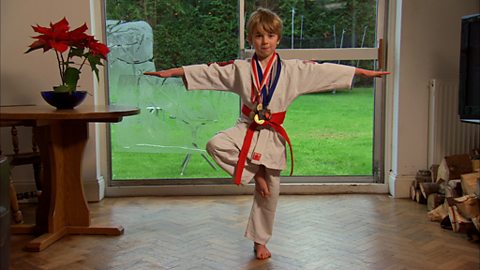
VO: It’s a Sunday afternoon, and the Measures are playing a family game.
It’s called the Origami Challenge. It’s very simple, everyone draws a shape to fold out of paper. Then they put all the suggestions in a hat.
Mum Measure: Ok, has everybody put theirs in the hat. Here we go, drum roll please.
A regular pentagon! Who put that in their?
Abi Measure: Yes!
VO: Ah, the task is to fold a regular pentagon, quite a tricky shape.
Mum Measure: Off we go. Dad start the timer.
Dad Measure: Ok losers.
VO: And they’re off. They’ve got two minutes.
The word penta comes from the ancient Greek language and means five. Pentagon means five angles. A regular pentagon is a polygon with five equal sides and five equal angles.
You can find the pentagon shape all over the natural world. And in man-made objects too.
How are they doing?
Abi Measure: And I am finished.
Dad, Mum & Ethan Measure: Oh!
VO: Time's up! Let's have a look at who's got it right.Ethan Measure: Envelope!
VO: Ethan's has only got four sides, so he’s disqualified. What about Mum?
Mum Measure: 1, 2, 3, 4, 5, 6! No, ok, that's no good.
VO: Dad’s got five sides, but it’s an irregular pentagon. Abi’s is the best. Let’s see how she did it.
Abi is using a sheet of A4 paper. She folds the bottom corner up to the opposite corner and smooths it. She has done that to make a crease. Now, she unfolds that and folds one half in, and lines it up with the centre crease, and smooths it. Now she does the same on the other side. And there we are, a regular pentagon.
Using a piece of A4 paper, fold a regular pentagon.
How many triangles can you find in your regular pentagon?
Using your protractor, find the sum of the internal angles.
Video summary
The ‘Origami Challenge’ is the game the Measures family is playing.
The challenge is to fold a regular pentagon from an A4 piece of paper.
The timer is set for the two-minute task. 'Penta' is explained as the Greek word for 5; 'pentagon' as five angles.
A diagram and explanation give the properties of a pentagon. Images from the natural and man-made world show that there are pentagons all around us.
After two minutes, Abi Measure is the only family member to succeed in making the regular origami pentagon.
It is demonstrated how she achieved that.
Three tasks follow: we are challenged to make our own pentagon; we are asked to explore how to investigate hidden triangles within the pentagon diagram; and finally we are challenged to find the sum of the internal angles using a protractor.
This is from the series: Let's Do Maths.
Teacher Notes
With an emphasis on practical, kinaesthetic approaches we learn how to fold a regular pentagon, about the properties of shape in terms of number of sides and angles and how to use a protractor to measure the angles in a regular pentagon.
Images shown from the natural world could be used as a stimulus for further shape investigations and artwork.
Ask the children to have a go and then show the clip afterwards, with the answer.
What's the difference between an irregular and regular pentagon?
Using the A4 paper, what 2D shapes can they create (a range of regular and irregular shapes can be created)?
The children could then write instructions for how to make them, or sort their shapes in Venn or Carroll diagrams.
Maths KS2: Capacity and measure. video
Jack and Jill visit Buttons to fill a bucket with water, and explore relative capacity.
Maths KS2: Weighing and measuring. video
How to solve the problem of making equal size pizzas from 2kg dough at the pizza parlour
Maths KS2: Using weights and measures. video
A pancake recipe challenges Mr Measure to adapt quantities to make enough for more people.
Maths KS2: Using timetables and the 24 hour clock. video
Pizza delivery boy Ambrose fills in a timetable of his journey times using 24 hour clocks.
Maths KS2: Using grams and kilograms. video
Washing day at the Panto House provides a problem involving weight and using scales.
Maths KS2: Using a compass and reading maps. video
An old map helps the Measures to learn about compass points, scale and directions.
Maths KS2: Using a calendar. video
Exploring time, dates and calendars in the Panto House.
Maths KS2: Units of time. video
The concept of measuring and converting time is explored in the Panto House.
Maths KS2: Understanding radius and diameter. video
The concepts of radius and diameter using pizza toppings in the Pizza Parlour.
Maths KS2: Understanding area and perimeter. video
The pizza parlour provides a real life context to solve area and perimeter problems.
Maths KS2: Understanding angles. video
The context of angles using unusual pizza toppings in the Pizza Parlour.
Maths KS2: Problem solving with money. video
Problem solving with money is explored as Abi Measure saves up to buy a new guitar.
Maths KS2: Problem-solving with equilateral triangles. video
Problems with equilateral triangles and tessellation are posed in the Pizza Parlour.
Maths KS2: Finding lines of symmetry. video
The Measures find the line or lines of symmetry and chop along them to win the medal.