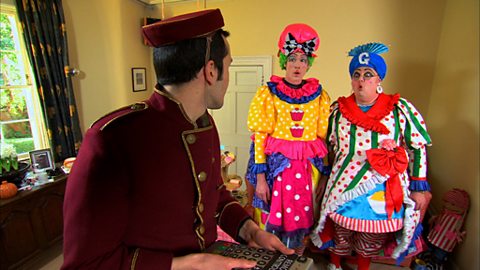
VO:Meet Ambrose. He’s an Apprentice at the Grecian Pizza Parlour. The boss here is famous the world over for his pizza making skills. He invented the Pepperoni Sun God and the Calamari Colossus and the Minotaur Munch. Today, he’s going to show Ambrose something that every young apprentice must learn; the secret of how to make lots of pizza bases from a two kilo lump of dough.
Pizza Boss: Out of this 2 kilos, we make 20 smaller pizza like this. It's beautiful, like my children. You do this. Twenty sm, write this down, 20 small pizza from the 2 kilo.
VO: Ambrose’s job today is to make 20 small pizza bases that are all the same.
Pizza Boss: Come on then, get on. Mush.
VO: Let's see how he gets on.
Hmmm.
How are you feeling about this Ambrose?
Ambrose: Alright, it's going really well thank you, yeah. I'm really really pleased.
VO: I think all your pizza bases are meant to be exactly the same.
Ambrose: Yeah, 20, yeah.
VO: Do you think you’ll get twenty out of that?
Ambrose: Uh, yeah. Yeah, yeah, yeah.
VO: Ambrose is meant to be making 20 small pizza bases. He doesn’t seem to be doing a very efficient job does he?
Ambrose, don’t you think you should use your weighing scales?
Ambrose: What for?
VO: If he doesn’t get this right, all the pizzas will be different sizes won’t they? What can he do?
Ambrose has got to divide up 2 kilos of dough into 20 pieces of equal size and weight. Decide how he could do this.
From 2 kgs of dough Ambrose has to make 20 small pizza bases. How much should each one weigh?
A large pizza base is twice the weight of a small one. If Ambrose makes 2 large and 10 small pizzas from the 2 kgs, what weight of dough will be left?
Video summary
At the Grecian pizza parlour apprentice, Ambrose, is learning from his boss how to make lots of pizzas from a 2kg weight of dough.
Ambrose must work out how to make 20 small pizza bases that are equal size and weight.
He tackles the problem by breaking off pieces randomly, resulting in some large and some small pizzas.
It is suggested he uses weighing scales.
Three questions of increasing difficulty help to work out how to solve the problem including having a mixture of large and small pizzas to make from the 2kg dough.
This is from the series: Let's Do Maths.
Teacher Notes
This clip tackles the difficulty children experience in choosing the correct operation when solving problems.
In this case it is division. To solve this they will also need to know that there are 1000g in a kilogram.
Three differentiated questions help to structure the problem and the last question has a mixture of pizzas and requires more than one step to find the solution.
Use the statement posed in the clip "Out of 2kg of dough, we make 20 pizzas".
Ask the children how many grams of dough it takes to make 1 pizza? 5 pizzas? 2 and 1/2 pizzas?
Can anyone convert that into imperial units? Does anyone know what ingredients dough is made out of?
Watch the clip further and get the children to discuss what mistakes Ambrose is making and how he should be doing it.
Watch the clip further and discuss the question posed. With a variety of statements based on the pizzas, get the children to rearrange these to form the problem.
The children should discuss which the relevant and irrelevant information is and what they should get rid of, as well as how they can calculate it.
This clip will be relevant for teaching Maths at KS2 in England and Wales and Second Level in Scotland and KS1 and KS2 in Northern Ireland.
Maths KS2: Using weights and measures. video
A pancake recipe challenges Mr Measure to adapt quantities to make enough for more people.
Maths KS2: Using timetables and the 24 hour clock. video
Pizza delivery boy Ambrose fills in a timetable of his journey times using 24 hour clocks.
Maths KS2: Using grams and kilograms. video
Washing day at the Panto House provides a problem involving weight and using scales.
Maths KS2: Using a compass and reading maps. video
An old map helps the Measures to learn about compass points, scale and directions.
Maths KS2: Using a calendar. video
Exploring time, dates and calendars in the Panto House.
Maths KS2: Units of time. video
The concept of measuring and converting time is explored in the Panto House.
Maths KS2: Understanding radius and diameter. video
The concepts of radius and diameter using pizza toppings in the Pizza Parlour.
Maths KS2: Understanding area and perimeter. video
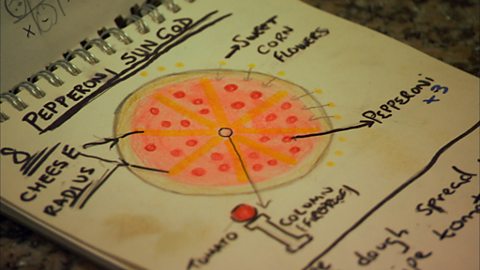
The pizza parlour provides a real life context to solve area and perimeter problems.
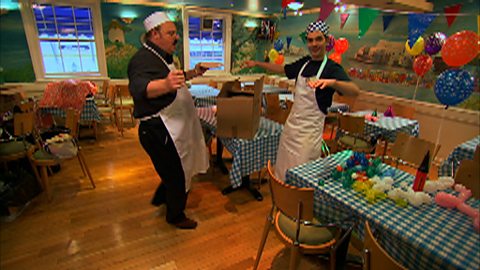
Maths KS2: Understanding angles. video
The context of angles using unusual pizza toppings in the Pizza Parlour.
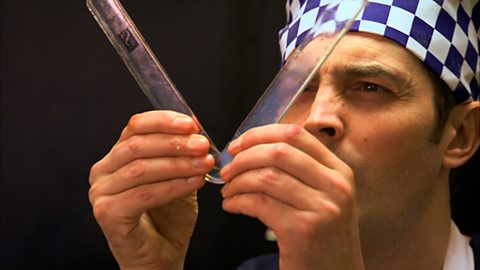
Maths KS2: Problem solving with money. video
Problem solving with money is explored as Abi Measure saves up to buy a new guitar.
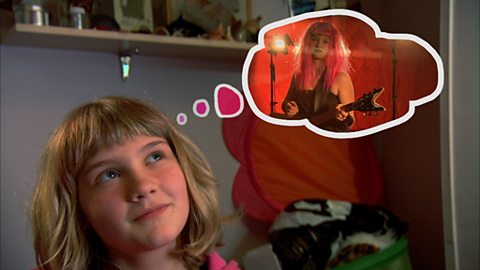
Maths KS2: Problem-solving with equilateral triangles. video
Problems with equilateral triangles and tessellation are posed in the Pizza Parlour.
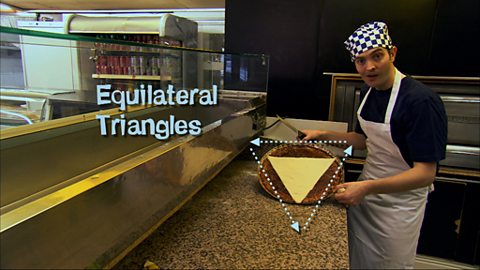
Maths KS2: Playing with polygons. video
The Measures face an origami challenge which explores the properties of pentagons.
Maths KS2: Measuring distance. video
Measuring distance round a rectangle and devising routes in the Panto House.