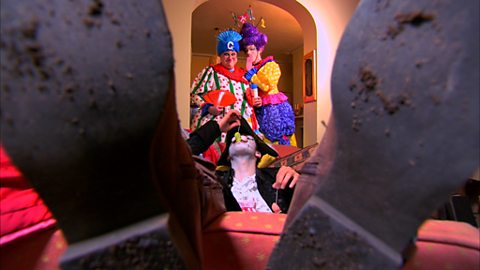
VO: Ambrose has just got a job at the world famous Grecian Pizza Parlour. He’s being trained in all aspects of pizza making. I don’t think this is part of the training though.
Pizza Boss: Coughs. What are you doing?
Ambrose: Uh. Nothing.
VO: The boss says he’s going to pop out, so Ambrose should carry on cleaning until he gets back.
Telephone rings.
Pizza Boss: Answer the phone Ambrose, it could be customer. Answer the phone.
Ambrose: Hello, Grecian Pizza.
Customer: Can I have 5 Pepperoni Sun God pizzas.
VO: It is a customer.
Ambrose: Five Pepperoni Sun God pizzas.
When will you pick them up.
Customer: How many minutes?
Twenty minutes.
Twenty minutes.
Ambrose: Twenty minutes. Ok, thank you.
Customer: Bye.
Pizza Boss: I have to go out Ambrose, you will have to do this yourself, here.
VO: Ambrose hasn’t been taught how to make a Pepperoni Sun God yet. The recipe is in this book.
Pizza Boss: Inside the recipe for the Pepperoni Sun God, the secret of…
VO: His boss explains the most important things about this pizza are the cheese radius that go out from the middle like rays of the sun.
Pizza Boss: …the radius. Ok, I get some dough I show you. You take the dough you see, you get a bit of flour and put it down there like this.
VO: His boss shows Ambrose how to make a perfect circle out of dough. Good isn’t he?
Pizza Boss: You spread the secret recipe tomato ketchup.
VO: He spreads the tomato sauce over the area. Then he estimates where the middle of the circle is.
Pizza Boss: And then we put the column in the middle. So we now know where the middle is and then you take the cheese. Ok. And put this from the middle to the edge. You see you take this, you put it from the middle to the edge. The radius. The radius is from the middle to the edge.
Ambrose: What's the radius?
Pizza Boss: From the centre to the edge, I just told you this. From the centre to the edge is the radius, from the edge to the edge all the way across is the diameter. It's simples. Look you do this, I gotta go out. Five pizza. Remember. Good boy.
VO: Will Ambrose remember what a radius is? Can you remember what a radius is?There are 8 cheese radii on the pizza. How many diameters is that? There are 8 cheese radii on this pizza. How many diameters is that?
This pizza has a diameter of 33 cms. What does the radius measure? This pizza has a diameter of 33 cms. What does the radius measure?
If we cut along each of the radii on this pizza it'll give 8 people an equal slice. Can you draw a pizza where there are 3 cheese radii to make 3 equal slices? If we cut along each of the radii on this pizza it will give 8 people an equal slice. Can you draw a pizza where there are 3 cheese radii to make 3 equal slices?
Video summary
At the Grecian Pizza Parlour, new employee, Ambrose, learns how to make pizzas.
The boss needs to teach Ambrose about radius and diameter as he puts the cheese strips onto the circular pizza for his first customer.
Three radius and diameter questions of increasing difficulty are posed at the end of the scenario to consolidate the learning.
This is from the series: Let's Do Maths.
Teacher Notes
While watching the clip, pause at the question "What is the connection between the radius and diameter?"
Ask students to respond.
Pause at the questions involving the diameter and radius of the pizza.
By either baking their own pizzas, the children could calculate the radii or diameter of each section, or create their own model pizza with given radii and apparatus.
Would it work with a square or would we refer to it as a different mathematical term?
This clip will be relevant for teaching Maths at KS2 in England and Wales, Second Level in Scotland and KS1 and KS2 in Northern Ireland.
Maths KS2: Weighing and measuring. video
How to solve the problem of making equal size pizzas from 2kg dough at the pizza parlour
Maths KS2: Using grams and kilograms. video
Washing day at the Panto House provides a problem involving weight and using scales.
Maths KS2: Using timetables and the 24 hour clock. video
Pizza delivery boy Ambrose fills in a timetable of his journey times using 24 hour clocks.
Maths KS2: Using weights and measures. video
A pancake recipe challenges Mr Measure to adapt quantities to make enough for more people.
Maths KS2: Using a compass and reading maps. video
An old map helps the Measures to learn about compass points, scale and directions.
Maths KS2: Using a calendar. video
Exploring time, dates and calendars in the Panto House.
Maths KS2: Units of time. video
The concept of measuring and converting time is explored in the Panto House.
Maths KS2: Playing with polygons. video
The Measures face an origami challenge which explores the properties of pentagons.
Maths KS2: Problem solving with money. video
Problem solving with money is explored as Abi Measure saves up to buy a new guitar.
Maths KS2: Finding lines of symmetry. video
The Measures find the line or lines of symmetry and chop along them to win the medal.
Maths KS2: Investigating angles. video
Puss in Boots' stinky boots provides a chance to learn about angles in the Panto House.