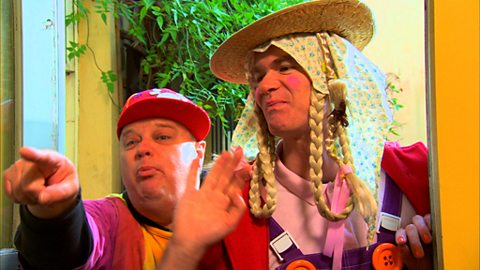
VO: Ethan Measure is a martial arts whizz kid. He’s won so many medals he can barely stand up. But there is one medal he's yet to win. The Symmetry Medal. It’s better than all the others because it’s made of chocolate. To win the Symmetry Medal, Ethan has to be able to find the line of symmetry on an object and karate chop it down that line. Like that. Well done Ethan.
VO: The line of symmetry is the imaginary line where if you cut something in half, then hold either half up to a mirror, the object will appear whole again.
VO: Some lines of symmetry are easier to spot than others. Let's see if he’s found it on this pineapple. Bad luck mate, too spiky. Try again. Has he got it right this time. Yes, that looks like a pineapple.
VO: Ethan’s Mum has prepared a selection of things for him to practice on.
Some of these have more than one line of symmetry, and some have none at all. Can you help him find the line every time, and win that golden chocolate medal?
Ethan has to find the lines of symmetry in a number of objects.
Identify the objects with one line of symmetry. Which ones have no lines of symmetry?
Find the objects with two or more lines of symmetry.
One of the objects has eight lines of symmetry. Can you identify it and find all eight lines?
Video summary
In order for Karate Kid, Ethan Measure, to win the symmetry medal, he must find the line of symmetry on various objects and karate chop along that line.
An explanation of finding a line of symmetry is given and demonstrated using a mirror.
Ethan then has to chop a pineapple. At first he gets it wrong, checking in the mirror.
Ethan’s mum has prepared a selection of objects for him to practise on.
Three questions of increasing difficulty challenge us to identify the line or lines of symmetry, while we learn that some objects are not symmetrical at all.
This is from the series: Let's Do Maths.
Teacher Notes
Ask pupils to draw what they deem to be symmetrical and asymmetrical and discuss the different words they associate with it.
Using the clip, show the different objects on the table and pause it.
Ask the children to discuss which are symmetrical and which aren't and use the interactive whiteboard to get the children to draw it on, using a dashed line.
With a variety of everyday objects, signs or symbols the children can identify the lines of symmetry on them.
Using a sorting diagram, the children can either sort a range of objects based on their symmetrical properties, or they can generate patterns using different apparatus, so they could fit in the different sorting diagrams.
This clip will be relevant for teaching Maths at KS2 in England and Wales, Early and First Level and Second Level in Scotland and KS1 and KS2 in Northern Ireland.
Maths KS2: Investigating angles. video
Puss in Boots' stinky boots provides a chance to learn about angles in the Panto House.
Maths KS2: Measuring distance. video
Measuring distance round a rectangle and devising routes in the Panto House.
Maths KS2: Playing with polygons. video
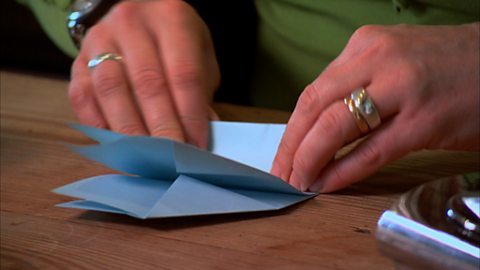
The Measures face an origami challenge which explores the properties of pentagons.
Maths KS2: Problem-solving with equilateral triangles. video
Problems with equilateral triangles and tessellation are posed in the Pizza Parlour.
Maths KS2: Problem solving with money. video
Problem solving with money is explored as Abi Measure saves up to buy a new guitar.
Maths KS2: Understanding angles. video
The context of angles using unusual pizza toppings in the Pizza Parlour.
Maths KS2: Understanding area and perimeter. video
The pizza parlour provides a real life context to solve area and perimeter problems.
Maths KS2: Understanding radius and diameter. video
The concepts of radius and diameter using pizza toppings in the Pizza Parlour.
Maths KS2: Units of time. video
The concept of measuring and converting time is explored in the Panto House.
Maths KS2: Using a calendar. video
Exploring time, dates and calendars in the Panto House.
Maths KS2: Using a compass and reading maps. video
An old map helps the Measures to learn about compass points, scale and directions.
Maths KS2: Using timetables and the 24 hour clock. video
Pizza delivery boy Ambrose fills in a timetable of his journey times using 24 hour clocks.
Maths KS2: Using weights and measures. video
A pancake recipe challenges Mr Measure to adapt quantities to make enough for more people.
Maths KS2: Capacity and measure. video
Jack and Jill visit Buttons to fill a bucket with water, and explore relative capacity.