VO: The Ugly Sisters Graphica and Angular are very busy catching up on a bit of culture. Too busy to help Buttons who has been tidying up Panto House all morning. Now he’s looking forward to a nice cup of tea and a fondant fancy or two. But the Ugly Sisters have left him a To Do list. Oh. Oh dear. Oh dear. What a pile of dirty mugs and plates, they’ve filled up the sink. Oh, it’s going to take him ages. Someone's at the door.
Buttons: Jack and Jill.
VO: Oh, it’s Jack and Jill from up the hill.
Buttons: How are you today.
Jill: Oh, very well Buttons.
VO: Jill loves Buttons. She thinks he looks like Superman, but shorter. Jack thinks this is really uncool. Sisters are so embarrassing.
Jack: So embarrassing.
Buttons: And what can I do for you?
VO: Jack and Jill can’t be bothered to go up the hill. So they want Buttons to fill a pail with water.
Buttons: Suppose so.
VO: But Buttons has a problem. The Sink’s too full.
Buttons: Won't fit.
VO: Jill’s got an idea.
Jill: Use the jug Buttons.
Jack: No.
Jill: Use the jug.
Buttons: Oh, the jug.
VO: But Jack disagrees.
Jack: Use the bottle.
Jill: Ignore him.
Buttons: Oh the bottle.
VO: Buttons has another idea.
Buttons: Could use the mug.
Jill: Use the jug Buttons.
Jack: Use the bottle.
Jill: Ignore him, use the jug.
Jack: Use the bottle.
VO: Buttons just wants to fill the pail so he can have his tea and cake. Can you help Buttons fill the bucket up with water?
Buttons What should I do?
VO:The pail holds 7.5 litres. The mug holds 500 millilitres. How many mugs would fill the pail?
There’s a one litre jug, a two litre bottle and a 500 millilitre mug.
Find ways to fill the 7.5 litre pail exactly using all the containers.
Which of the following containers has the biggest capacity to hold water? A pint bottle, a half litre jug, or a six hundred millilitre cup.
Here’s a clue – a litre of water’s a pint and three quarters.
Video summary
At the Panto House, Buttons is forced to do the washing up.
The sink is full of dirty pots.
Jack and Jill come to the door and want Buttons to fill their bucket with water.
Buttons' problem is that the sink is too full to put the bucket under the tap.
Jill suggests he fills it with the 1 litre jug.
Jack suggests he uses the empty Fizz Wizz Pop bottle.
Buttons thinks it would be best to use a mug. The question is, which container will fill the bucket the fastest?
This is from the series: Let's Do Maths.
Teacher Notes
Capacity with conversions needed between millilitres and litres is the key learning.
Problem solving in a real life context provides a stimulus for practical activities.
There are three differentiated questions that can be paused for the discussion of solutions and could be revisited in the plenary, as well as giving ideas for further investigations and pupil-generated problems.
Watch the clip to introduce the idea of how many jugs it takes to fill the bucket.
Ask the pupils what they think the ratio and connection is between the jug and the bucket.
How many times bigger is it? Watch the clip all the way through and see how the different amounts are created using the different equipment.
Outside, with a variety of buckets, cups or jugs, the children must make every number of litres from 1 to 5, using two pieces of apparatus eg a bucket = 5 litres and a jug = 3 litres. (The children will need to pour out different amounts)
This clip will be relevant for teaching Maths at KS2 in England and Wales, Early and First Level and Second Level in Scotland and KS1 and KS2 in Northern Ireland.
Maths KS2: Finding lines of symmetry. video
The Measures find the line or lines of symmetry and chop along them to win the medal.
Maths KS2: Investigating angles. video
Puss in Boots' stinky boots provides a chance to learn about angles in the Panto House.
Maths KS2: Measuring distance. video
Measuring distance round a rectangle and devising routes in the Panto House.
Maths KS2: Playing with polygons. video
The Measures face an origami challenge which explores the properties of pentagons.
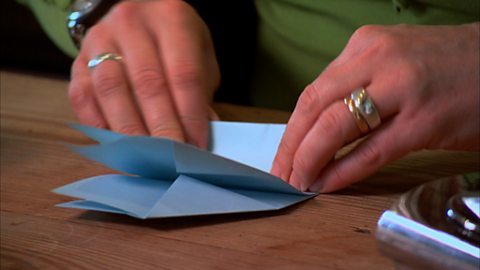
Maths KS2: Problem-solving with equilateral triangles. video
Problems with equilateral triangles and tessellation are posed in the Pizza Parlour.
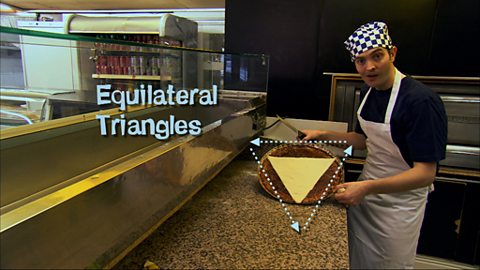
Maths KS2: Problem solving with money. video
Problem solving with money is explored as Abi Measure saves up to buy a new guitar.
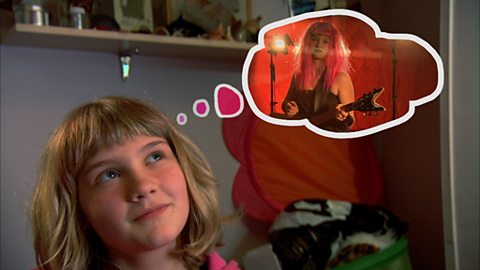
Maths KS2: Understanding angles. video
The context of angles using unusual pizza toppings in the Pizza Parlour.
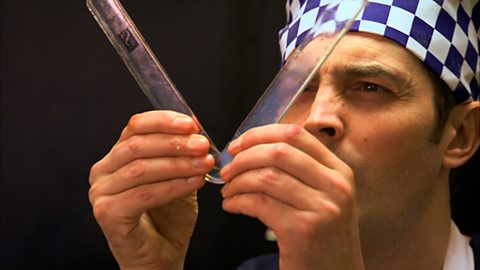
Maths KS2: Understanding area and perimeter. video
The pizza parlour provides a real life context to solve area and perimeter problems.
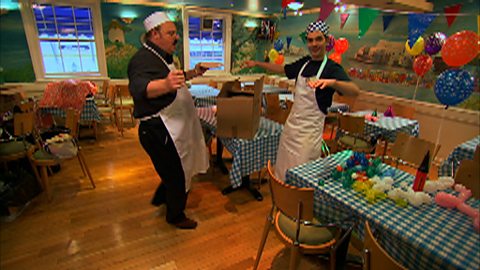
Maths KS2: Understanding radius and diameter. video
The concepts of radius and diameter using pizza toppings in the Pizza Parlour.
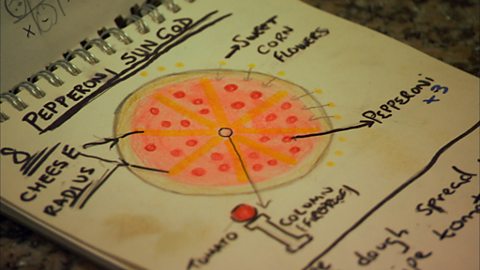
Maths KS2: Units of time. video
The concept of measuring and converting time is explored in the Panto House.
Maths KS2: Using a calendar. video
Exploring time, dates and calendars in the Panto House.
Maths KS2: Using a compass and reading maps. video
An old map helps the Measures to learn about compass points, scale and directions.
Maths KS2: Using grams and kilograms. video
Washing day at the Panto House provides a problem involving weight and using scales.
Maths KS2: Weighing and measuring. video
How to solve the problem of making equal size pizzas from 2kg dough at the pizza parlour