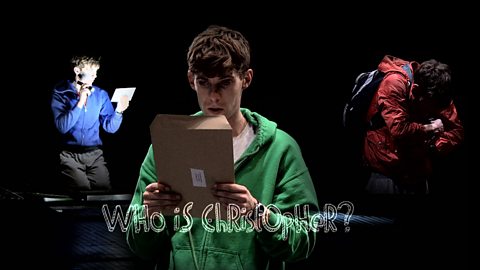
Siobhan:
My name is Christopher John Francis Boone.
Luke:
The story of curious incident is a story about Christopher Boone a 15 year old boy who finds a dog with a fork through it in his neighbours front garden one evening when he's out for a walk.
Siobhan:
It was seven minutes after midnight, the dog was lying on the grass in the middle of the lawn in front of Mrs Shear’s house…
Mrs Shears:
"Get away for my dog!"
Luke:
By following clues and finding things in his house he goes on a journey to London…
Ticket man:
Single or return?
Christopher:
What does single or return mean?
Luke:
… and discovers his mother who he thought was dead is still alive.
Christopher's Mum:
Where’s your father, Christopher?
Christopher:
I think he’s in Swindon!
Luke:
His whole family life in his head changes really from what he thought his family life was to the reality of it.
Christopher:
I thought Father said you were dead.
Christopher's Mum:
What?Christopher:
He said you went into hospital because you had something wrong with your heart and then you had a heart attack and died.
Christopher's Mum:
Oh my god.
Simon:
Everybody who reads this book falls in love with the way Christopher thinks, and the detail and the wit and the clarity, with which Christopher sees the world.
Christopher:
I have a rat…
Mrs Alexander:
A rat??
Christopher:
He’s called Toby…
Mrs Alexander:
Ooooh
Christopher:
Most people don’t like rats because they think they carry diseases like bubonic plague, but that’s only because they lived in sewers were stowed away on ships coming from foreign countries where there were strange diseases…but rats are very clean…
Marianne:
Doing an adaptation of a very, very well known book or film in the theatre is risky because people come expecting what they remembered or how they’d imagined it.
Simon:
My way into interpreting Christopher, was being very loyal to Mark Hadden, and just really sticking to what he had written in the novel.
Mrs Alexander:
Well, maybe I can bring some tea out here? Do you like lemon squash?
Christopher:
I only like orange squash.
Mrs Alexander:
Luckily, I have some of that as well. Oh! And what about Battenberg?
Christopher:
I don’t know because I don’t know what Battenberg is.
Simon:
One of Mark Hadden’s great geniuses is he writes brilliant direct speech, a lot of novelists use dialogue as means of releasing back story or a means of getting characters to say how they’re feeling and Mark never does that.
Ed:
Where have you been?
Christopher:
I have been out…
Ed:
I just had a phone call from Mrs Shears what the hell were you doing poking round her garden?!
Christopher:
I was doing detective work trying to figure out who killed Wellington.
Simon:
Every time Mark attributes direct speech to a character, it’s very much because they want to affect other people they are talking to.
Christopher:
I know you told me not to get involved in other people’s business but Mrs Shears is a friend of ours.
Ed:
Well she isn’t a friend anymore!
Simon:
The first thing I did, was really simple, I went through the novel and every time a character spoke, I typed that out to create a very, very, very rough sketch of a draft of a play.
Policeman:
Have you got a ticket?
Christopher:
No.
Policeman:
How precisely do you expect to get to London then?
Simon:
Another thing I did was that I went through the book and just listed all the events that happened.
Siobhan:
Mother died. Two years ago… I came home from school one day and no one answered the door. So I went and found the secret key that we under a flower pot outside the kitchen window.
Simon:
One of the challenges of the book was that Mark is very playful with time he goes backwards and forwards in time and he's unpredictable about when he's going to go forwards and when he's going to go backwards and that presents challenges to the dramatist.
Siobhan:
An hour later, Father came home from work.
Ed:
Christopher, have you seen your mum?
Christopher:
Nope!
Siobhan:
He went downstairs and started to make some phone calls.
Simon:
I was faced with the possibility of re-ordering the chronology and going right from the beginning to the end of the story and for a while I really thought about doing that. I decided in the end that would be a mistake.
Ed:
I’m afraid that you won’t be seeing your mother for a while.
Christopher:
Why not?
Ed:
Your mother has had to go into hospital.
Simon:
I think the reason Mark plays with chronology is because he wants to create a more truthful perception of what it’s actually like to feel like Christopher Boone.
Siobhan:
The next day was Saturday and there’s not much to do on a Saturday unless Father takes me out somewhere on an outing to the boating lake or the garden centre.
Marianne:
Mark Haddon deliberately didn’t explain or describe who Christopher was but everything is seen through Christopher’s eyes in a very gentle way.
Siobhan:
I think I would make a very good astronaut.
Simon:
I think theatre could only ever be in the third person. Mark’s great genius was creating first person voice that people could really relate to and the stage doesn't work like that. What I had to do was to find a way to make Christopher’s voice dramatic. So making that voice about somebody behaving, and the way into that was through Siobhan.
Siobhan:
The word metaphor means carrying something from one place to another.
Niamh:
Siobhan is in the book, she is Christopher’s teacher and I think a very good teacher. She then, in the play becomes the Narrator for some of the time.
Siobhan:
The first main reason that people do a lot of talking without using any words!
Simon:
I made the decision that Siobhan should be the narrator of Christopher’s book. It was important that Christopher’s narration was revealed somehow. But I didn’t want to break the rules of Mark’s book and one of the rules of Mark’s book was that Siobhan gets to read Christopher’s book.
Siobhan:
This is good Christopher! It’s quite exciting!
Simon:
She gets stuff that Christopher doesn’t get and the book works for us the reader as we get stuff that Christopher doesn’t get. And she is the bridge through that dramatic irony.
Siobhan:
And there was no one around me for thousands and thousands of miles…
Simon:
She’s a really invaluable dramatic character. For me, she became the fulcrum of the entire adaptation.
Siobhan:
… And I put my hands in the on the side of my face so I can’t see the fence or the chimney or the washing line. And I can pretend I am in space!
Video summary
PLEASE NOTE: There is footage from the theatre production of a model dog with a pitchfork through it, which some people might find upsetting.
This short film is to support teaching around GCSE English Literature or Drama.
Playwright Simon Stephens explains the strategies he used in adapting the story of Mark Haddon’s much-loved novel into a script for his production at the National Theatre.
He discusses the structure of the novel, how Mark Haddon plays with chronology in the story and why.
We hear how Simon Stephens used the dialogue in the novel as a starting point for his script, and see examples of speech lifted directly from the novel used onstage.
He discusses the use of the character Siobhan as a narrator in the play, and we see footage of the relationship between Siobhan and Christopher.
This short film is from the BBC series, The Curious Incident of the Dog in the Night-Time: From Page to Stage, made in collaboration with the National Theatre.
It explores how Mark Haddon’s much-loved novel became a multi-award-winning theatre production.
Interviews with the playwright, director and cast and footage from both rehearsal and performance reveal the process of bringing the story alive on stage.
Teacher Notes
When teaching the novel as a set text, students may find this short film useful for understanding structure.
Students could analyse the play as a piece of live theatre, or study the play's structure and style when using it as a set text.
This is particularly useful for exploring the character of Siobhan and her role in the narrative.
Students could also examine Mark Haddon's use of language in the novel, and the role of the narrative voice.
This short film is suitable for teaching GCSE English literature and drama in England, Wales and Northern Ireland and National 5 in Scotland.
Creating Atmosphere. video
Through interviews with the director and designers, we learn how projection, lighting and sound come together to create atmosphere in the production.
Creating Comedy and Tension. video
The cast and creative team explore how they created moments of comedy and tension in the play.
Design Elements. video
A look at how the highly stylised set of the play was designed, featuring interviews with the director and designers.
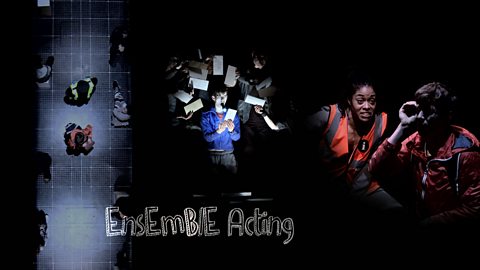
Ensemble Acting. video
The cast and creative team give us an insight into the use of ensemble acting, where a small group of actors play a large number of different parts.
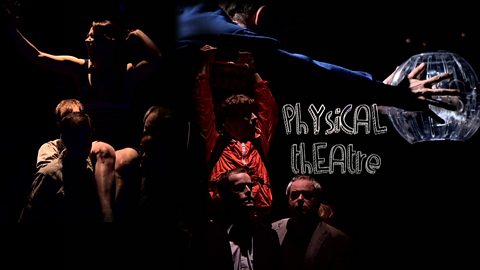
What is Physical Theatre? video
Scott Graham from theatre company, Frantic Assembly, explains what physical theatre is, and how it was used to create the original National Theatre production.
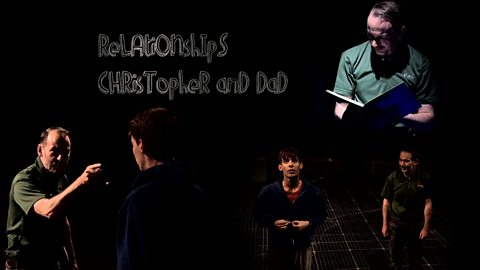
Christopher and his Dad. video
An exploration of the relationship between Christopher Boone and his Dad, Ed Boone, using footage from the original National Theatre production of 'The Curious Incident of the Dog in the Night-Time'.
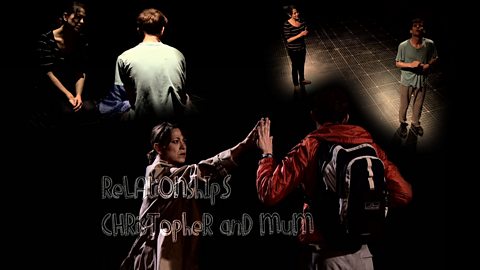
Christopher and his Mum. video
A look at the relationship between Christopher Boone and his Mum, Judy, through interviews with the actors and footage from the National Theatre production.
Christopher and Siobhan. video
A look at the relationship between the characters of Christopher Boone and his teacher, Siobhan, played by Niamh Cusack in the National Theatre production.
Themes. video
Playwright Simon Stephens explains the themes of the novel and play; family, love, honesty and truthfulness.
Who is Christopher Boone? video
An exploration of the character Christopher Boone, from the actor and director who originated the role in the National Theatre production of 'The Curious Incident of the Dog in the Night-Time'.