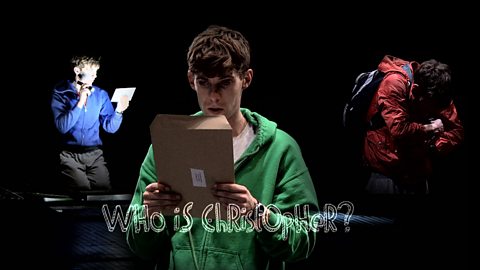
Christopher:
I knew the station was near, and if something is near you can find it by moving in a spiral. Walking in a clockwise direction taking every right turn until you come to a road you already walked on.
Marianne:
The design had to be a piece of imagination. The more realistic you made it, the more domestic and clunky and, er… heavy it felt. It has to be light and agile and highly imaginative.
Judy:
Over here! Christopher! Look!
Bunny:
Very early on, we talked quite a lot about setting it as if it’s in the school hall. That Christopher, the school that Christopher’s at. Because quite a lot of the scenes happen at Christopher’s school. And then quite quickly when Marianne and I were working on it, we want to make it more abstract than that, so we wanted to make it as if we were inside Christopher’s head, as we were inside his imagination. In order for that to feel comfortable for Christopher, it was clear that it had to be somewhere that was very ordered and very clean and mathematical.
Christopher:
Show that a triangle with sides that can be written in the form n2 + 1, n2…
Bunny:
When I was doing the design, I went and bought the A Level papers and took a lot of the diagrams and the grids and looked at some of the questions, so a lot of the design came directly from A Level maths.
Siobhan:
Siobhan says that if you raise one eyebrow it can mean lots different…
Marianne:
The design was on kind of two levels; one was in the book he describes himself as being a little bit like Sherlock Holmes in that his brain was a bit like a laboratory, in which he could come to some sort of solution so that was very much how we decided to design the show, like a laboratory of his brain. And the other thing was that the first half of the show is like a kinda who done it cos that’s what his book is initially and so we also wanted to make the design a bit like an incident board, in a crime room, in a police station.
Christopher:
I only know one person who didn’t like Mrs Shears and that is Mr Shears, who divorced Mrs Shears and went to live somewhere else. And who knew Wellington, very well indeed. This means Mr Shears is my prime suspect.
Marianne:
It’s used like a bit of graph paper actually so the projections that are projected onto it are his diagrams or his workings out.
Bunny:
Inside Christopher’s head, we can go anywhere then so we can shoot off into the atmosphere in and amongst the stars… so the set really had to be able to be lots of different places and feel like lots of different places.
Siobhan:
Because imagining an apple in someone’s eye doesn’t have anything to do with liking someone a lot.
Marianne:
He jumps timelines, so he goes back and forth in time…
Christopher:
I’m sorry.
Marianne:
… And he goes from one scene and jump cuts to the middle of another scene and we needed to do that in a very agile way.
Siobhan:
Christopher, I think you should do what your father tells you to do.
Mrs Alexander:
What happened to you the other day?
Christopher:
Which day?
Mrs Alexander:
I came out and you’d gone. I had to eat all the biscuits myself!
Christopher:
I went away.Mrs Alexander:
I gathered that!
Marianne:
If you’d had umm, a set trundling on of a realistic kitchen and doing a realistic set and then that set trundling off and suddenly we’re in a garden. You wouldn’t be following him at the speed that his brain goes.
Mrs Alexander:
Maybe we should take a little walk in the park together. This is not the place to be talking about this kind of thing.
Bunny:
You’re really creating an environment where the story can be told clearly and that’s all got to happen and quite fluidly and poetically in front of peoples eyes. So the whole evening makes sense and moves the way that the director wants the story to be told.
Siobhan:
I decided to go out on my own.
Ensemble:
Ohhhh!
Paule:
When you talk about a lighting design, really I felt that the lighting shouldn’t describe a place because the lighting was just Christopher saw and what Christopher saw I always saw as being very cool white and controlled. So we don’t use colour, or warmth or anything like that. We’re very specific about when places changed and when they don’t.
(Bell Ringing)
Christopher:
Reverend Peters? Where is heaven?
Lady:
Bzzzzz, Bzzzzz
Paule:
In a way, Curious moves like the inside of Christopher’s head. So it has to be lots changes in the lighting all of the time because it’s as busy as he is.
Bunny:
We talked a lot about it feeling like it was Christopher’s brain and that the company, the rest of the actors within that are almost like microbes of his brain. They are like energy systems that are whizzing around and bouncing off the walls. So that the whole set has to feel like its another character.
Marianne:
We designed every scene before we went into rehearsal. And we did a story board with models and photographed every scene, so we knew how every scene should look and should be staged.
Bunny:
The model box was really, really vital unlike of course a computer animation. When I go and visit the builders we can pick it up we can make things work on it we’ve got It in our hands we can turn it around we can look at it as we’re working on it. The painters work directly from the model box so they match exactly my colours and design, 25 times bigger.
And there’s a kind of a kit for the show, and everything that we need to tell that story is there within that kit.
Marianne:
The props clearly displayed, the actors clearly displayed – some of them never leave the stage, they’re sort of hopefully taking the audience with them on this highly imaginative, suggestive, stylised way of telling Christopher’s story.
Video summary
This short film is to support teaching around GCSE English Literature or Drama.
A look at how the highly stylised set design of the National Theatre’s production of 'The Curious Incident of the Dog in the Night-Time' was created, featuring interviews with the director and designers.
The director explains the decision to have the set represent Christopher’s mind, meaning it had to be imaginative, creative and non-naturalistic.
As the story jumps back and forth, sets had to be able to be changed in an instant.
The designer explains how she used A-level maths papers as an inspiration for the mathematical diagrams projected onto the floor, and the imagery of a police incident room to reflect Christopher’s idea that he is solving a murder mystery.
The lighting designer talks about the decision not to use colour or warmth, as Christopher’s mind is white and cool. We see the model box of the set and hear how it is used in the design process.
This short film is from the BBC series, The Curious Incident of the Dog in the Night-Time: From Page to Stage, made in collaboration with the National Theatre.
It explores how Mark Haddon’s much-loved novel became a multi-award-winning theatre production.
Interviews with the playwright, director and cast and footage from both rehearsal and performance reveal the process of bringing the story alive on stage.
Teacher Notes
Students could consider the set design decisions made, and transfer the thought process to their own drama work.
If analysing the play as a piece of live theatre, your students could look at how design elements contribute to the storytelling.
This short film is suitable for teaching GCSE English literature and drama in England, Wales and Northern Ireland and National 5 in Scotland.
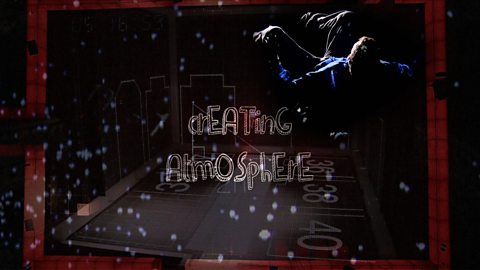
Creating Atmosphere. video
Through interviews with the director and designers, we learn how projection, lighting and sound come together to create atmosphere in the production.
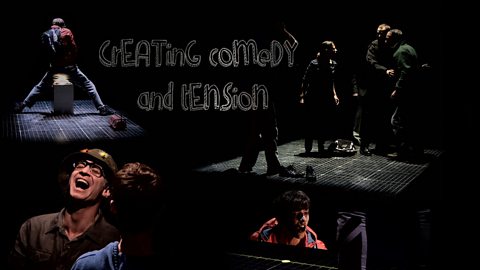
Creating Comedy and Tension. video
The cast and creative team explore how they created moments of comedy and tension in the play.
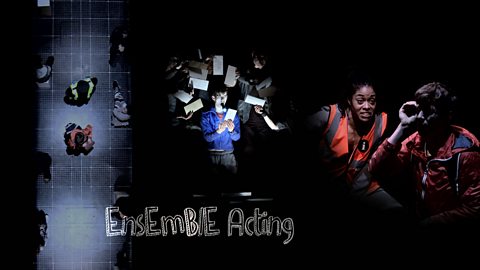
Ensemble Acting. video
The cast and creative team give us an insight into the use of ensemble acting, where a small group of actors play a large number of different parts.
Adapting a Novel for Theatre. video
Playwright Simon Stephens explains the strategies he used in adapting the story of Mark Haddon’s novel into a script for his production at the National Theatre.
What is Physical Theatre? video
Scott Graham from theatre company, Frantic Assembly, explains what physical theatre is, and how it was used to create the original National Theatre production.
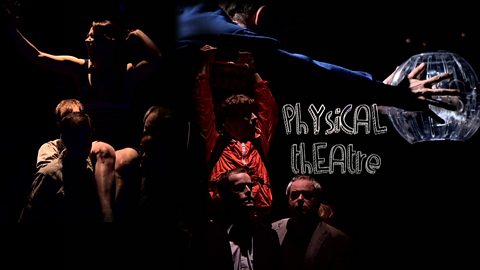
Christopher and his Dad. video
An exploration of the relationship between Christopher Boone and his Dad, Ed Boone, using footage from the original National Theatre production of 'The Curious Incident of the Dog in the Night-Time'.
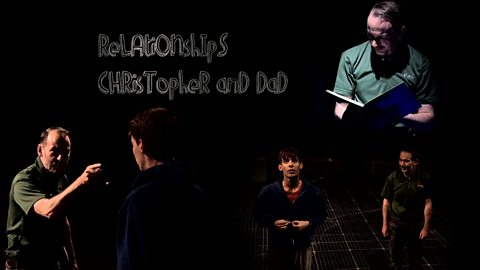
Christopher and his Mum. video
A look at the relationship between Christopher Boone and his Mum, Judy, through interviews with the actors and footage from the National Theatre production.
Christopher and Siobhan. video
A look at the relationship between the characters of Christopher Boone and his teacher, Siobhan, played by Niamh Cusack in the National Theatre production.
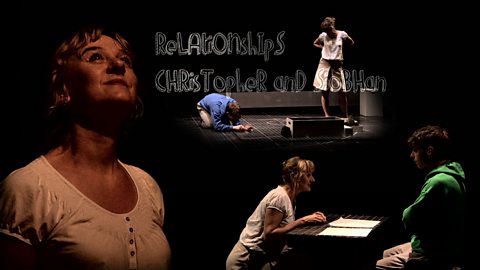
Themes. video
Playwright Simon Stephens explains the themes of the novel and play; family, love, honesty and truthfulness.
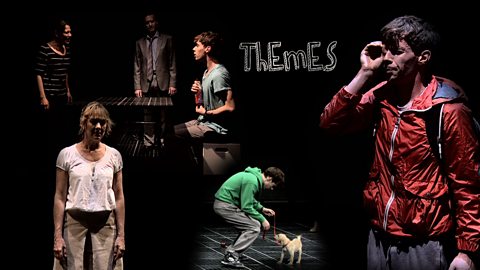
Who is Christopher Boone? video
An exploration of the character Christopher Boone, from the actor and director who originated the role in the National Theatre production of 'The Curious Incident of the Dog in the Night-Time'.