Brian Cox:
Here at CERN, the European Organization for Nuclear Research, can be found perhaps the best example of Britain’s scientific legacy.
Below the ground here, around hundred metres below the ground, is the Large Hadron Collider. It's 27 kilometres in circumference. Its job is to accelerate protons to 99.9999 percent the speed of light, at which speed they circumnavigate these 27 kilometres 11,000 times a second. The protons are collided together, at each one of those collisions the conditions that were present less than a billionth of a second after the universe began, are recreated.
By making particles collide and studying the products of the collisions, scientists can glean a new understanding of the structure of the subatomic world and the laws of nature that rule it. The collider was designed to explore some of the biggest mysteries in the universe, including what happened immediately after the Big Bang.
The sheer audacity of it, that human beings might be able to reach back 13.7 billion years to discover how the universe evolved, is breath-taking. And yet, that's what's being done here on an epic scale.
The Large Hadron Collider is the most complicated scientific experiment ever built, but it's still just an experiment like any other.
At its heart there is repeatable process. Teams of people dedicated to making detailed measurements, and comparing those measurements with theoretical predictions. These are simple principles, yet they hold great power.
Half of the world's particle physicists, 10,000 of them, are gathered here because of the tantalising prospects of what they might discover.
Scientist 1:
CERN is now the place to be because everything is happening here.
Scientist 2:
New physics, new stuff, supersymmetry, dark matter.
Scientist 3:
So we're solving problems which are fundamental to all, all people, everywhere.
Scientist 4:
You don't really care where anyone comes from, it's w-, we all want the same thing.
Scientist 5:
And being part of this is just, is just brilliant (laughs).
Scientist 6:
What do I do. I'm going to have to think about that for a second (laughs).
Brian:
But while one or two of them can't remember what they're supposed to be doing individually, as a group the scientists here have made one of the most important discoveries in physics.
In July 2012 it was confirmed that a new particle, the Higgs Boson, had been detected. This elusive piece of the subatomic jigsaw is responsible for the masses of the building blocks of the universe. The particle is named after British physicist Peter Higgs, who worked on the theory some 50 years earlier.
The discovery is a vindication of the ideas behind CERN, but the reason that we can be confident in the discovery is the painstaking effort that has gone into the design of the experiments.
Even to the point of funding two separate teams of researchers analysing exactly the same things, a cross-check so vital that the teams are not allowed to discuss their work even with each other.
My institute in Manchester is part of an experiment about a few hundred metres in that direction called Atlas, it's a collaboration of over 160 institutes from 38 countries, and together we designed, we built and we operate that experiment. Now, if you go several miles actually in that direction over to the other side of the LHC there's another collaboration, it's called CMS and it's run by different physicists.
It was designed, built, and it is operated completely independently from Atlas. But they're both designed essentially to do the same thing, which is to search for new physics like the Higgs Boson. And because these two groups found exactly the same thing everyone could be confident that the Higgs really had been discovered.
All the basic principles of science are put in to action here at CERN. And it is this, the scientific method that gives CERN and all of scientific investigation its power and validity.
Science is one of this country's success stories, many of its important characters are British, and Britain has always been a place where crucial discoveries are made.
Newton's theory of gravity, the form of the DNA molecule, all courtesy of a few small islands in the North Atlantic.But these great discoveries haven't happened by accident. The existence of organisations like the Royal Institution demonstrates that here is a place where inquiring minds are valued, and the apparently unknowable is thought worthy of investigation.
This is also a nation that celebrates curiosity – and combining this curiosity with a powerful method to investigate nature, it has always ensured that British science is amongst the world's best.
Video summary
Professor Brian Cox visits CERN and describes the experiments that are being conducted at the Large Hadron Collider to explore the moments immediately after the Big Bang.
The LHC is the most complicated and expensive experiment ever undertaken, and this short film includes interviews with the physicists from all over the world who work there.
Brian Cox also outlines the scientific process that's taking place, and the principles of a sound scientific experiment.
This short film is from the BBC series, Science Britannica.
Teacher Notes
This short film will be useful in conveying the importance of repetition and reproduction in scientific investigations.
It can be used to showcase the kind of work that is being done at CERN, and how this work relates to simple experiments done in the classroom.
This short film will be relevant for teaching physics at KS3, GCSE/KS4 and National 4/5 and Higher.
The topics discussed will support OCR, Edexcel, AQA,WJEC GCSE in GCSE in England and Wales, CCEA GCSE in Northern Ireland and SQA National 4/5 and Higher in Scotland, and Cambridge IGCSE Physics.
Sir Isaac Newton and the scientific method. video
Brian Cox outlines the historical context of the era in which Newton began to be interested in the nature of the visible spectrum obtained using a prism.
John Tyndall and blue skies research. video
Brian Cox describes the work of John Tyndall and his attempts to explain what makes the sky blue and the sunset red.
Who was Henry Cavendish? video
Professor Brian Cox introduces Henry Cavendish, the 18th Century scientist who investigated hydrogen, came up with the formula H20 and founded the Royal Institution.
Who was Humphry Davy? video
Brian Cox follows in the footsteps of 19th Century chemist Humphry Davy, recreating one of his explosive experiments that he used to impress the crowds at the Royal Institution.
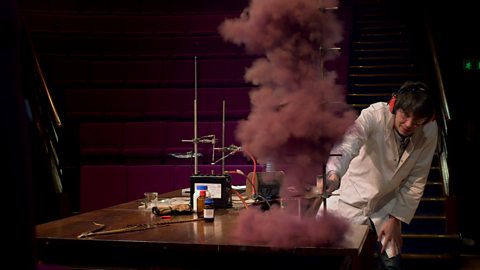
William Perkin and making scientific discoveries by chance. video
Brian Cox uses William Perkin's discovery of mauveine to explain how scientific discoveries are sometimes made by chance.
Targeted research. video
Brian Cox learns about targeted research in the modern pharmaceutical industry and how by focusing only on positive results, it fails to report negative results.
Global warming resistant GM crops. video
Brian Cox outlines the history of the discovery of DNA and how this has led to a controversy over the use of genetic modification in agriculture.
John Hunter and public engagement in science. video
Brian Cox describes how John Hunter pushed the boundaries of medicine using corpses obtained from grave-robbing and how he set up a museum to open minds about medical research.