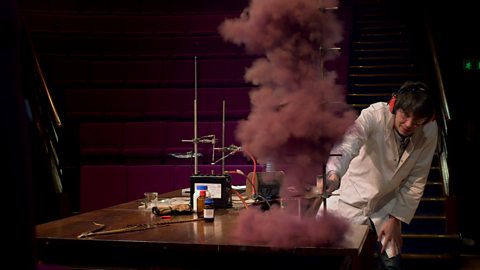
The British pharmaceutical industry is at the forefront of drug discovery and manufacture.
They have pioneered antibiotic medicine, enabled mass vaccination, and made previously fatal conditions treatable.
It’s part of an industry worth an estimated 200 billion pounds a year and it's not a business that hangs around waiting for happy accidents.
Drug-discovery uses a targeted approach to scientific research.
See, what I am amazed about is the level of work …compared to University. There’s so many people.
Glaxo Smith Klein is behind many of the pharmaceuticals that are common place in today’s market place from painkillers to asthma inhalers.
One of GSK’s biggest research and development hubs is here on home soil, 20 miles north of London in Stevenage.
Tom:
So this lab in general, this is the early, early discovery within biopharm, so we're responsible.
Brian:
Doctor Tom Webb joined GSK three years ago and has been working to develop new drugs ever since.
Brian:
How do you do it? I mean if somebody comes along from management to GSK and said, "Right, we need a drug to treat um arthritis, a new one," um what, what do you do? Do you say, "Okay, um-,"… "Here's a test tube,".
What do you do?
Tom:
So it's, it's an incredibly complex process, so drug-discovery takes ten to 15 years.
Brian:
Mm.
Tom:
It starts off with a target in mind for, for treating that disease, and then we start off with, with huge libraries, those might be libraries of small molecules, so containing tens of thousands of different chemical compounds, and it's starting with all of these potential medicines and really whittling them down to one, one candidate, one medicine.
Brian:
So that sounds very, very, a targeted approach, really…
Tom:
Absolutely.
Brian:
You have a specific example, a specific challenge in mind. It's a beautiful example, isn't it, of a, a, almost like an industrial scale search…
Tom:
Absolutely.
Brian:
For for useful antibodies or useful…
Tom:
Sure.
Brian:
Drugs to focus…
Tom:
Yeah, and we're getting better and better at doing it as-, as we gain more experience.
Brian:
The screenings done at pharmaceutical companies such as GSK allow researchers to test millions of different compounds, antibodies or genes to see if they'll work as part of a new drug or treatment. The scale of the work means the chance of success over conventional research methods is dramatically increased.
Tom:
If we were just playing around in the lab I think the likelihood of us stumbling across a discovery that enables us to make a medicine is-, is probably unlikely, so we have to commit to making medicines for patients and that doesn't happen by complete serendipity.
Brian:
The pharmaceutical industry in Britain is a triumph for home-grown science, providing cures for previously untreatable diseases and changing the lives of millions of patients around the world.
This is an impressive place and it's science on an industrial scale, and you see these vast research labs, and that's what you need because you have to do hundreds of thousands or even millions of individual experiments to bring a new drug to market. It also costs billions of pounds. So this is targeted science, there are particular problems that need solutions, there's a particular disease that needs treating, and I suppose for medical science as a whole you can state its goal in one simple sentence, is to make people better.
It's undeniable that targeted research delivers, but, and it's a big but, there is a catch. And it's this; in any commercial environment specific targeting brings with it a possibility that during the process of discovery any kind of result that doesn't positively enhance the chance of success may be ignored.
Now on the face of it that seems fair enough, but in fact it's extremely worrying indeed. See, if you look through the history of science, through any scientific journal, then you'll find that the negative results are recorded as well as the positive ones, and that's important because all knowledge is valuable. But in a commercial setting where you're asking a question, 'Can we find a drug to cure this particular disease, to do this particular job?' then the temptation is to ignore the negative results.
This is almost anti-knowledge, it goes against the ethos of science, and, more importantly, it closes the doors to some magnificent serendipitous discoveries.
Video summary
Please note that this short film is from the BBC series, Science Britannica, first broadcast in 2014 and some of the information included may no longer be up-to-date.
Professor Brian Cox learns that drugs are not discovered by accident, but that the process usually begins with a library of chemicals that can be tested in automated processes to find out which ones are potentially beneficial.
However, he goes on to explain that targeted research does not tend to report negative results of these trials, unlike traditional academic journals, which could potentially be worrying.
This short film is from the BBC series, Science Britannica.
Teacher Notes
This short film could be used as a stimulus to discuss the different ways that scientists work and how they communicate their research findings.
Students could be encouraged to compare science on an industrial scale to experiments conducted by an individual. What are the advantages and disadvantages of each approach?
What are some fields other than medicine that rely on targeted research?
This short film will be relevant for teaching biology and chemistry at KS3 and KS4/GCSE level.
This topic appears in AQA, OCR, EDEXCEL, CCEA, WJEC, SQA.
Global warming resistant GM crops. video
Brian Cox outlines the history of the discovery of DNA and how this has led to a controversy over the use of genetic modification in agriculture.
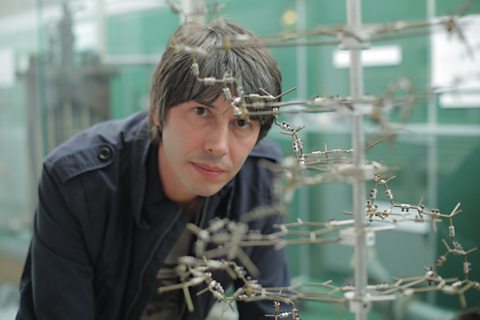
John Hunter and public engagement in science. video
Brian Cox describes how John Hunter pushed the boundaries of medicine using corpses obtained from grave-robbing and how he set up a museum to open minds about medical research.
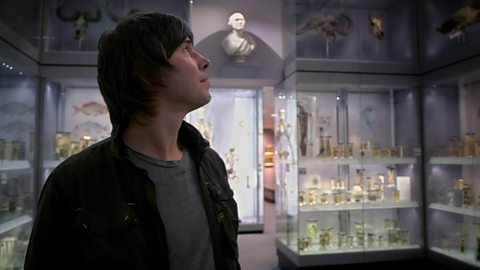
William Perkin and making scientific discoveries by chance. video
Brian Cox uses William Perkin's discovery of mauveine to explain how scientific discoveries are sometimes made by chance.
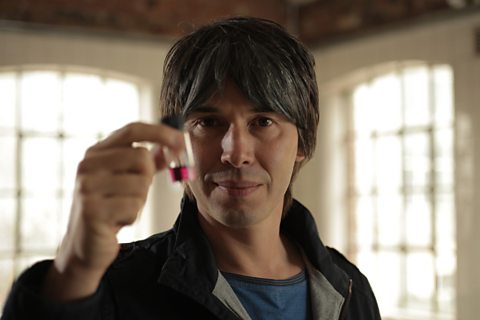
Sir Isaac Newton and the scientific method. video
Brian Cox outlines the historical context of the era in which Newton began to be interested in the nature of the visible spectrum obtained using a prism.
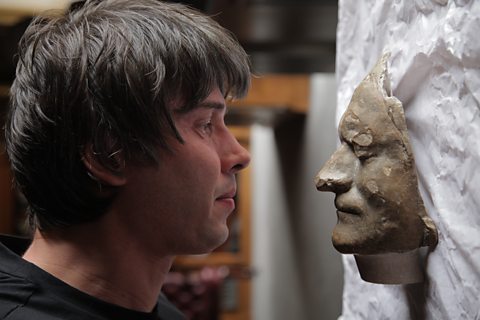
John Tyndall and blue skies research. video
Brian Cox describes the work of John Tyndall and his attempts to explain what makes the sky blue and the sunset red.
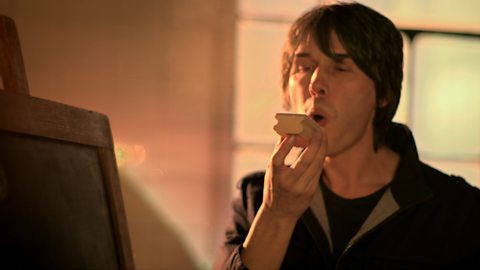
Who was Henry Cavendish? video
Professor Brian Cox introduces Henry Cavendish, the 18th Century scientist who investigated hydrogen, came up with the formula H20 and founded the Royal Institution.
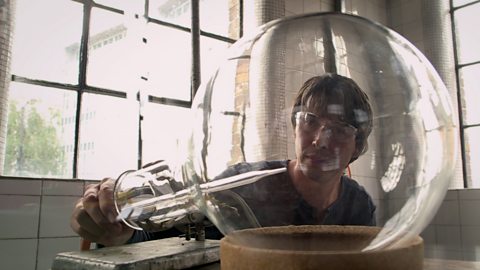
Who was Humphry Davy? video
Brian Cox follows in the footsteps of 19th Century chemist Humphry Davy, recreating one of his explosive experiments that he used to impress the crowds at the Royal Institution.