In the early 19th century, as science ever more rapidly transformed the way we understood the world, the public became increasingly desperate to hear of the latest advances.
London’s Royal Institution was a beacon of scientific learning. Lectures given by the top scientists of the day were sold out quickly, and in 1802 the hottest ticket in town offered a chance to see a real star – the Royal Institution’s new professor of chemistry, Humphry Davy.
As well as being a brilliant chemist Davy was also a passionate communicator of science.
Davy was a genuine star. The Royal Institution theatre was packed with the great and the good of the day. They had come to witness Davy's spectacular demonstrations. It had all the excitement of a magic show, but what Davy was doing was better than magic. It was chemistry.
Davy was said to be something of a pyromaniac. He even burnt diamonds to demonstrate that these most precious gems are made of carbon, the same stuff as coal.
To Davy's audience this was captivating. Here, in front of their eyes, he was demonstrating one of the latest scientific theories, that everything is made up of a limited number of elements.
Davy was famous for doing spectacular experiments, in particular for blowing things up. And this is one of the experiments, it's involving iodine which is in fact one of the elements Davy is famous for discovering. So, Davy mixed iodine with this liquid, and what happens is a powerful contact explosive is made, and in (laughs) one of his experiments he temporarily blinded himself by doing just what I'm doing now.
Now, what Davy wanted to do was to educate his audience. He wanted to show them that chemistry was exciting, and counter intuitive. This idea that you could make compounds out of other substances and have extremely surprising and in this case …spectacular properties.
Nitrogen triiodide is a wonderful compound for demonstrating those ideas. It's basically a nitrogen atom with three iodines stuck to it. Now, nitrogen atoms want to interact, they want to bond together into the very stable nitrogen molecule, but the iodines keep them just far enough apart that they can't interact. All you have to do to change that and make them interact very quickly indeed, is to give them a little tickle. And it really is a very little tickle.
(explosion)
Wha! (laughs)…
Look at that, and that purple vapour there is iodine, so that was a very rapid chemical reaction. Nitrogen is produced and iodine is released. Yeah I can see why Davy liked that.
Davy was demonstrating that acquiring and applying scientific knowledge, gives us power over nature. And his writings reveal how he believed the future of human kind lay in exploiting that power.
Science has bestowed upon him powers which may be almost called creative, which have enabled him to modify and change the beings surrounding him, and by his experiments to interrogate nature with power, not simply as a scholar, passive and seeking only to understand her operations, but rather as a master, active with his own instruments.
Here, Davy is talking about being a creator in the Biblical sense… of controlling nature. Davy is claiming for science the territory previously occupied exclusively by religion.
The seeds of public disquiet regarding scientists ‘playing God’, were sown - and may have provided the inspiration for Mary Shelley’s seminal novel, ‘Frankenstein’. The idea of scientists creating monsters was born.
Video summary
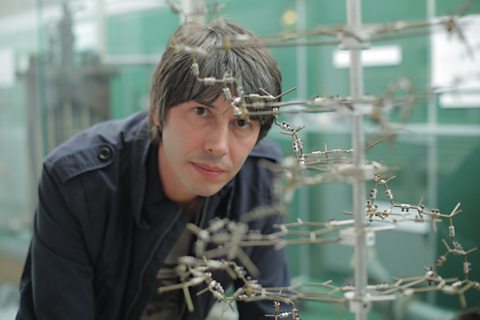
Professor Brian Cox introduces Humphry Davy, who was passionate both about chemistry and communicating his enthusiasm for science to the public.
He visits the Royal Institution to recreate one of Davy's spectacular public experiments, making nitrogen triiodide from iodine (an element that Davy discovered) and concentrated ammonia, with explosive results.
Cox explains the, at that time, new theory of chemical elements and that Davy believed that understanding science would allow man to control the world around him, beginning an uneasy tension between science and religion.
This short film is from the BBC series, Science Britannica.
Teacher Notes
This short film could be used as a basis to discuss chemical reactions and the formation of compounds.
This could also help encourage students in discussing the work of famous scientists and the tension between science and religion.
Nitrogen triiodide can potentially be prepared in school by experienced science teachers who have sought advice from CLEAPSS and performed an appropriate risk assessment.
This short film will be relevant for teaching chemistry at KS3 and KS4/GCSE and National 4/5 and Higher in Scotland.
This topic appears in OCR, Edexcel, AQA, WJEC KS4/GCSE in England and Wales, CCEA GCSE in Northern Ireland and SQA.
Who was Henry Cavendish? video
Professor Brian Cox introduces Henry Cavendish, the 18th Century scientist who investigated hydrogen, came up with the formula H20 and founded the Royal Institution.
William Perkin and making scientific discoveries by chance. video
Brian Cox uses William Perkin's discovery of mauveine to explain how scientific discoveries are sometimes made by chance.
John Hunter and public engagement in science. video
Brian Cox describes how John Hunter pushed the boundaries of medicine using corpses obtained from grave-robbing and how he set up a museum to open minds about medical research.
Sir Isaac Newton and the scientific method. video
Brian Cox outlines the historical context of the era in which Newton began to be interested in the nature of the visible spectrum obtained using a prism.
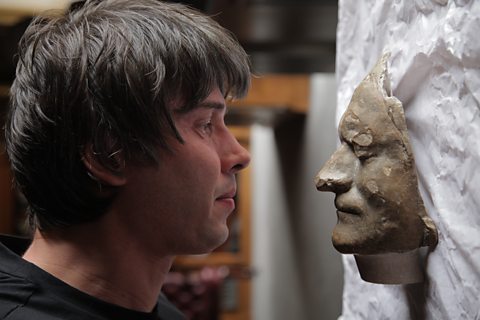
John Tyndall and blue skies research. video
Brian Cox describes the work of John Tyndall and his attempts to explain what makes the sky blue and the sunset red.
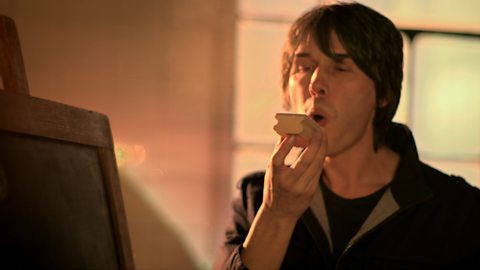
Targeted research. video
Brian Cox learns about targeted research in the modern pharmaceutical industry and how by focusing only on positive results, it fails to report negative results.
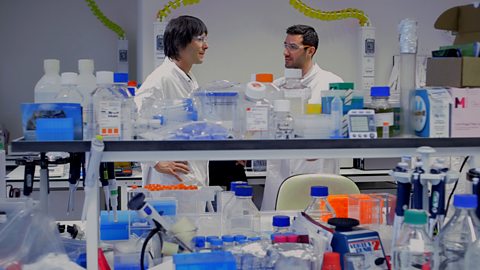
Global warming resistant GM crops. video
Brian Cox outlines the history of the discovery of DNA and how this has led to a controversy over the use of genetic modification in agriculture.