These potato plants growing in a field in Norfolk are considered by some people to be dangerous because they have been genetically modified. They’re even referred to as Frankenfoods.
They were created here at the Sainsbury Laboratory – just outside Norwich, by plant geneticist Jonathan Jones, but he doesn’t see these plants as monsters.
Jonathan:
You can put in genes that you could not put in by breeding. So there are certain genes that do something really useful, er, such as make it much easier to control disease, much easier to control pests and control weeds.
Brian:
It is remarkable that we have the ability to precisely manipulate and alter the genetic make-up of other living organisms.
But it also means GM is at the heart of a long standing debate about the possible dangers of scientific progress. A debate that started at the beginning of the genetic revolution with the discovery of DNA.
It’s here in Cambridge that Francis Crick and James Watson discovered the structure of DNA - the molecule that passes biological information from generation to generation. Crick and Watsons approach to finding that structure was to build physical models of the molecule. But it was proving unsuccessful. They desperately needed more and better data and it came from a branch of physics called x-ray crystallography.
This is a very famous photograph it’s called photograph 51. It was actually taken by another scientist, Rosalind Franklin. And it’s what called an x-ray diffraction photograph.
So Franklin shone x-rays through a sample of DNA molecules and the way that they scatter – or diffract off the molecules – the pattern they leave on the photographic plate allows you to deduce the structure of those molecules. The key piece of evidence is the X– that allowed Franklin to suggest that the molecule must be helical – and in fact must have that famous double helix.
So this photograph along with Franklin’s suggestion, her interpretation, the pattern, allowed Watson and Crick to go away and build their model of DNA.
When they published the structure of DNA in 1953, Crick said “We have discovered the secret of life”.
Crick was right - The discovery of the structure of DNA was one of the great moments in modern scientific history.
By the early 1970’s, the genetic code had been translated making it possible to identify individual genes and study their function.
We now had access to the workings of life itself. But the genetic revolution was accompanied by a widespread feeling that science had gone too far. And to this day, scientists haven’t always been able to control the debate.
And nowhere is that clearer than in the controversy over GM crops in this country.
To many scientists GM crops hold the key to more efficient, more environmentally friendly agriculture. But they have been unable to persuade a sceptical public of the safety of the technique. Instead public opinion has been led by a vigorous anti-GM campaign that started in the 1990s, and which has left many people dead set against GM crops.
There are fears that the crops may contaminate the environment or that they may be unsafe to eat. And underlying it all is a feeling that there is something fundamentally wrong about meddling with life at such a basic level.
What do you think of this label ‘Frankenfood’? The suggestion is that because we can now put genes from an animal, let’s say a cow or a jellyfish or whatever it is, into a plant, there’s something unnatural and therefore potentially dangerous about that procedure.
Jonathan:
Well, the word ‘unnatural’ is a real weasel word. I mean it’s unnatural to treat your kids with antibiotics, it’s natural to let them die. I know which I’d prefer.
Agriculture is fundamentally unnatural, whether it’s organic agriculture or high tech agriculture, conventional agriculture. We are eliminating all the trees and wildlife that used to be there and planting the plants that we want to have there to provide the stuff that’s um, that we eat. So the – the er, the thing we have to ask ourselves is what’s the least bad way of protecting our crops from disease and pests for reducing the losses caused by weeds.
Brian:
As a scientist working on GM crops, you would expect Jonathan to be a powerful advocate of the technology. But his view is also backed up by a vast body of research that shows it to be safe and effective. So if GM crops are to have a future in this country the scientists need to find a better way to persuade the public to share their confidence.
Video summary
Professor Brian Cox meets a plant scientist who describes the benefits of genetic modification of plants. Brian then describes the history of the discovery of DNA in Cambridge by Crick and Watson.
He discusses the work of Rosalind Franklin, explains the significance of Photograph 51 and outlines how this allowed her to suggest the double helix structure, leading to Crick and Watson being able to build their famous model.
He describes the significance of genetic sequencing and how this has ultimately led to the controversy around genetic modification.
This short film is from the BBC series, Science Britannica.
Teacher Notes
This short film could be used to launch classroom discussions on selective breeding and genetic modification.
Students could discuss some other ways in which scientific activity impacts on the environment.
Encourage students to consider other controversies in science and debate on the pros and cons of scientific progress.
This short film is relevant for teaching biology at KS3 and KS4/GCSE.
Appears in OCR, Edexcel, AQA, WJEC in England and Wales, CCEA GCSE in Northern Ireland and SQA National 4 in Scotland.
Targeted research. video
Brian Cox learns about targeted research in the modern pharmaceutical industry and how by focusing only on positive results, it fails to report negative results.
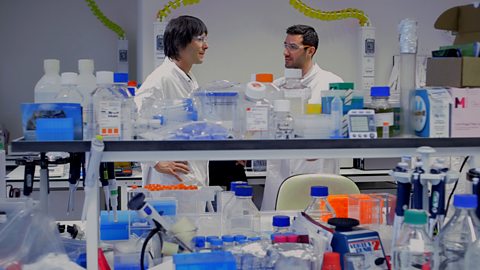
John Hunter and public engagement in science. video
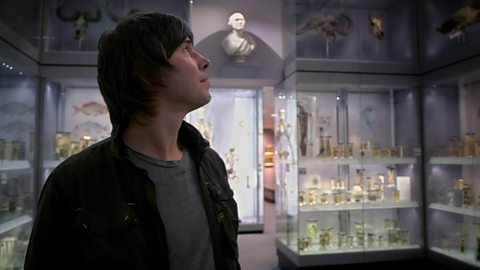
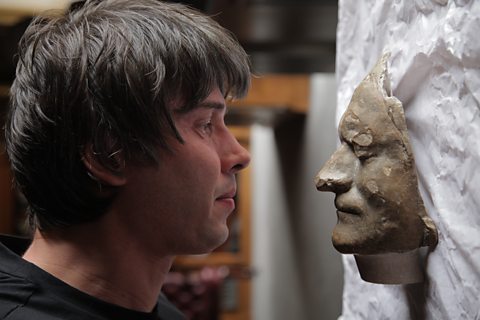
Brian Cox describes how John Hunter pushed the boundaries of medicine using corpses obtained from grave-robbing and how he set up a museum to open minds about medical research.
William Perkin and making scientific discoveries by chance. video
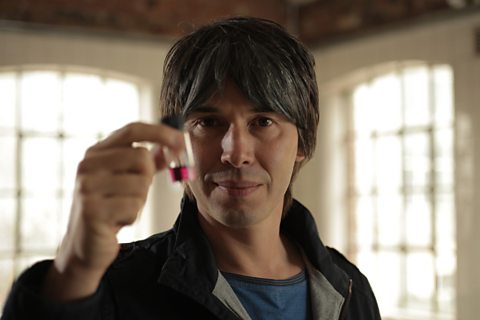
Brian Cox uses William Perkin's discovery of mauveine to explain how scientific discoveries are sometimes made by chance.
Sir Isaac Newton and the scientific method. video
Brian Cox outlines the historical context of the era in which Newton began to be interested in the nature of the visible spectrum obtained using a prism.
John Tyndall and blue skies research. video
Brian Cox describes the work of John Tyndall and his attempts to explain what makes the sky blue and the sunset red.
Who was Henry Cavendish? video
Professor Brian Cox introduces Henry Cavendish, the 18th Century scientist who investigated hydrogen, came up with the formula H20 and founded the Royal Institution.
Who was Humphry Davy? video
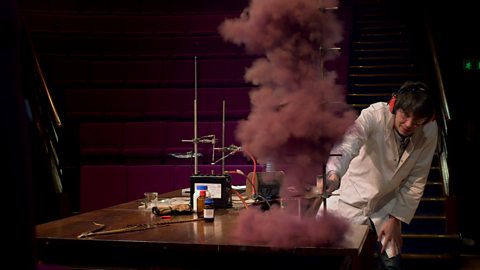
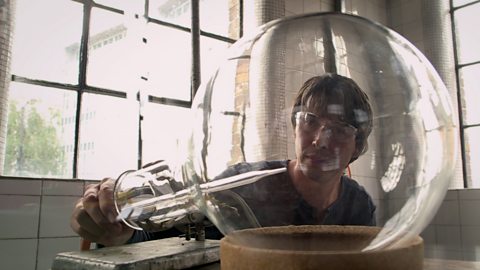
Brian Cox follows in the footsteps of 19th Century chemist Humphry Davy, recreating one of his explosive experiments that he used to impress the crowds at the Royal Institution.