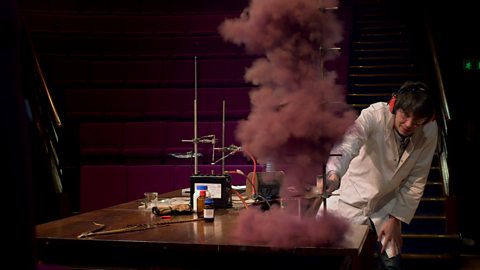
Scientists are often baffled by negative public reaction to a new scientific discovery, they sometimes fail to appreciate that the public genuinely fear that science is dangerous.
The way to combat that fear is through effective public engagement.
And perhaps surprisingly – one of the best examples of that comes from over 200 years ago and a scientist who at the time was perceived to be a dangerous villain.
In the lobby of the Royal College of Surgeons stands a statue of John Hunter – a Scotsman and one of the fathers of modern medicine.
In the 1780s he started performing surgical operations that were decades ahead of their time.
This is the original documentation of the case of John Burley – a really excellent example of Hunters skill as a surgeon.It’s a picture of a tumour – so that’s what happens when you leave a tumour for too long.
It says here – it was an increased to the size of a common head attended with no other inconvenience than it size and weight.And then the second drawing here –is after the operation – it’s completely cured essentially.
But for all his medical brilliance Hunter was treated with suspicion and even horror. Because to develop his remarkable surgical skills he had practiced on human corpses.
In the 18th century, anatomists were legally entitled to corpses fresh from the gallows – but even then demand comfortable exceeded supply – and so they had to look to another source of bodies for experimentation.
And the easiest place to get hold of fresh corpses was to dig them up from a graveyard…
Anatomists were prepared to pay a large amount of money for corpses and that meant there were hundreds of grave robbers operating in gangs in London, who could dig up, up to 10 bodies per night. And the best customer of all was John Hunter.
On one occasion he was even arrested for giving a hand to a gang of grave robbers. And these exploits made Hunter incredibly unpopular with the man on the street.
Hunter revolutionized surgical techniques for the benefit of everybody – but I suppose not unsurprisingly his work was controversial in public. So, even though he was working in the 18th century – I suppose you could say in the modern vernacular he had a PR problem.
Hunter was so afraid of the adverse public reaction of his work – that he was actually in fear of his life. But he reasoned that fear was borne of ignorance. And therefore education was the answer. And so he opened this museum to display his work to the public.
His collection is still on display today in the Royal College of Surgeons. In these exhibits people could see how Hunter was using corpses to learn about anatomy and physiology. You could even see his pioneering attempts at opening new fields of medicine. These chicken heads were the recipients of some of the first transplant operations. Although some of these exhibits are gruesome they show how Hunter was using his knowledge to move medicine out of the dark ages.
This exhibit marks the beginning of the end of the age of barbaric surgery.
What you see here is an aneurysm in the popliteal artery – that’s the artery that runs behind the knee. And it’s essentially a sack of blood where the artery swells up and if this goes untreated what will happen is that sack will eventually burst and the patient will bleed to death. Now the treatment at the time for that – was amputation.
But what Hunter noticed through his work on animal physiology and indeed on the dissecting of human specimens was, that there were many other arteries in the leg – and he reasoned that if he tied off the effected artery – ligated it – then the blood supply to the aneurysm would be cut off and he hoped that the other arteries would expand to allow blood to flow down the leg.
As well as revolutionizing medicine – John Hunter’s approach was a model for public engagement. By inviting people into his museum, he was able to address and confront the moral objections to his work.
Video summary
Please note that this short film is from the BBC series, Science Britannica, first broadcast in 2014 and some of the information included may no longer be up-to-date.
Professor Brian Cox describes how John Hunter engaged the public in his work in order to garner public support.
In 18th century Britain, Hunter was a pioneer in surgery, but he had developed his skills by using bodies that were legitimately obtained from executions, and also illegally from grave-robbing.
This made him unpopular with members of the public.
He founded a museum to display his work to the public in the belief that fear of his work was due to ignorance.
This allowed members of the public to confront their moral objections to his work.
Due to the sensitive nature of the subject matter, we strongly advise teacher viewing before watching with your pupils.
Teacher Notes
This short film could be useful as a discussion starter for the importance of public opinion in scientific practice and how we find out about recent discoveries in science.
Students could be encouraged to monitor new discoveries through the news over a period of time and share them with the class.
This could also be used as an introduction to how surgical techniques and scientific inquiry has developed over time, and a point of debate about ethics and science.
This short film is relevant for teaching biology at KS3 and KS4/GCSE.
Appears in OCR, Edexcel, AQA, WJEC in England and Wales, CCEA GCSE in Northern Ireland and SQA National 4 in Scotland.
Targeted research. video
Brian Cox learns about targeted research in the modern pharmaceutical industry and how by focusing only on positive results, it fails to report negative results.
Global warming resistant GM crops. video
Brian Cox outlines the history of the discovery of DNA and how this has led to a controversy over the use of genetic modification in agriculture.
William Perkin and making scientific discoveries by chance. video
Brian Cox uses William Perkin's discovery of mauveine to explain how scientific discoveries are sometimes made by chance.
Sir Isaac Newton and the scientific method. video
Brian Cox outlines the historical context of the era in which Newton began to be interested in the nature of the visible spectrum obtained using a prism.
John Tyndall and blue skies research. video
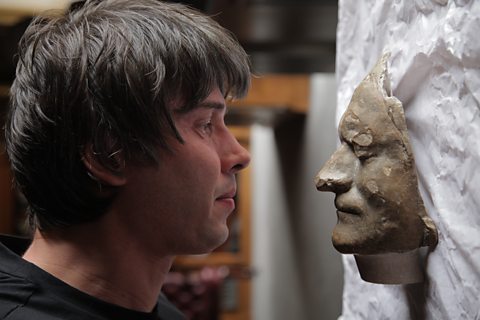
Brian Cox describes the work of John Tyndall and his attempts to explain what makes the sky blue and the sunset red.
Who was Henry Cavendish? video
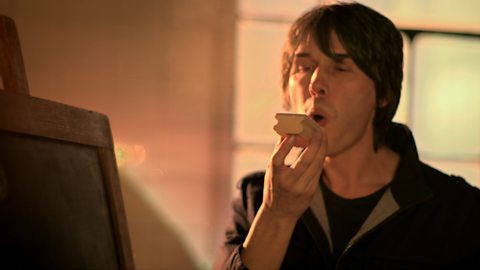
Professor Brian Cox introduces Henry Cavendish, the 18th Century scientist who investigated hydrogen, came up with the formula H20 and founded the Royal Institution.
Who was Humphry Davy? video
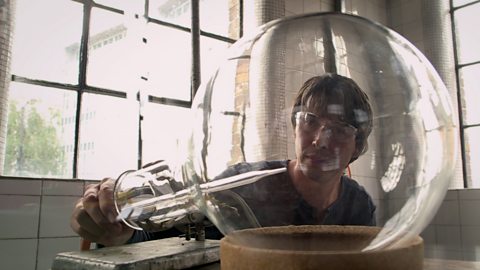
Brian Cox follows in the footsteps of 19th Century chemist Humphry Davy, recreating one of his explosive experiments that he used to impress the crowds at the Royal Institution.