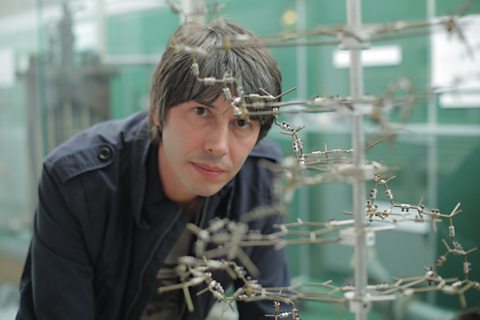
The great British scientists, who have transformed our thinking about the universe and our place within it, owe much of their success to one incredible idea: the scientific method.
It’s the bedrock of modern science. A way of making scientific ideas testable by comparing them to experimental results. One of its earlier practitioners was Sir Isaac Newton.
This is Newton's death mask, it's a plaster cast of his face that would've been taken moments after he died, you think of Newton as almost an abstract set of theories, you think of his universal law of gravitation. But when you look at this you see a different Newton, you see Newton the man.
Newton was obsessive, malicious, and prone to outbursts of rage, but there was something quite extraordinary about the way that he worked. In an age when people still believed in magic Newton devised a revolutionary theoretical framework with which to accurately investigate the nature of the world.
Newton was born in 1642 into an England that was a country in transition, where science, where rational thought, where reason were beginning to flower. Now, at the time one of the great questions was about the nature of light. It was known that if you take a prism and shine sunlight through it, then it splits that sunlight into all the colours of the rainbow. The question was why.
The common explanation for the appearance of the colours was that they were impurities added by the prism to the pure white light. Newton thought that the colours were already present in the white sunlight, but what set Newton apart was the fact that he devised and performed an experiment to test his hypothesis. He shone a white source of light through a prism and as expected obtained a rainbow. But then he added a twist…
Here's the genius, he introduced a slit into that rainbow beam, and that allowed him to isolate a particular colour of light and shine that into a second prism. Then, he looked for the deflection of the coloured light onto his wall. You can see that over there.
Now, look what happens when I move the red light across the slit, to the green light. On the wall what you see is green light into the prism equals green light out. Now, that implies that the colours themselves are pure, the prism is not adding or subtracting anything. That means that Newton's hypothesis was shown to be correct. The colours themselves are the basic building blocks of light and white light is made up of all those individual colours. That's genius.
Newton was one of the first to interrogate nature using the principles of what we now call the scientific method. In other words he observed the world, came up with theories to explain what he saw, then tested them with experiments to see if he was right. The power of this approach is that it aims to remove preconceived ideas and in doing so deliver a more accurate description of the natural world.
And that’s how Newton made his incredible discoveries. Most of which he wrote in this priceless book: the Principia.
It's in here that the first time that the universal law of gravitation is outlined, it's also his laws of motion that say how objects move around in the universe. It's pretty much everything you do in the first year of an undergraduate degree in physics actually.
On the face of it, it seems baffling that the scientific method took so long to emerge. After all, Newton lived just a few hundred years ago. Part of the problem is that our world is a complicated and baffling place. But it’s much easier to understand if you simplify it. It is possible to deduce the nature of light by investigating a rainbow, but by creating a controllable, repeatable experiment, Newton was able to support his hypothesis and then transfer that understanding to the much more complex world outside the laboratory.
But powerful though the method is, a crucial in its success, seems to be extraordinary individuals, people who appear to bring something extra to the process.
Video summary
Professor Brian Cox outlines the historical context of the era in which Newton began to be interested in the nature of the visible spectrum obtained using a prism.
He recreates Newton’s simple experiment that proved that the colours were the pure components of white light rather than being impurities.
He explains that Newton observed aspects of the world, came up with theories to explain them and then tested them with experiments.
He then looks at Newton’s 'Principia Mathematica', before concluding that science is about simplifying the complex world around us, creating controllable and repeatable experiments to test hypotheses, and then transferring understanding to the complex world outside the laboratory.
This short film is from the BBC series, Science Britannica.
Teacher Notes
Before showing this short film, ask your students to share in groups and write down what they already know about Sir Isaac Newton.
During the short film, they should write brief notes to explain the contribution that he made to the nature of science and scientific enquiry.
This short film will be relevant for teaching physics at KS3, GCSE/KS4 and National 4/5 and Higher.
The topics discussed will support OCR, Edexcel, AQA,WJEC GCSE in GCSE in England and Wales, CCEA GCSE in Northern Ireland and SQA National 4/5 and Higher in Scotland, and Cambridge IGCSE Physics.
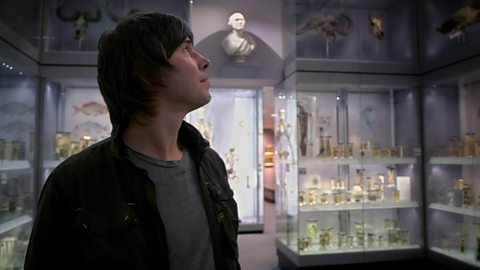
John Hunter and public engagement in science. video
Brian Cox describes how John Hunter pushed the boundaries of medicine using corpses obtained from grave-robbing and how he set up a museum to open minds about medical research.
John Tyndall and blue skies research. video
Brian Cox describes the work of John Tyndall and his attempts to explain what makes the sky blue and the sunset red.
Who was Henry Cavendish? video
Professor Brian Cox introduces Henry Cavendish, the 18th Century scientist who investigated hydrogen, came up with the formula H20 and founded the Royal Institution.
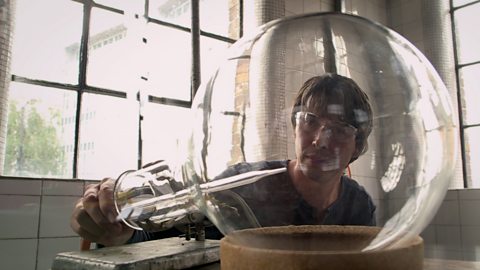
Who was Humphry Davy? video
Brian Cox follows in the footsteps of 19th Century chemist Humphry Davy, recreating one of his explosive experiments that he used to impress the crowds at the Royal Institution.
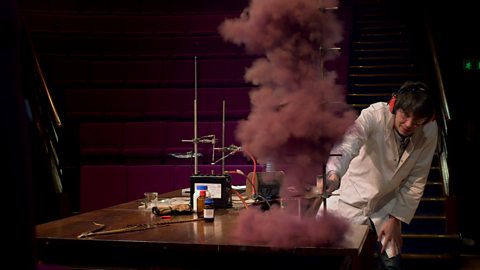
William Perkin and making scientific discoveries by chance. video
Brian Cox uses William Perkin's discovery of mauveine to explain how scientific discoveries are sometimes made by chance.
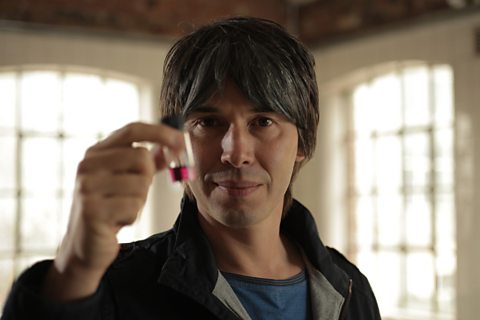
Targeted research. video
Brian Cox learns about targeted research in the modern pharmaceutical industry and how by focusing only on positive results, it fails to report negative results.
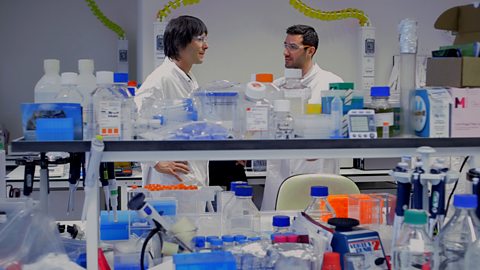
Global warming resistant GM crops. video
Brian Cox outlines the history of the discovery of DNA and how this has led to a controversy over the use of genetic modification in agriculture.