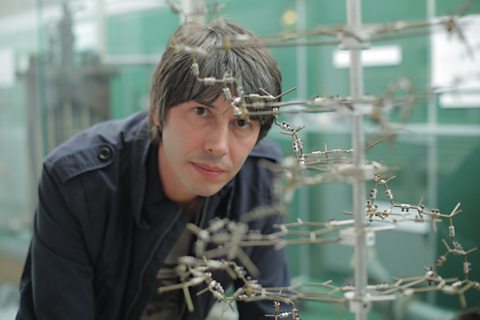
Throughout history Britain's scientists have often been motivated by one thing, indeed some argue it's perhaps the greatest driver of scientific discovery; the simple aspiration to understand how nature works.
In its purest form it is just that, the desire to understand without any regard at all for how useful the discoveries may be, or how profitable. This approach to science is called 'curiosity-driven research', or sometimes 'blue skies research'.
And one the best examples of a practitioner of this pure form of discovery is John Tyndall.
He was born in 1820. As well as being a scholar, Tyndall was also something of a romantic. He was transfixed by the alpine sunsets and their magnificent range of colours; so he set out to understand their origin and in turn inspired generations of scientists to pursue fundamental research.
This is the experiment he hoped would provide answers.
This is a tank full of water, and into that water I'm just going to put a few drops of milk. Now that basically just introduces some particles into the liquid. Now what Tyndall then did was shine a white light into the tank, and you immediately see that the tank lights up with different colours. Tyndall loved this, in his typically poetic fashion he described it as sky in a box. You see that this side of the tank, then the solution is blue, and as you move through the tank, then it becomes more and more yellow, and actually to us this end it's even beginning to become orange. So this is the alpine sky in a box, and Tyndall had an explanation for why this happens.
He knew that white light is made of all the colours of the rainbow and he proposed that the blue light has a higher probability of bouncing around a scattering of the particles of milk in the water. Now, we know this is because blue light has a shorter wave length than the other colours of visible light.
So that means that the blue light will be the first to scatter and get dispersed throughout the liquid, and so the first piece of the tank will look blue.
And this is essentially why the sky is blue. Because blue light from the sun has a higher probability of scattering in the atmosphere.But the tank also explains the sunset colours. As the light penetrates deeper into the milky water eventually all of the shorter wave lengths of blue light are scattered away, leaving just the longer wave lengths of orange and red, so the water looks progressively more orange, and if the tank were long enough, red. So too, the sky. As the sun gets lower its light has to travel through more atmosphere so the shorter blue wave lengths scatter away completely, leaving just the orange and red light, making the sky appear red at sunset.
Today we know that light scatters primarily off the air molecules themselves rather than dust particles, so Tyndall's explanation was right in principle but wrong in detail.
But it didn't matter, and in fact it was the misinterpretation of his results that led Tyndall to make his most important discovery of all.
Being a curious scientist, Tyndall decided to proceed and carry out more experiments, so he took a box of air filled with dust, and he let the dust settle for days and days and days. He called his sample with all the dust settled out optically pure air. And then he started putting things in the box to see what happened. So he put some meat in it and he put some fish in it, and he even put samples of his own urine in it, and what he noticed was something very interesting; the meat didn't decay, the fish didn't decay, and his urine didn't cloud, he said that it remained as clear as a fresh sherry.
He hadn't just created dust-free, or optically pure air, without realising it Tyndall had sterilised it. He'd let all of the bacteria settle out and stick to the bottom of the box, the air inside was now germ-free.
It may not have been his original intention, but Tyndall had provided decisive evidence for a controversial theory of the time, and that is that decay and disease are caused by microbes in the air.
John Tyndall was a man who followed his curiosity for its own sake, not for where it might lead. He didn't set out to discover the origins of airborne disease when he began exploring the colours of the sky, but that's exactly what he did. It's appropriate then that curiosity-led investigation like this is often called blue skies research.
Video summary
Professor Brian Cox recreates Tyndall's experiment, using a few drops of milk in a long tank of water.
Tyndall hypothesized that light was scattered by dust particles.
Blue light has a shorter wavelength and has a higher probability of being scattered, so the sides of the tank look blue and the red light penetrates to the far end of the tank.
Although we now know that individual molecules in the air, not dust particles, cause scattering, Tyndall's further exploration - leaving the dust for many days in a sealed box - allowed bacteria (as well as dust) to settle out of the water.
This provided significant support for the theory of microbes causing disease, which was still controversial at the time.
This short film is from the BBC series, Science Britannica.
Teacher Notes
This short film could be used to explain why the sky is blue and the sunset is red, and as an introduction to the concept of light waves, dispersion and scattering.
Students could be encouraged to replicate Tyndall’s experiment in class and review their understanding of the colour spectrum.
Students could discuss an aspect of nature that fascinates them and research experimental methods of learning about it.
This short film will be relevant for teaching physics at KS3, GCSE/KS4 and National 4/5 and Higher.
The topics discussed will support OCR, Edexcel, AQA,WJEC GCSE in GCSE in England and Wales, CCEA GCSE in Northern Ireland and SQA National 4/5 and Higher in Scotland, and Cambridge IGCSE Physics.
John Hunter and public engagement in science. video
Brian Cox describes how John Hunter pushed the boundaries of medicine using corpses obtained from grave-robbing and how he set up a museum to open minds about medical research.
Sir Isaac Newton and the scientific method. video
Brian Cox outlines the historical context of the era in which Newton began to be interested in the nature of the visible spectrum obtained using a prism.
Who was Henry Cavendish? video
Professor Brian Cox introduces Henry Cavendish, the 18th Century scientist who investigated hydrogen, came up with the formula H20 and founded the Royal Institution.
Who was Humphry Davy? video
Brian Cox follows in the footsteps of 19th Century chemist Humphry Davy, recreating one of his explosive experiments that he used to impress the crowds at the Royal Institution.
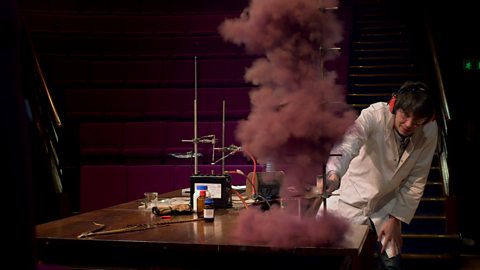
William Perkin and making scientific discoveries by chance. video
Brian Cox uses William Perkin's discovery of mauveine to explain how scientific discoveries are sometimes made by chance.
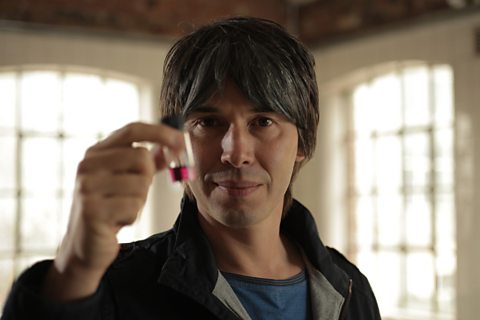
Targeted research. video
Brian Cox learns about targeted research in the modern pharmaceutical industry and how by focusing only on positive results, it fails to report negative results.
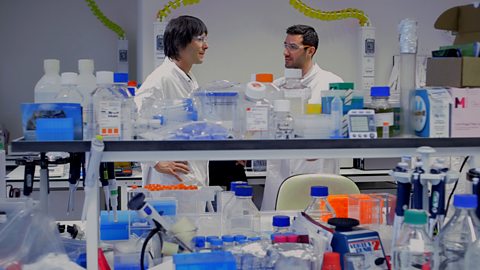
Global warming resistant GM crops. video
Brian Cox outlines the history of the discovery of DNA and how this has led to a controversy over the use of genetic modification in agriculture.