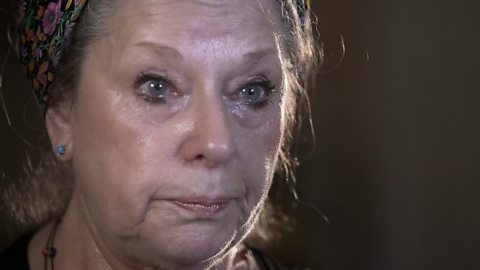
Ruth Rogoff:
I was born in Zwickau which is in Eastern Germany.
There’s quite a big mountain range which separates Germany from the Czech Republic, and these are called the Erzgeburge, the Copper Mountains.
My father took us all over the mountains leaving everything behind and went to Prague.
Hitler marched into Prague in March 1939.
My father realised he’s on a wanted list. So he left my mother and went to Poland.
It was extremely difficult for my Mother to be left alone with two small children.
Street by street, Jews were cleared and any moment it was probably our turn.
My mother she must have had a will of iron and great courage.
She went from one embassy to another, queued up all night.
And if she ever got to the desk, they said to her “We will take you, but we can’t take your two children”.
And my mother wouldn’t separate us. So she hung on to us.
The only thing she could think of was to hope somebody would take her and the children.
She was rejected by everyone.But then, the miracle happened.
A knock on the door meant death, because it meant deportation.
But for us a knock on the door was the beginning of a new life.
Because we opened the door to a woman from the British Embassywho had braved the curfew.
She brought the entry visa to Britain, train tickets to get through Germany, through Holland and a ferry to Ramsgate,
BUT she did not have an exit visa. You were supposed to have an exit visa to cross borders.
And she said “You’ll just have to say you’re going to see family in Holland and take nothing with you that could possibly show anyone that you’re going for more than a day.”
We made it through Czechoslovakia without any problem, and we got on the train in Germany.
Sat down, thinking “Good we’ve got a carriage to ourselves”, when an SS Officer came and sat next to her.
He was trying to chat her up. And he realised what was going on,and he couldn’t help us. And the fact that he sat there, now that might have been her salvation.
Off we went to the hook of Holland and got on a ferry to Ramsgate.
On the ferry, I kept saying “When are we going to be in England?” My mother got really fed up of me, she said “When it starts raining, you’ll know you’re in England.” So (laughs) as I was on the train, it began raining;and I must have been the only person there who was just totally thrilled, because I knew I was in England
The next morning was, Sunday, September the 3rd 1939.As we arrived to Liverpool Street Station, I put my foot on the platform,suddenly, everything went quiet and there was a huge announcement on the loudspeaker and everybody stood, perfectly still.
The announcement was, Chamberlain saying:
“I am speaking to you from the cabinet room at 10 Downing Street. This morning, the British Ambassador in Berlin handed the German Government a final note stating that unless we heard from them by 11 o’clock, that they were prepared at once to withdraw their troops from Poland, a state of war would exist between us. I have to tell you now, that no such undertaking has been received, and that consequently, this country is at war with Germany. “
That was 11 o’clock 3rd of September 1939, as my foot hit the platform. And that was the beginning of the Second World War.
Video summary
As a child, Ruth Rogoff escaped from Germany and arrived in Britain on the day that war started - 3 September 1939.
In this short film, she relates her childhood experiences and talks of her mother’s remarkable courage.
She begins by explaining how the German occupation of the Sudetenland led to her family fleeing Germany to the relative safety of Prague, Czechoslovakia.
She goes on to explain how Hitler’s annexation of Czechoslovakia and move into Prague in March 1939 led to her family being in danger once again.
Her father was a wanted man and escaped over the border, leaving Ruth, her brother and mother to fend for themselves.
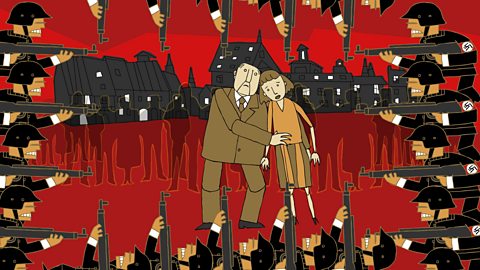
Like many of the 56,000 Jews in Prague under Nazi occupation, Ruth recounts how her mother went from embassy to embassy, seeking a way to leave. When she was told she could only leave without her children, she refused.
Finally, a ‘miracle’ clerk from the British embassy, breaking the night curfew, brought the family papers to travel to the UK – but they could take nothing with them and had to make it look as though they were only going on a day trip.
PLEASE NOTE: This short film contains disturbing scenes. Teacher review is recommended prior to use in class.
Teacher Notes
This short film could be used as an introduction to the start of the Second World War and lessons on home front Britain. How did job, roles and lives change?
Explore the evacuation of children and the role and contribution that foreigners brought to the British war effort.
This topic appears in history at KS3 and KS4 / GCSE in AQA, OCR A, OCR B, EDEXCEL, EDUQAS and WJEC GCSE in England and Wales,and CCEA GCSE in Northern Ireland.
It is also on the curriculum for 2nd, 3rd and 4th Level, National 4 and 5, and Higher in Scotland. It also appears in PSHE and PDE at KS3 and KS4.
Interview with Holocaust survivor Ruth Rogoff. video
Ruth Rogoff discusses her memories of the Holocaust and details the horrors of watching footage from concentration camp Bergen-Belsen at her local cinema.
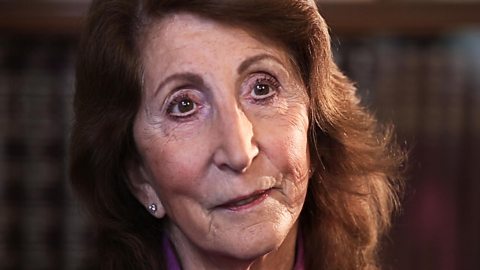
Arek’s Story - Survival in Auschwitz-Birkena. video
Arek Hersh recounts his experience as a prisoner, at the age of only 14, in the notorious death camp at Auschwitz-Birkenau.
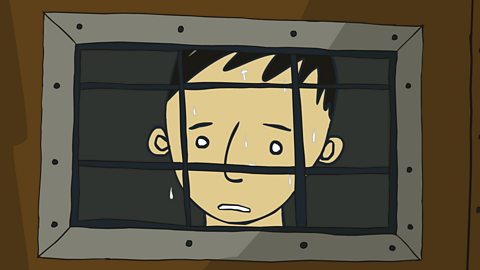
Interview with Holocaust survivor Arek Hersh. video
Arek Hersh, an 85-year-old concentration camp survivor expresses his anger for what the Nazis did to him. He talks about why it’s important for him to tell his story to others.
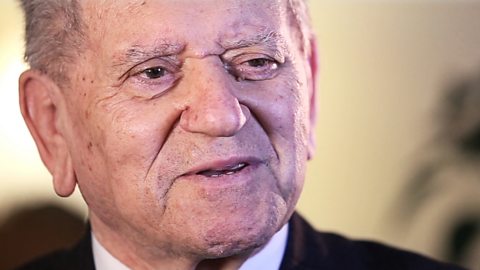
Heinz’s Story - Kristallnacht and escape to Britain. video
Holocaust survivor Heinz Skyte on life in Nazi Germany and his escape to Leeds in the UK.
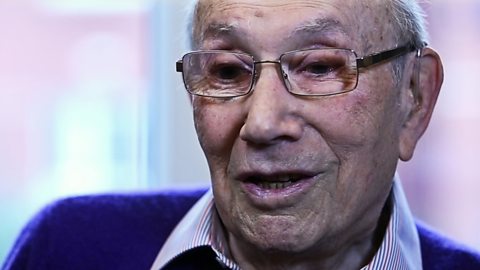
Interview with Holocaust survivor Heinz Skyte. video
Heinz, a Holocaust survivor, reflects on his childhood experiences in Nazi Germany.
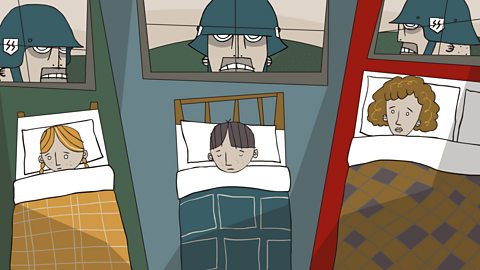
Martin's Story - Interrupted childhood experiences of a young Holocaust survivor. video
Martin Kapel, a survivor of the Nazi Polenaktion ("Poland Action") in October 1938, relates his childhood that included expulsion, escape and bombing.
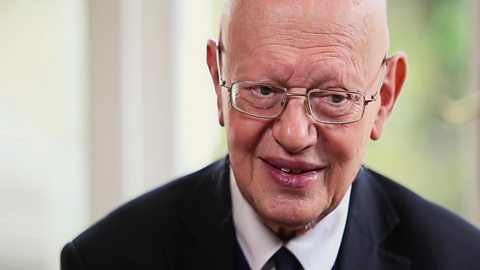
Interview with Holocaust survivor Martin Kapel. video
Martin Kapel came to the UK via the Kindertransport, following the Nazi Poland Action in October 1938. He reflects on the importance of studying history in order to learn from the past.
Trude’s Story - Escaping from Nazi occupied Czechoslovakia. video
In this animation, Trude Silman describes her experience as a young Jewish girl living in Nazi occupied Czechoslovakia, and escaping to Britain in 1939.

Interview with Holocaust survivor Trude Silman. video
Trude Silman, a Holocaust survivor who escaped to the UK, reflects on the impact of her experiences and how it has shaped her subsequent beliefs.
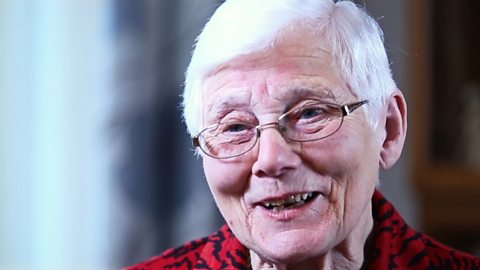
Suzanne’s Story - Hiding from the Nazis in occupied France. video
Suzanne Ripton’s story of living in hiding, as a Jewish child in Nazi-occupied France.
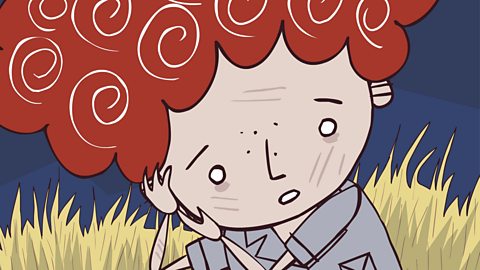
Interview with Holocaust survivor Suzanne Ripton. video
Suzanne Ripton, a Holocaust survivor who now lives in the UK, discusses the traumatic after effects of her experiences, her hatred of the Nazis and why we should remember the Holocaust.