Arek Hersh:
I was fourteen.
In the wagon was only a very small window.
It was hot. We were so cramped, we couldn’t even sit down.
Some people had some water, and some people didn’t.
After 2 days and 1 night. Through the wagon I could see SS Men with dogs, barbed wire, electric fences.
We’d arrived in Birkenau, Auschwitz.
And they said “Men on one side, Women and children on the other side”.
And we made two long queues. Mengele happened to be on the selection platform.He pointed the finger to the left or to the right.
I’d noticed a lot of people who were chosen to go to the right were fitter men.
To the left, children went, mothers with children, elderly men. I knew that’s not a good point with the Germans. You know if they don’t need you, then that’s it.
Then suddenly, they tried to take a child away from her mother,and she started screaming and the SS men run towards her.
As they run there I decided to go over to the right.I was very lucky. All the people which went to the left hand side went to the gas chambers.And they gassed them and then burned their bodies.
We walked into a place called the sauna, a brick built building in Birkenau, and were told to leave all our clothing on the floor.
And I had six photographs of my family.
And that’s the last I’ve ever had a photograph of my family.
I had my hair shaved off.
And from there we went in to the next room and we had our uniforms. Striped suits. It was big on me, so I put it up.
They didn’t give us any bath or shower.They soon started getting problems with lice.
Lice walked round all over us. Itchy, yes, very itchy. They live on your skin.
We were a thousand men in a barrack. Three bunks high, ten people on a bunk.
We slept on the boards. There was no straw, there was no covers. People snored, people moaned, people died next to you.
5.30 in the morning, they woke us up. And they allowed us to go to the washroom.
In the washroom there was about 5 buckets of water. And you just dipped your hands, washed your eyes and that was it.
I was very, just skin and bones, because they didn’t feed us.
They gave us small piece of bread in the morning, with some black coffee made of burnt wheat
And lunchtime we got some watery soup with a few leaves swimming round and that’s it.Live on that for months and years, going on, you’re just like a skeleton.
Your mind can’t think properly, your body is weak, you’re starving all the time. You think about food all the time. You can’t help but think about it.
In Auschwitz I’ve been tattooed, I’ve got a number B7608, on my left hand. It’s still there now. And I just can’t take it off.
I’ve lost 81 from my family.I’ve only found my sister, 2 years after the war.
How could I say how it changed me?I’ll never forget what I went through.
I suffered so much.It was the most horrific thing any human being should ever see.
The world should never see that again.
Video summary
Arek Hersh recounts his experience as a prisoner, at the age of only 14, in the notorious death camp at Auschwitz-Birkenau.
When he arrived at the concentration camp Auschwitz-Birkenau, 14 year old Arek describes how men and women were separated - men on one side and women with children on the other - known as ‘selection’. Arek quickly ran to the line with the men, recognising early that he had a better chance of survival.
The women and children were sent straight to the gas chambers and murdered on arrival. Tattooed with the number B7608, Arek had his only photographs of his family ripped away from him and he relates the constant battle against disease and lice experienced by the prisoners.
Arek discusses the cramped and squalid sleeping barracks where upwards of 1000 men were kept together in virtual starvation and how the constant hunger kept him thinking about food.
The war and the Holocaust destroyed 81 members of his immediate family and only his sister survived.
PLEASE NOTE: This short film contains disturbing scenes. Teacher review is recommended prior to use in class.
Teacher Notes
After watching this short film, pupils could discuss how people were dehumanized in camps such as Auschwitz-Birkenau.
You could discuss how Auschwitz has become a symbol of the Holocaust
This topic appears in history and PSHE / modern studies at KS3 and KS4 / GCSE in AQA, OCR A, OCR B, EDEXCEL, EDUQAS and WJEC GCSE in England and Wales, and CCEA GCSE in Northern Ireland and SQA National 4/5 in Scotland.
Interview with Holocaust survivor Arek Hersh. video
Arek Hersh, an 85-year-old concentration camp survivor expresses his anger for what the Nazis did to him. He talks about why it’s important for him to tell his story to others.
Heinz’s Story - Kristallnacht and escape to Britain. video
Holocaust survivor Heinz Skyte on life in Nazi Germany and his escape to Leeds in the UK.
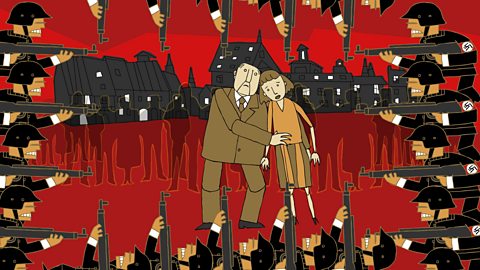
Interview with Holocaust survivor Heinz Skyte. video
Heinz, a Holocaust survivor, reflects on his childhood experiences in Nazi Germany.
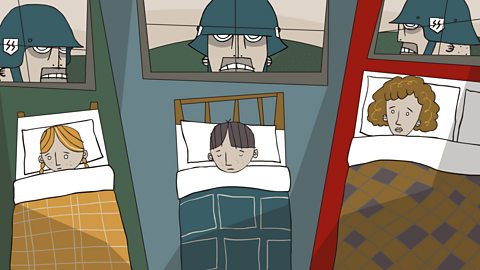
Martin's Story - Interrupted childhood experiences of a young Holocaust survivor. video
Martin Kapel, a survivor of the Nazi Polenaktion ("Poland Action") in October 1938, relates his childhood that included expulsion, escape and bombing.
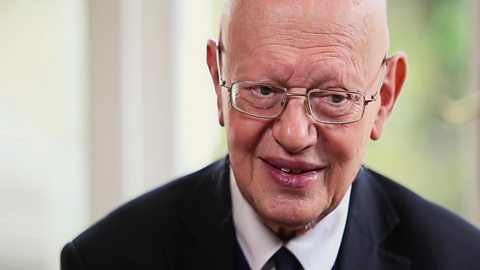
Interview with Holocaust survivor Martin Kapel. video
Martin Kapel came to the UK via the Kindertransport, following the Nazi Poland Action in October 1938. He reflects on the importance of studying history in order to learn from the past.
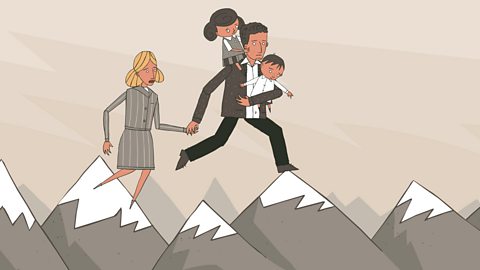
Ruth's Story - Escaping the Nazis as war began. video
Jewish girl Ruth Rogoff escaped from Germany and arrived in Britain on 3 September 1939. She relates her childhood experiences and talks of her mother’s remarkable courage.
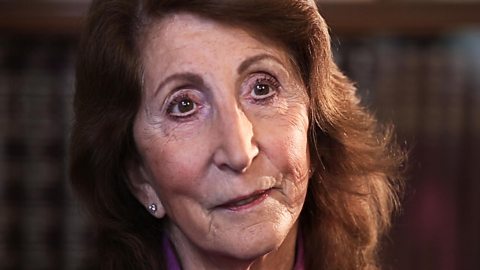
Interview with Holocaust survivor Ruth Rogoff. video
Ruth Rogoff discusses her memories of the Holocaust and details the horrors of watching footage from concentration camp Bergen-Belsen at her local cinema.
Trude’s Story - Escaping from Nazi occupied Czechoslovakia. video
In this animation, Trude Silman describes her experience as a young Jewish girl living in Nazi occupied Czechoslovakia, and escaping to Britain in 1939.

Interview with Holocaust survivor Trude Silman. video
Trude Silman, a Holocaust survivor who escaped to the UK, reflects on the impact of her experiences and how it has shaped her subsequent beliefs.
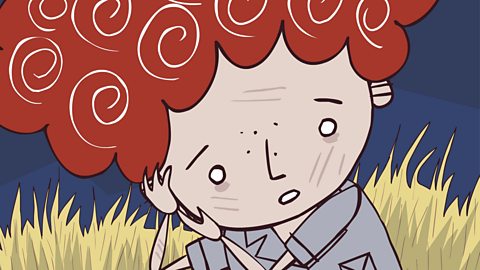
Suzanne’s Story - Hiding from the Nazis in occupied France. video
Suzanne Ripton’s story of living in hiding, as a Jewish child in Nazi-occupied France.
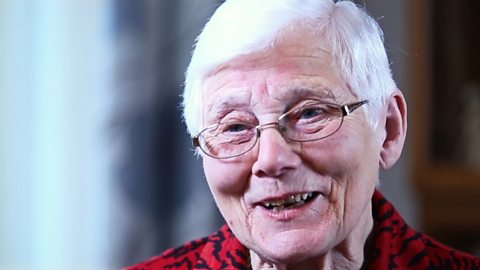
Interview with Holocaust survivor Suzanne Ripton. video
Suzanne Ripton, a Holocaust survivor who now lives in the UK, discusses the traumatic after effects of her experiences, her hatred of the Nazis and why we should remember the Holocaust.