The northern shore of the broad features patches of Broadland that represents a lot of the land use in this part of the world for the last few hundred years. If you take the path to the platform at the edge of the water, depending on the time of year you visit, you'll see a myriad of plantlife including the yellow flag iris. This used to be cut every July and sent off the best stables in London for use as horse litter. Reed and sedge were hugely important to the Norfolk economy and the examples at Whitlingham are representative of the reed beds that once covered parts of Broadland. 
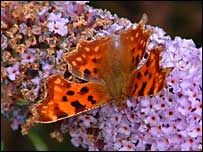
Swallowtail butterfly |
In the past, reed and sedge was a very important crop in Norfolk to thatch houses and other buildings - but with the decline in its use, this has meant the loss of a very important habitat for wildlife. Straight straw like reed was used to make up the main part of a roof and sedge, which is ribbon shaped and able to bend, straddled the ridge. Commercial reed beds are normally cut once a year in winter and two or three year rotations are common to increase the mix of plants in the fen. Sedge is cut in summer every three to four years. The Norfolk and Suffolk Broads are the largest protected area of wetland in Britain and levels of reed and sedge are maintained to provide an important wildlife habitat for the icon species of the area such as the bittern, Norfolk hawker dragonfly and swallowtail butterfly. Swallowtail butterfly The swallowtail is Britain's largest butterfly with a wingspan in the area of 80mm. Covered in a pattern of black marks and veins, the lower wings have a curved band of blue ending in a small red spot. It has distinctive long black tails projecting to the rear. The swallowtail is widespread in mainland Europe, but in Britain the species are now restricted to the marshlands of the Norfolk Broads. In years gone by, they used to common throughout the region's fenland. In addition to species of butterflies, the range of plantlife at Whitlingham Country Park helps to support the many other kinds of wildlife to be found in the area. This is the last stop on our nature tour around Whitlingham Great Broad. 
Walkers passing a bank of buddleia |
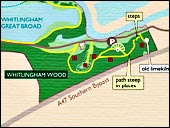
As you return to the main path, turn left and follow the pathway around the water's edge. After some distance you will reach a crossroads of paths. Turning right would lead you to the River Yare and the river bus platform. Turn left and follow the path between the Little and Great Broads. Where the path forks take the left hand fork, this brings you to a small grassy area where this is a bench if you need a rest. Once at the road turn left, then take the second right and you are back in the Great Broad car park. Picture credit: Swallowtail butterfly courtesy of Norfolk Wildlife Trust bbc.co.uk/norfolk would like to thank The Broads Authority, the Norfolk Wildlife Trust and the Norfolk Museums & Archaeology Service for their expertise and assistance in the production of the Whitlingham Country Park Walk Through Time. | 



 PREVIOUS




 Realplayer required