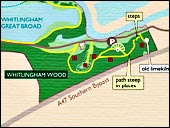
The conservation area is the fourth stop on our tour. It forms a horseshoe of water around a small wooded island. Boats are not allowed in this area in order to help protect the habitat. The water in this part of the broad is much shallower, this makes it ideal for waders and the wildfowl wanting to use the area. The area also includes a blank area of shingle, made up of flint and stone. This forms a small island that will hopefully encourage terns to come and breed in the future. You'll see a great deal of Greater Reed Base along the northern side of the broad, what a lot of people call Bullrush. Whatever you wish to call it, the reed provides excellent cover for a great deal of birdlife. You'll see coots, mallards and one of Britain's largest and heaviest birds, the mute swan. 
Egyptian goose |
Foreign visitors You can also find Egyptian and Canadian geese in the parkland. The Egyptian Goose (Alopochen aegyptagus) was introduced to Britain in the late 17th century to decorate the lakes and gardens of large estates. It's thought that more than three quarters of the feral population live in Norfolk, with the largest flock of nearly 200 birds at Holkham. This highly adaptable visitor has not spread across to other parts of the country, so visitors to Norfolk always find them a surprise resident to the county's birdlife. Found mainly around lakes and rivers, they are also known to roost and even nest in trees. Despite being a very attractive bird they are quite quarrelsome and are normally only seen in pairs. They are also known to drive off other geese and wildfowl, and will break other birds eggs. During the winter month you'll see a number of wildfowl on the Great Broad including teal. These are the smallest duck and, unlike most wildfowl, do not need to taxi to take off. After you've spotted some of the birdlife on the conservation island, make your way back to the main path and turn left. | 




 PREVIOUS




 Realplayer required