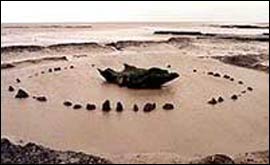
Scientists working with English Heritage were able to show that the wood for the ancient circle dated back to 2050 BC. It had sat unnoticed and undisturbed off the coast for almost 4,000 years. It's believed that Seahenge was used as a ceremonial site. The 55 posts, with an up-turned stump of an oak tree in the middle, were spotted on the beach at Holme when the peat dune covering them was swept away by winter storms. The excavation of Seahenge sparked opposition from some local people and druid groups. The timbers have been studied at the Bronze Age research centre at Flag Fen near Peterborough. When scientists used 3D laser scanning, they found the earliest metal tool marks on wood ever discovered in Britain. They have shown that tools used 4,000 years ago were far more advanced than what scientists had believed. Now that experts there have finished their investigations, there are plans to put Seahenge on display in the Lynn Museum in King's Lynn. Recommended reading
By Sheila McKeown, a librarian at the Millennium Library in Norwich. Awesome Archaeology, by Nick Arnold. Hippo 2001. ISBN 0439999081. An Ancient Land: Prehistory - Vikings. OUP 2001, ISBN 0199108285. You can get hold of these books through your local library. |
More A-Z: Go to Y» | 


































 View
View