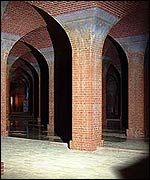
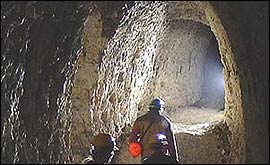
Dating back as far as the 13th or 14th centuries, Norwich's chalk mines were dug to exploit the rich deposits of chalk and flint that run from north west to south east across the county. The raw mineral was cooked in kilns, fired by charcoal, then coal and coke. Then, new chalk and fuel was added to the top of the kiln in layers. The end result - lime, was removed from the bottom. The lime was mixed with animal hair as a binding agent to form mortar for construction. It was also used on farmland, to improve the texture of the soil. The Lime dug in Norwich was sold in London with wherries carrying the mineral down the River Yare to Great Yarmouth. Underground reservoirs Norwich also has an underground reservoir - in Lakenham, between Hall Road and City Road. The reservoir was built by hand in 1871. It normally holds a million gallons of water but every five years it has to be emptied and cleaned - and when it is empty you can see just what an amazing structure it is. It is still in very good condition and the engineers say it should last another 130 years without too much difficulty. Underground bunkers Hidden away in the heart of the Norfolk Broads is a military base whose role used to be so secret, for many years it didn't feature on any map. 
People working in the bunker |
Today the Ministry of Defence is more open about the work done by the 500 staff at RAF Neatishead. In this underground bunker they work around the clock monitoring Britain's airspace. The station was set up to track enemy aircraft during the Second World War. Later in the Cold War it monitored Russian planes as they tested Britain's defences - if they came too close, fighter aircraft would be scrambled from nearby RAF Coltishall to chase them off. You can learn more about the bunker at the Radar Museum near Horning. Grimes Graves It was Neolithic miners who first dug flint out from the chalk at Grimes Graves, near Thetford, some 4000 years ago. Named after the Devil's holes of the pagan god Grim, the miners used the flint to make all kinds of blades, from scrapers to axes and spear-heads. Visitors can descend 10 metres (30 feet) by ladder into one of the 300 excavated shafts. Flint was also used with stone to create buildings. In the 14th century, it began to be used decoratively in architecture. The Guildhall in Norwich is an example of how flint was used for building work. Recommended reading
By Sheila McKeown, a librarian at the Millennium Library in Norwich. Deep Down Underground, by Robert Crowther. Walker Books 1998. ISBN 0744549450. What are Caves? by Claire Llewellyn. Heinemann 2001, ISBN 0431024405. You can get hold of these books through your local library. |
More A-Z: Go to V» | 



































 View
View