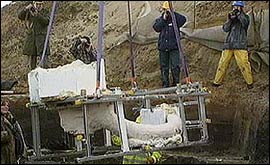
Cliff erosion at West Runton near Cromer had revealed a pelvis bone and a year later, more bones were found. It took two years to dig out just a quarter of the whole elephant. The rest was still buried beneath 20 metres of cliff, and a full excavation eventually took place in 1995. The giant elephant was an early type of mammoth - Mammuthus Trogontherii. It lived more than 600,000 years ago, stood about four metres at the shoulder, and at 10 tonnes would have been nearly twice the weight of a modern African elephant. 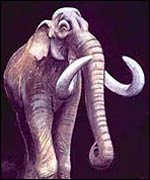
Artist's impression of elephant, courtesy of the Norfolk Museums Service |
The elephant is a very important find as it is the best example of its species in the world - it is very rare for scientists to find a fossil which is almost complete. It is also the biggest elephant skeleton found in Britain. The elephant skeleton is now in the hands of the Norfolk Museum and Archaeology Service. A team of up to 12 experts are doing research on the fossil, to try and recreate the conditions in which the animal lived. You will be able to see an exhibition about this extraordinary find at Cromer Museum in autumn 2004. Recommended reading
By Sheila McKeown, a librarian at the Millennium Library in Norwich. Prehistoric Animals, by Michael Bright. Aladdin/Watts 2001. ISBN 0749644109. Woolly Mammoth: Gone Forever! by Rupert Matthews. Heinemann 2003, ISBN 043116603x. You can get hold of these books through your local library. |
Read more:CBBC Newsround: Scientists discover dinosaur sick!»
More A-Z: Go to N»
| 



































 View
View