Summary

  1. Bangladesh Nationalist Party wins landslide majoritypublished at 13:35 GMT 13 February
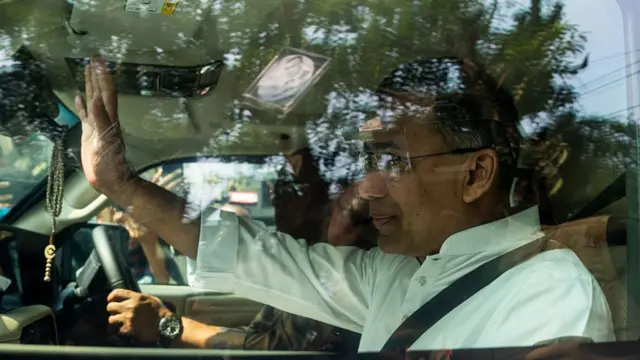
    Bangladesh Nationalist Party (BNP) chairman and election candidate Tarique Rahman (L) greets his supporters as he leaves his residence in Dhaka on February 13, 2026, a day after Bangladesh's general election.Image source, Getty Images

    The centre-right Bangladesh Nationalist Party (BNP) has won an overwhelming election victory, with its leader, Tarique Rahman, completing a stunning reversal of fortune after 17 years of self-imposed exile.

    We're now pausing our live coverage. If you'd like to read more on who Bangladesh's new leader is, our profile on Tarique Rahman has you covered. For the latest updates and reaction to the election, read our news story.

  2. Women share 'mixed feelings' about electionpublished at 12:57 GMT 13 February

    Women played a leading role in the student protests that preceded the mass uprising that toppled Sheikh Hasina's government in 2024.

    But despite their contribution, many female voters say they feel marginalised from politics. "They wanted to sideline us," Shima Akter, a 25-year-old student who helped lead protests, told the BBC before the vote.

    Rashna Mahzabin, who also took part in the uprising, told the BBC she had "mixed feelings" about the results.

    But after years of authoritarian rule under Hasina, Mahzabin says she is happy an election happened where people could "actually raise their voices".

    "That's a huge win," she says.

    Of the main parties, the BNP fielded 10 female candidates, the student-led National Citizen Party (NCP) just two and the Islamist Jamaat-e-Islami none.

    Initial results show 85 women ran in the election and seven have so far been elected to parliament, the newspaper Prothom Alo reported.

  3. A sweeping 'yes' to the referendum. What next?published at 11:42 GMT 13 February

    Soutik Biswas
    India Correspondent

    Voters also endorsed sweeping constitutional reform in a referendum held alongside the general election.

    Unlike most referendums - which typically conclude a long legislative process after broad parliamentary consensus - this vote sets a new one in motion.

    Historically, Bangladesh’s three previous referendums came during moments of political rupture: in 1977 and 1985 to legitimise military rulers, and in 1991 to restore parliamentary democracy.

    This latest vote, more than three decades on, again follows upheaval - but centres on constitutional reform rather than regime endorsement.

    With the “Yes” camp prevailing, the process now moves to implementation: translating the July Charter’s provisions into constitutional amendments, legal changes and institutional restructuring.

    The referendum gives political legitimacy to the reform package. But its durability will depend on how transparently and inclusively the next steps are carried out.

  4. Modi calls Rahman, congratulating him on 'remarkable victory'published at 11:30 GMT 13 February

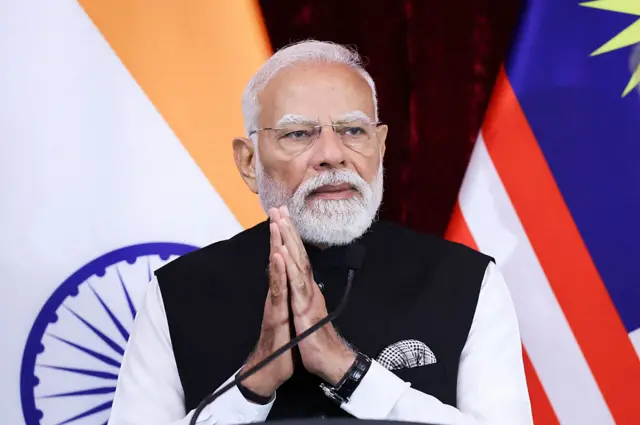
    A close up shot of Indian Prime Minister Narendra Modi with his hands clasped togetherImage source, Getty Images

    Indian Prime Minister Narendra Modi has spoken on the phone with Bangladesh Nationalist Party leader, Tarique Rahman, who is set to become prime minister.

    Modi says he called Rahman to congratulate him on "the remarkable victory in the Bangladesh elections".

    Modi says he "reaffirmed India's continued commitment to the peace, progress, and prosperity" of those in Bangladesh and India.

    His remarks come following a period of souring relations between the two countries, as ousted prime minister Sheikh Hasina lives in exile in India.

  5. The issues weighing on Bangladesh's economypublished at 11:16 GMT 13 February

    Osmond Chia
    Business reporter

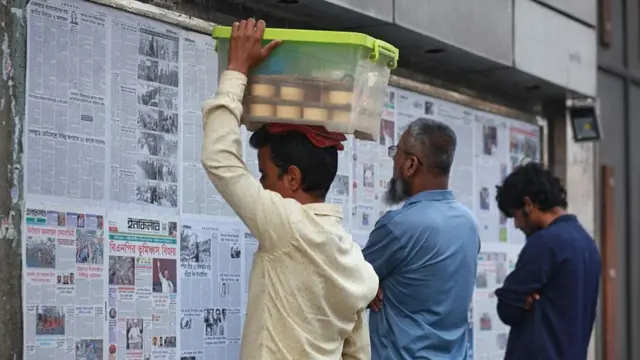
    Three men look at newspaper pages posted on a wallImage source, Getty Images

    Bangladesh's elected party will face a host of economic issues which have plagued the country after protests and political turmoil.

    Fast fashion manufacturing has helped Bangladesh become one of the fastest growing economies in the world, but outside of factory jobs that has not translated into more work for its aspiring youths - many of whom are disillusioned with a lack of higher-skilled work opportunities.

    Households, too, are feeling the strain, faced with rising costs of living and persistent inflation.

    Meanwhile, slow growth in private businesses, high debt and a weakened currency are holding Dhaka’s economy back from recovery, fuelling pessimism.

    The new leaders will have to win over investors, many of whom have been shaken after years of political uncertainty.

  6. An election of many firstspublished at 11:02 GMT 13 February

    Mir Sabbir
    Editor, BBC News Bangla

    This election, the first since the mass uprising of 2024, is significant in many ways.

    Both leaders of the two main parties, the BNP and Jamaat-e-Islami, competed for the prime minister's office for the first time.

    It is also the first time Jamaat-e-Islami has emerged as a major contender in the national election. This has largely been made possible because the Awami League, one of the country's biggest parties, has been banned from politics – the party's first-ever absence from a national election.

    This is also the first election since 1991 - when Bangladesh returned to parliamentary democracy - that's held without former Prime Ministers Khaleda Zia and Sheikh Hasina.

  7. Clear election result a positive start for garment industrypublished at 10:40 GMT 13 February

    Archana Shukla
    India business correspondent

    Bangladesh’s garment industry is pinning its hopes on the new BNP-led government to restore stability, curb corruption and fix law and order - long seen as roadblocks to fresh investment.

    Industry leaders I have been speaking with say a clear election outcome is a positive start. Fazlee Shamim Ehsan, vice president of the knitwear exporters’ body told BBC that he’s happy that a credible election was held and believes a single-party majority could finally deliver the stability businesses need.

    The garment industry is the backbone of Bangladesh economy, generating more than 80% of export earnings. From supplying to nearly all global brands like Gap and Zara, the garment factories underpin a roughly $55bn industry.

    But in recent months exports slowed - first owing to the political upheaval and then high tariffs in the US, which is a key market. Exporters say many buyers have been holding back orders, leading to losses for the factory floors.

    Shehab Udduza Chowdhury of the Bangladesh Garment Manufacturers and Exporters Association said the country has been waiting for an elected, democratic government to lift investor confidence and global order flows.

    “The business community wants more than just promises, we want guarantees, partnership, and a clear vision,” said Mohiuddin Rubel, additional managing director of Denim Expert Ltd, a supplier to H&M.

    He’s optimistic though that the new leadership will understand what businesses and supply chains need to make Bangladesh more competitive in the global market.

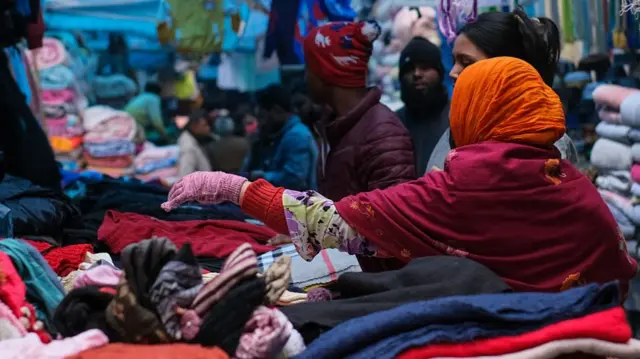
    Shoppers browse through stacks of garments at a market in BangladeshImage source, Getty Images
  8. 'The rich get richer, the poor get poorer'published at 10:21 GMT 13 February

    BBC Newsbeat
    Mollie Perella

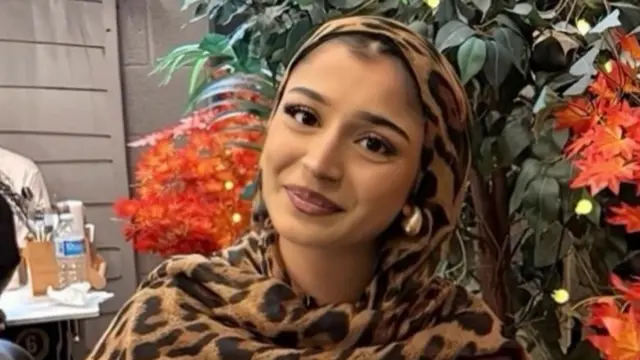
    For Londoner Hafsa Yasmin, who has family in Bangladesh, the student-led protests that led to Sheikh Hasina being ousted were a sign of young people making their voices heard.

    "You know that saying that says the rich get richer, the poor get poorer, I felt like Hasina was pushing for that motto and equity matters no matter where you are," the 21-year-old tells BBC Newsbeat.

    "I think young people in Bangladesh were responding to that principle."

    With Sheikh Hasina in power for 15-years, some believe this was the first genuine chance to vote for people under 33.

    "Young people want a voice in shaping their future," says Hafsa.

    Close up shot of young woman
    Image caption,

    Hafsa Yasmin

  9. Rahman greets supporters on his way to Friday prayerspublished at 10:07 GMT 13 February

    As we've been reporting, Tarique Rahman is on track to become Bangladesh's new PM, as his centre-right party won the majority of seats in the parliamentary election.

    Rahman returned to the country late last year, after 17 years in exile, ahead of these landmark general elections.

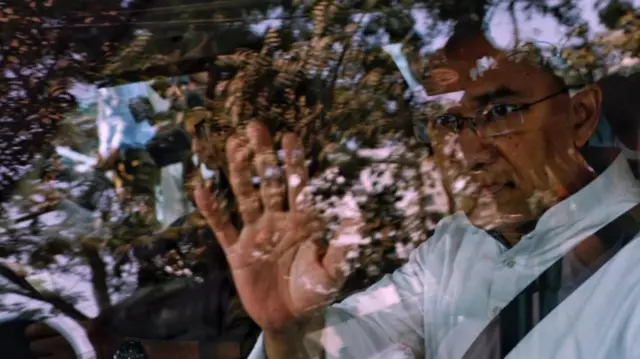
    We now have pictures of Rahman greeting his supporters on his way to Friday prayers in Dhaka.

    Tarique Rahman, chairman of Bangladesh Nationalist Party (BNP), waves from a car on his way to the mosque to attend Friday prayer, as results project BNP's victory in the 13th general election, in Dhaka, Bangladesh, February 13, 2026.Image source, Reuters
    Tarique Rahman, chairman of Bangladesh Nationalist Party (BNP), in a car on his way to the mosque to attend Friday prayer, as results project BNP's victory in the 13th general election, in Dhaka, Bangladesh, February 13, 2026.Image source, Reuters
  10. Garment sector looks to new leadership after tariff pain and unrestpublished at 09:40 GMT 13 February

    Suranjana Tewari
    Asia Business Correspondent

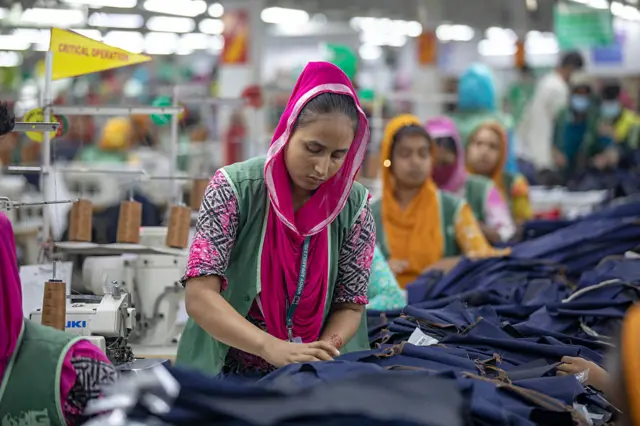
    Some of the world’s best-known brands make their clothes in Bangladesh. But the industry is in crisis, after six straight months of falling exports driven by US tariffs and domestic political unrest.

    Textiles are the country’s economic lifeblood, accounting for more than 10% of GDP and employing nearly four million people - most of them women.

    Industry leaders say a recent US trade deal offers some relief and potential opportunities, but warn that key details still need to be worked out.

    In the meantime, they are pinning their hopes on the new government to restore stability, implement a workable wage framework, revive the banking sector and rein in energy costs.

    Politicians from both major parties have also promised to reduce the economy’s heavy reliance on garments and to diversify into other industries.

    A readymade garments worker works in a green factory in Tongi, BangladeshImage source, Getty Images
  11. A rundown of where things standpublished at 09:24 GMT 13 February

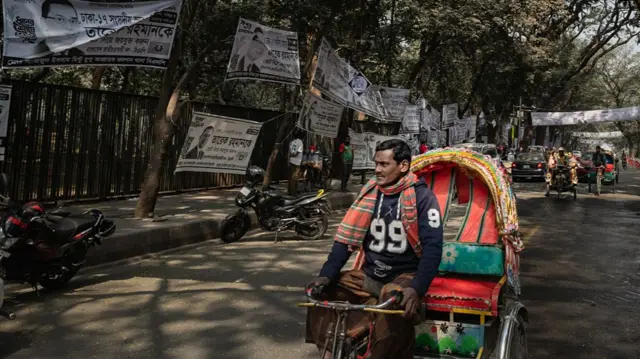
    Man driving motorbike past election campaign posters in BangladeshImage source, Getty Images

    Vote counting is nearly done in Bangladesh's first election since student-led protests in 2024 ended the 15-year-old rule of its autocratic leader Sheikh Hasina. If you are just joining us, let's get you up to speed on what we've been covering:

    • The Bangladesh Nationalist Party, or BNP, has secured more than a two-thirds majority, which marks a dramatic turnaround for its leader Tarique Rahman, who is on track to become the next prime minister
    • Rahman, 60, had just returned to Bangladesh after 17 years of self-exile in London. He had been convicted for various charges under Sheikh Hasina's rule, which he says were politically motivated
    • Rahman is the son of three-time PM Khaleda Zia and former president Ziaur Rahman
    • With Hasina's Awami League banned from this election, Bangladesh's largest Muslim party Jamaat-e-Islami has emerged as a formidable contender. Jamaat and its allies have secured 78 seats so far, its strongest showing among all past elections it had contested in
    • Jamaat, which had allied with the youth-centered National Citizen Party that played a major role in the 2024 uprising, has questioned the vote-counting process, pointing to "repeated inconsistencies and fabrications in unofficial result announcements"
    • Members and supporters of Awami League had called for a boycott of the vote, saying it cannot be free and fair when the party is banned from contesting

    We're not far from getting the final results now. Stay with us as we bring you the latest.

  12. An incredible turn of events for Tarique Rahmanpublished at 09:16 GMT 13 February

    The BBC's Yogita Limaye reports from outside the office of the BNP's Tarique Rahman in Dhaka.

    Bangladesh's next leader, has urged supporters to go to Friday prayers instead of celebrating his party's landslide election victory.

    Media caption,

    What do we know about Bangladesh's next prime minister, Tarique Rahman?

  13. The man set to become Bangladesh's next PMpublished at 09:02 GMT 13 February

    Tarique RahmanImage source, NurPhoto via Getty Images

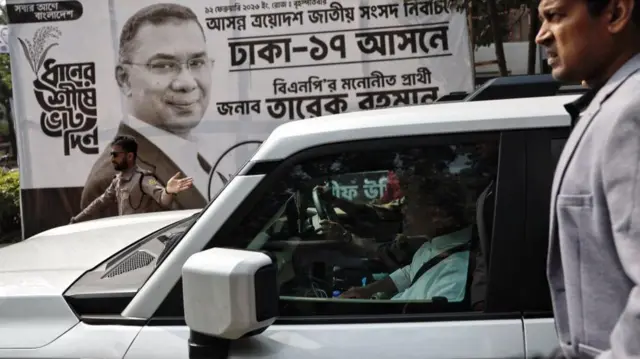
    Tarique Rahman is on course to become the new prime minister of Bangladesh after his centre-right Bangladesh Nationalist Party (BNP) won enough seats to secure a majority in the general election.

    Rahman, 60, is the figurehead of the influential Zia family, who have dominated politics in the country for decades. Both of his parents previously served as leaders of Bangladesh.

    Yet it has been far from a smooth path to the top for Rahman, whose career has been dogged by allegations of nepotism and corruption by political rivals, as well as a period of exile and his father's assassination.

    His eventual ascent to chairman of the BNP came just weeks before Bangladesh headed to the polls, following the death of his mother, the country's first female prime minister Khaleda Zia.

    Read more here about Tarique Rahman.

  14. BBC Verify

    BBC Verify reporting on the spread of disinformationpublished at 08:50 GMT 13 February

    Bangladesh is nearly done counting votes in the country's first election since student-led protests ousted Prime Minister Sheikh Hasina in 2024.

    BBC Verify’s Shruti Menon is in the capital Dhaka and has been tracking election-related disinformation, AI fakes and false claims across social media in the country.

    Media caption,

    BBC Verify reporting on the spread of disinformation around Bangladesh's election

  15. ‘People just want some peace’published at 08:37 GMT 13 February

    BBC Newsbeat
    Mollie Perella

    BBC Newsbeat has been speaking to young Bangladeshis about what the election means to them.

    Sazia Mahmud, who lives in the capital Dhaka, describes the political landscape over the last year as a "rollercoaster".

    Since student-led protests ousted Sheikh Hasina in 2024, Nobel Peace Prize laureate Muhammad Yunus has served as the country's interim leader.

    "When the interim government started, I felt he could have done a little bit more," the 27-year-old says.

    Sazia says this election's result will be about securing a calmer political future.

    "People don’t want dirty politics they just want some peace," she says.

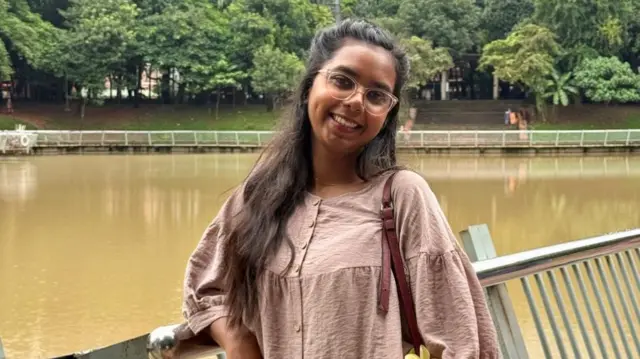
    Young woman standing on a pedestrian bridge over a river
    Image caption,

    Sazia Mahmud

  16. What has the BNP promised on the economy?published at 08:19 GMT 13 February

    Suranjana Tewari
    Asia Business Correspondent

    In its 2026 manifesto, the Bangladesh Nationalist Party (BNP) said it wants to turn Bangladesh into a $1tn economy by 2034.

    The party said it will try to grow the economy through more investment and reforms. Its plans included attracting more foreign investors, supporting small and medium-sized businesses, as well as startups.

    BNP leaders have also talked about upskilling workers, selling more products abroad besides garments, and improving roads, ports and transport to make it easier to move goods.

    The manifesto proposes “Farmer Cards” to help guarantee fair crop prices and provide subsidies, easier loans, insurance and marketing support in the agriculture sector.

    For poorer families, it proposes “Family Cards”, which would give cash or basic goods to help with daily living costs.

    The party also says government needs major reform, promising to fight corruption, strengthen the courts, and change how the civil service and police function.

  17. BNP asks supporters to 'refrain from victory processions'published at 08:09 GMT 13 February

    The BNP has, again, called on its leaders and supporters to "refrain from victory processions or public celebrations".

    "Instead, we call upon the nation to observe a day of prayers today (13 February), seeking peace, stability, and guidance for the future of Bangladesh," the party says in an X post.

  18. Analysis

    What does this result mean for the Awami League?published at 08:04 GMT 13 February

    Azadeh Moshiri
    Reporting from Dhaka

    Even before the polls opened yesterday, the Awami League had claimed these are not free and fair elections, and from hiding, casting doubt on its legitimacy. Now, its arch rival the BNP has been declared the winner.

    The Awami League has been suspended from political activities, including contesting the elections, under an anti-terrorism law.

    Would a BNP government reverse that ban?

    When I spoke to BNP senior politician Amir Khasru Mahmud Chowdhury on the campaign trail, he said the BNP "has never asked for banning any political party”.

    But, Khasru also questioned whether the Awami League could still be considered a political party, after its brutal crackdown on student protesters, and years of increasingly authoritarian rule. It’s up to “the law of the country” to decide whether the Awami League is guilty of terrorism, he said.

    When we spoke to one of their politicians in hiding, who asked his identity be kept anonymous for his safety, he said the allegations against them were “false” and “fabricated.”

    No matter the BNP’s decision, a major challenge for them is how to unite a country that includes Awami League supporters who feel disenfranchised and cast aside.

  19. Sombre mood outside Jamaat's HQ in Dhakapublished at 07:17 GMT 13 February

    BBC News Bangla
    Reporting from Dhaka

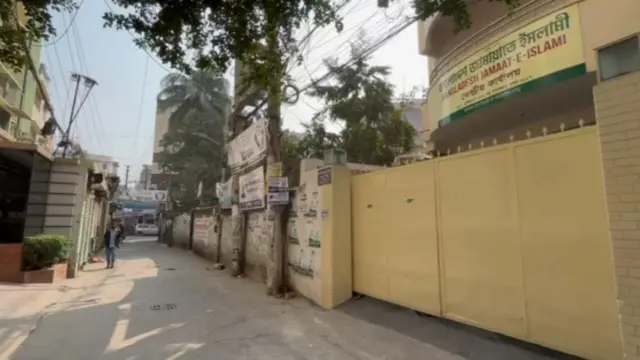
    Jamaat's central office in MoghbazarImage source, BBC Bangla

    The mood at Jamaat-e-Islami's headquarters now cannot be more different than it was yesterday.

    Jamaat leaders and activists had been there until midnight on Friday, and had repeatedly said they were going to form the government.

    But now that the BNP has won the election and are going to form the government, it is all quiet and sombre outside Jamaat's office in the Dhaka neighbourhood of Moghbazar. We saw a few Jamaat activists and journalists this morning, but the atmosphere was all very raw.

    Although Jamaat failed to fulfill its goal of forming the next government, it is on track to deliver its strongest showing among all the elections it has participated in so far.

    The party is expected to address the public after afternoon prayers today.

  20. Official results: BNP crosses two-thirds majority with 204 seatspublished at 07:12 GMT 13 February

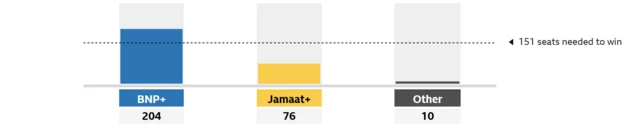
    The BNP has surpassed the two-thirds majority with 204 seats, and its main rival Jamaat-e-Islami has secured 76 seats.

    Bangladesh electionsImage source, BBC Bangla