Summary

  • Polls have closed in Bangladesh's first election since student-led protests in 2024 ended the 15-year rule of its increasingly autocratic leader, Sheikh Hasina

  • People were voting for a new government and also taking part in a referendum to change the constitution

  • No official results are expected until Friday

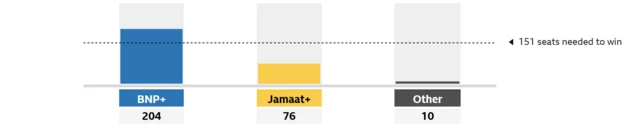
  • The two frontrunners are the Bangladesh Nationalist Party (BNP) and the Islamist party Jamaat-e-Islami, which has joined forces with a party born out of the student uprising

  • As many as 1,400 protesters were killed during the uprising - with Hasina accused of having directly ordered the crackdown, an allegation she denies

  • Hasina's party, the Awami League, was banned from contesting this election

  • An interim government, led by Nobel Peace Price laureate Muhammad Yunus, has led Bangladesh since Hasina fled

  1. Bangladeshis await results of election and referendumpublished at 10:58 GMT

    A woman votes in a designated area during the 13th general election in Dhaka, Bangladesh,Image source, Reuters

    Voting in Bangladesh's election has now ended and we are pausing our live coverage.

    This is the first election since a youth-led movement dramatically ousted former Prime Minister Sheikh Hasina last year, bringing an end to 15 years of increasingly authoritarian rule. Her Awami League party has been barred from politics, including taking part in the election.

    As well as voting for a new leader, Bangladeshis are also casting their ballot on whether to approve sweeping constitutional reforms.

    More than 120 million people in the country are eligible to vote, including a large number of youth, and many are hopeful that today's election will usher in a new era of representative governance for Bangladesh.

    It is not yet known what the final voter turnout has been but the Election Commission said it was 32.88% at midday local time (06:00 GMT).

    We will be back to bring you the results, including who will be the next prime minister, as well as analysis of what it means for the country.

  2. Challenges lie ahead for next governing partypublished at 10:43 GMT

    Mir Sabbir
    Editor, BBC News Bangla

    Because the last three elections were controversial and did not include all parties, it is difficult to judge the true level of voter support for each of the two main parties.

    The new government in post-uprising Bangladesh will have to restore law and order or lead in economic recovery. It will also have to determine the country's direction in a changed geopolitical world.

    Furthermore, the new leadership will be tasked with implementing the state and social reforms that the people have repeatedly demanded.

    Whichever party wins, this is an election of many firsts - and it heralds new experiences ahead for Bangladesh.

  3. Voting closes in landmark electionpublished at 10:33 GMT

    A woman casts her vote at a polling station while a child looks on, during the 13th general election in Dhaka, Bangladesh,Image source, Reuters

    It has just gone 16:30 in Bangladesh (and 10:30 here in London), which means that voting is now closed in the election.

    As well as choosing a new leader, people have been choosing whether to approve constitutional reforms - the first time in the country's history that the two votes have been held at the same time.

    We are not expecting to get any official results for either until Friday.

  4. Voting going 'fairly peacefully', says Jamaat-e-Islami leaderpublished at 10:23 GMT

    Shafiqur Rahman, Jamaat-e-Islami Ameer (President), votes inside a polling station during the national election in DhakaImage source, Reuters

    The head of Jamaat-e-Islami, Shafiqur Rahman, says he thinks that, overall, voting is going on "fairly peacefully".

    He believes that the voter turnout in the election up to 13:00 local time (07:00 GMT) was slightly less than previous elections which included the participation of all parties.

    According to the Electoral Commission, voter turnout at 12:00 local time was 32.88%. Polls close at 16:30 local time.

    Rahman says he is optimistic that voter turnout will increase as the day progress.

  5. Student who took part in uprising 'hoping for great things'published at 10:16 GMT

    Azadeh Moshiri
    Reporting from Dhaka

    A man wearing classes and a green sweatshirt gives a thumbs up

    Tawsif Rahman Khan was part of the student uprising that overthrew years of authoritarian rule under Sheikh Hasina last year.

    At the time, he tells us, he never thought he’d see this day. Now a 25-year-old graduate, he says it’s the first time he’s voting.

    "There wasn’t any point before, it was a one party system," Tawsif says.

    He adds that when he entered the polling booth, he had one thing on his mind: "More rights than before... I’m hoping for great things to happen."

  6. What do voters care about?published at 10:01 GMT

    BBC World Service

    Porter in the Kawran Bazar vegetables and fruits morning market in DhakaImage source, Getty Images

    Although everyday concerns such as rising prices, jobs, corruption, and law and order dominate, the bigger question for many voters is whether the new government can deliver on political reforms and ensure a democratic process.

    For years, the country has seen political violence, including brutal crackdowns, mass arrests and forced disappearances.

    There's growing demand for accountability for abuses under previous governments.

    Corruption is another major issue, especially in public office.

    Bangladesh routinely finds itself among the world’s most corrupt countries on various indices. The two front-running parties, the Bangladesh Nationalist Party (BNP) and Jamaat-e-Islami, have put tackling corruption high on their agenda.

    With more than 40% of the eligible electorate between the ages of 18 and 37, physical safety and employment is also high on the list of expectations.

    In a November 2025 press release, the World Bank said that poverty in Bangladesh has increased and there are fewer jobs, especially for women.

  7. 'No way' this election is free and fair - Awami League leaderpublished at 09:46 GMT

    Azadeh Moshiri
    Reporting from Dhaka

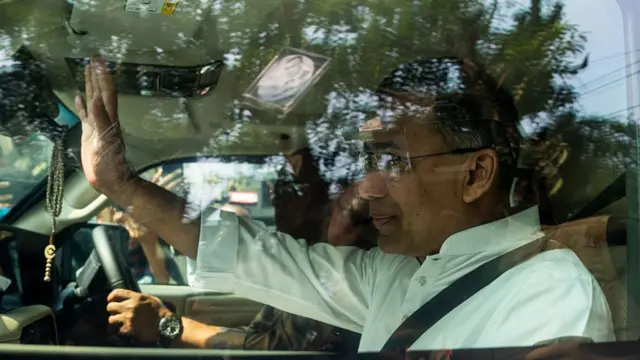
    The party leader requested to stay anonymous for his safety
    Image caption,

    The party leader requested to stay anonymous for his safety

    Today, the leader of the interim government Muhammad Yunus will attemp to deliver on his biggest promise: free and fair elections.

    But the Awami League argues that is not happening. The once-dominant party has been banned from politics following the deadly protests which unseated it in 2024.

    We travelled to a remote location to meet an Awami League politician in hiding.

    "[By] excluding the Awami League, a free and fair election is in no way possible," he told us.

    A group of US lawmakers raised similar concerns, writing in a letter to Bangladesh authorities that free and fair elections “cannot happen if the government suspends activities of political parties”.

    Authorities tell the BBC the ban on Awami League was a decision handed down by the courts under an "anti-terrorism" law.

    Some party leaders are facing trials in Bangladesh’s International Crimes Tribunal for their role in the crackdown during the uprising, among other alleged crimes. The party has dismissed these charges as “false” and “fabricated”.

  8. Tight security as fears of political violence cast shadow over electionpublished at 09:30 GMT

    Police officers patrol on horses

    Elections in Bangladesh have often been marred by violence - but security has been especially tight around this year's vote.

    Nearly a million security personnel have been deployed across the country to maintain security until 14 February. We've also seen armed officials standing guard outside polling stations and police personnel patrolling the streets on horses.

    It comes after a spate of recent political violence

    Last December, youth leader Sharif Osman Hadi, was shot by masked attackers in Dhaka and died of his injuries days later. His death sparked protests, which saw the offices of major news outlets torched and vandalised.

    Hadi, 32, was a well-known figure in the youth-led protests that ousted Sheikh Hasina in 2024. Hasina's government launched a brutal crackdown on the protests, killing some 1,400 people, according to UN estimates.

    A crowd gathers, with a large banner of Hadi propped up in the back.Image source, Getty Images
  9. Fake news and disinformation dominate election campaignpublished at 09:16 GMT

    Anbarasan Ethirajan
    Global Affairs Reporter

    A colleague jokingly said to me that “Bangladeshis live and breathe on Facebook”.

    And indeed, it is one of several social media platforms that are widely used in the country, particularly among young people. That’s why political parties have been so active on social media.

    But one of the most striking aspects of this election has been the use of AI and deepfake videos.

    “Some have tried to discredit rival politicians through fabricated quotes, distorted videos or invented scandals,” Tohidul Islam Raso, a research officer for Dhaka-based fact-checking group Dismislab, tells the BBC.

    Fact checking groups say dozens of false claims have been made against party leaders, including fake videos suggesting candidates had withdrawn from the election or expressed support for rival candidates.

  10. I was here in 2018 - the air feels different nowpublished at 08:56 GMT

    Yogita Limaye
    Reporting from Dhaka

    I remember being in Bangladesh during an election in 2018 when Sheikh Hasina was in power. The atmosphere was very different from what it is now.

    Driving around Dhaka and other parts of Bangladesh back then, I remember seeing polling agents, campaign material and posters from just one party: Sheikh Hasina’s Awami League.

    There was a restrictive atmosphere. People were scared to speak openly when we tried talking to them.

    Now, the air feels different. There is palpable excitement among many of the voters we have spoken to. You see posters from different political parties.

    Of course, the Awami League is banned from this election, and that casts a shadow on whether this vote is truly free and fair. In Gopalganj, an Awami League stronghold, our colleague told us polling booths were more or less empty this morning.

    At polling booths in Dhaka, however, we have seen many cast their votes within the first hour - and some of the voters we have spoken to say they hope there will be true democracy in this country after today's election.

  11. Thumbs up from smiling voters in Dhakapublished at 08:40 GMT

    A man holds up a phone while a group of women smile behind himImage source, Tarekuzzaman Shimul/BBC Bangla

    There are some happy faces on the streets of the capital, Dhaka, as voting continues in the election.

    These young people, whose thumbs are marked with ink to show they have voted, are among more than 120 million in the country who are eligible to vote.

    Many will be under the age of 33 and will have never had a genuine chance to vote before, as one academic told the BBC.

    Police officers are also on the streets to ensure that voting goes ahead peacefully.

    Two women pose with their thumbs up for a selfieImage source, Tarekuzzaman Shimul/BBC Bangla
    Two police officers on the street look at the cameraImage source, Tarekuzzaman Shimul/BBC Bangla
  12. 'Where are the women?' asks student leader in 2024 protestspublished at 08:25 GMT

    Azadeh Moshiri
    Reporting from Dhaka

    Shima Akhter

    Shima Akhter joined demonstrations in 2024 to protest against new quotas in civil service jobs.

    The 25-year-old music student would belt out renditions of "We shall overcome”, the anthem of the American Civil Rights Movement, to rally fellow protesters.

    Women like her played a leading role in the 2024 uprising. Bangladesh has also had two female prime ministers, who dominated politics for decades here.

    Yet just 4% of the candidates on the ballot this election – 83 out of 2,015 – are women.

    "Where are the women?” Shima asks, adding that it has "felt impossible" to get involved.

    Both major parties deny sidelining women, instead claiming the number of those standing is a result of Bangladesh's "social structure".

    Shima dismisses that as “just a patriarchal excuse".

  13. A quick recap for those just joining uspublished at 08:06 GMT

    It's early afternoon in the Bangladeshi capital of Dhaka, and polls have now been open for seven hours.

    For those just joining, here's a quick recap to get you up to speed:

    • More than 120 million people across Bangladesh are casting their votes in the country's first election since a youth-led movement dramatically ousted former Prime Minister Sheikh Hasina
    • Main contenders are the centre-right Bangladesh Nationalist Party (BNP) - considered the front-runner - and Jamaat-e-Islami, Bangladesh's largest Muslim party, once barred from elections
    • The Awami League, Sheikh Hasina's former party and a mainstay of Bangladeshi politics for decades, has been banned from competing, stoking criticisms that these elections are neither fair nor free
    • Hasina remains in self-imposed exile in India, having been sentenced to death for crimes against humanity over her crackdown on protesters
    • Security is at an unprecedented high, with almost a million security personnel deployed across the country amid fears of violence - though voters on the ground seem buoyed more by hope than fury
    • It's not only Bangladesh's future leadership that's at stake: voters are also being asked to have their say in a national referendum, covering a broad package of proposed reforms

    Stay with us as we bring you more analysis and updates from the ground.

  14. Why many voters are confused about the referendumpublished at 07:32 GMT

    Soutik Biswas
    India Correspondent

    For all its ambition, the referendum on which Bangladesh will be voting today remains shrouded in uncertainty.

    Will two ballots on a single day confuse rural voters? Could uncertainty translate into indifference - or simply lower participation?

    Shafqat Munir of the Bangladesh Institute of Peace and Security Studies (BIPSS) think tankbelieves the risks are real.

    “The process could have been executed much better,” he told me.

    Many voters remain unsure about the mechanics, what exactly is being proposed and how the reforms would work.

    History, however, illustrates the challenges of separating the votes. The last referendum, in 1991 - when Bangladesh shifted from a presidential to a parliamentary system - was held separately and drew only about 35% turnout.

    A view of the Bangladesh National Parliament House at Sher-e-Bangla Nagar in Dhaka, Bangladesh, on February 9, 2026. Political parties across the country officially begin their campaigns on January 22 for the 13th parliamentary election. The national election and a referendum on the proposed July National Charter constitutional reforms are set for February 12, 2026. (Photo by Mamunur Rashid/NurPhoto via Getty Images)Image source, NurPhoto via Getty Images
  15. What is the July Charter referendum and why does it matter?published at 07:14 GMT

    The July Charter is a set of 84 reforms suggested by the interim government.

    It lays out the framework for how Bangladesh will be governed in the future - aiming to reduce concentrated power in the executive, strengthen checks and balances, and prevent the kind of political dominance that has shaped the country in recent decades.

    The charter spells out the role of Bangladesh's institutions, suggests the creation of a parliament with an upper and lower house and lists out the reforms that a new government must carry out.

    A 'yes' vote would see the new parliament legally bound to implement it in full. If the 'no' vote wins, reforms will be entirely dependent on the will of the majority party.

  16. An 'unprecedented' second votepublished at 06:53 GMT

    Soutik Biswas
    India Correspondent

    Two ballots, one day: one to elect an MP, the other to approve sweeping constitutional reforms. That alone makes this election unusual in Bangladesh’s history.

    Ali Riaz, the US-based academic who advised Muhammad Yunus’s interim government on the referendum, calls the simultaneous holding of a parliamentary vote and a constitutional plebiscite “unprecedented” - particularly given the scale of the proposed changes.

    While other democracies sometimes pair elections with referendums, Bangladesh has never combined a national poll with such fundamental institutional redesign.

    The decision, Riaz told me, was driven by constraints. The interim government wanted elections completed by February; any delay would run into Ramadan and the monsoon. Political parties were unwilling to prolong the transition.

    Holding both votes together, he says, ensures the same electorate mandates both reform and the lawmakers tasked with implementing it.

    A campaign calls on voters to cast their votes in favor of ''Yes'' in the referendum in the upcoming 13th National Parliamentary Election in Dhaka, Bangladesh, on February 6, 2026. (Photo by Maruf Rahman/NurPhoto via Getty Images)Image source, NurPhoto via Getty Images
    Image caption,

    A campaign calls on voters to cast their votes in favor of ''Yes'' in the referendum

  17. 'A very different election'published at 06:44 GMT

    The BBC's South Asia correspondent Yogita Limaye reflects on the sense of excitement and hope in Bangladesh as voters queue up at polling booths.

    "I have covered elections in Bangladesh in the past. I can say that the air feels different."

    Media caption,

    BBC speaks to voters about their hopes for the Bangladesh election

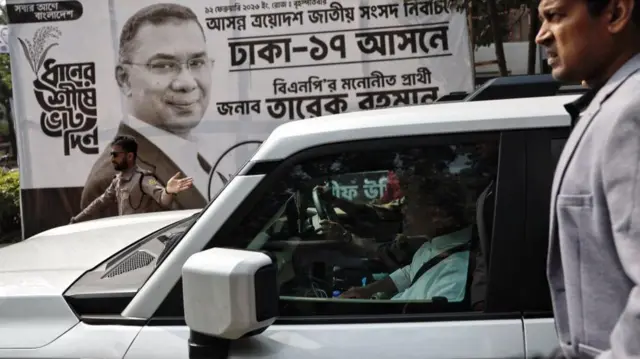
  18. BNP's Tarique Rahman says he 'waited more than a decade' for this daypublished at 06:32 GMT

    Azadeh Moshiri
    Reporting from Dhaka

    Tarique RahmanImage source, Aamir Peerzada/BBC

    Crowds of supporters and journalists swarmed around the leader of the Bangladesh Nationalist Party, Tarique Rahman this morning as he arrived to cast his vote.

    He tells me he's been waiting “more than a decade” for this day. The country had been waiting a long time too, he said.

    Before walking into the polling booth, Rahman said he was feeling “confident” about how the election would play out.

    What a contrast to how he spent election day in 2024 – in self-imposed exile in London during the rule of Sheikh Hasina. Thousands of his party's members and supporters were in jail then. His party had also boycotted the election.

  19. How AI-generated videos flooded Bangladesh ahead of this votepublished at 06:23 GMT

    Shruti Menon
    BBC Verify

    What’s interesting about this election is the amount of AI-generated political content that has flooded social media.

    I’ve been monitoring dozens of Facebook pages since January and have come across hundreds of AI-generated political videos, many of which are not labelled as synthetic content.

    The clips feature hyper-realistic but fabricated news presenters, computer-generated “ordinary citizens” and individuals dressed in police-style uniforms. The production quality is often polished, making the videos appear real at first glance.

    One video I’ve verified as AI-generated using SynthID, Google’s own AI detector tool, has been viewed nearly eight million times. It shows a man in a blue uniform resembling an official figure delivering a partisan political message.

    Another widely shared clip, viewed nearly 200,000 times, features a synthetic shopkeeper explaining why he would not vote for a particular candidate.

    Under Bangladesh’s electoral code of conduct, creating or sharing misleading AI-generated content is prohibited. However, there is limited clarity on how such content is being monitored or enforced online.

  20. Why this could be Bangladesh's 'most historic' electionpublished at 06:15 GMT

    Soutik Biswas
    India Correspondent

    Is this the most historic election in Bangladesh’s history - or simply another turn in a turbulent political journey?

    It may well be the former.

    Shafqat Munir of Bangladesh Institute of Peace and Security Studies (BIPSS), a think tank, offers a stark view: for 17 years, Bangladeshis have not had a genuine chance to vote.

    “The last proper election was in December 2008; everything since has been a fixed match,” he says.

    Nearly 60 million young voters have never "experienced a real contest" - to them, elections evoke "ballot stuffing and irregularities".

    There is excitement about reclaiming the ballot - but also caution.

    “Apprehension remains high, fuelled by disinformation,” Munir says.

    Yet he sees promise. This campaign has been far less violent than previous polls and marked by unexpected civility.

    “This is not just about casting ballots,” he says. “It is about a suppressed nation reclaiming its voice - perhaps the beginning of a golden hour.”

    BNP supporters at an election meeting in BangladeshImage source, NurPhoto via Getty Images)
    Image caption,

    BNP supporters at an election meeting in Bangladesh