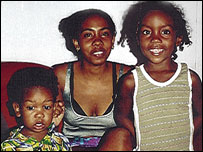
I wake up to my last day in Santiago and can hardly believe it. The time has flown. I have one more lesson with Reynaldo on the drums scheduled for today and take a taxi down town. Driving through his Barrio (district) I realise the place looks even harsher in daylight. The big man gives me a warm welcome and we spend two hours drumming. He is pleased with my progress. I wake up to my last day in Santiago and can hardly believe it. The time has flown. I have one more lesson with Reynaldo on the drums scheduled for today and take a taxi down town. Driving through his Barrio (district) I realise the place looks even harsher in daylight. The big man gives me a warm welcome and we spend two hours drumming. He is pleased with my progress. Some time later we go through to the lounge and chat to his wife Yusely and two children. I ask Reynaldo to tell me a little about his life and his feelings towards Cuba and the revolution. He was born and raised as an only child in Santiago. His first encounter with the drums didnt happen till he was 21. However it was apparent that he had rhythm in his blood and was soon teaching percussion at the Escuella (School) Del Arte Jose Maria and Escuella Del Arte Pepito Rey here in Santiago. Rey then goes on to tell me that he would love nothing more than for his children to continue in his footsteps as percussionists. He is passionate about his Afro Cuban heritage. And while he firmly believes that Cuba is undoubtedly a Mecca for Afro Cuban music, people should not forget that the true roots of this musical style is inexorably tied to Africa. He cites Giovanni Hidalgo and Chanquito as his favourite Conga players. I then ask him about the future of his beloved country and the famous revolution 44years on. Does he still believe in the socialist dream? Absolutely. And what of the future, when their beloved leader Fidel castro retires? "For me, the ideas will continue, as will the dreams and our belief in a Socialist democracy." Reynaldo then asks if he can share the taxi with me. He gets changed and we say goodbye to his wife and children. We arrive at the Parque Cespedes and find somewhere to sit. He asks what my plans are when I get back to England. I tell him that I need to find work. That way I can come back in a years time. He suggests that I revisit in July. This is the month of Carnival in Santiago and is full to capacity with revellers from all over the world. I thank him for the drumming lessons and take his address, promising to keep in touch. We shake hands and say our farewells. I walk back to the Casa and pack one final time before heading off to catch the Red Eye Express, the night train  to Havana. I Thank Isabella and her husband for a lovely time and head off into the night, sad but happy. to Havana. I Thank Isabella and her husband for a lovely time and head off into the night, sad but happy.
The views expressed on this page are those of the contributor and the opinions expressed are not necessarily those of the BBC. |