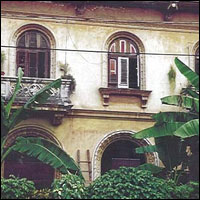
By seven thirty the next morning, I was back on the hotel balcony enjoying my breakfast. After three cups of irresistible Cuban coffee, I returned to my room to pack. As I handed my keys in, I felt a surge of excitement brought on by the prospect of heading off into the unknown. By seven thirty the next morning, I was back on the hotel balcony enjoying my breakfast. After three cups of irresistible Cuban coffee, I returned to my room to pack. As I handed my keys in, I felt a surge of excitement brought on by the prospect of heading off into the unknown. My journey to La Isla would involve a bus journey of two hours and then a three-hour ferry crossing. Arriving in darkness, I would then have to find somewhere to stay. From here on in, I would be staying in 'Casas Particulares' - the Cuban equivalent of a bed and breakfast. Cheaper than hotels, they are an ideal opportunity to experience life within Cuban society and a great way to improve your Spanish. The market in Casas Particulares did not really develop until the early 90s when the Cuban people were allowed to own and spend US dollars. Now flourishing industry, it is closely monitored by the State and subject to stiff licensing fees. | The beautiful colonial houses |
Out on the streets, the people of Havana were busy with another day. Mothers ushered young ones off to school, fruit and vegetable sellers sat patiently by meagre stalls. Up above me Salsa music floated off every balcony. The atmosphere here in the Barrios (neighbourhood) is wonderful; a true reflection of Cubas open, friendly society. However, step into the tourist zone and the magic dies. Rounding the corner is like walking into another world; a cacophony of horns, pollution, locals, confused tourists, and of course the ubiquitous Jintero. "Taxi Amigo, guided tours, cheap Casas, whatever you want
" This morning was no different. I grabbed the nearest available taxi and was soon on my way Havana's central bus station, roughly two miles away. As soon as we pulled up half a dozen hungry looking souls mobbed the car, desperate to earn a dollar by carrying my luggage. "Gracias, pero Soy joven y las piernas son fuerte." (Thanks but I am young and the legs are strong). I then made my way to the reservation window to make enquiries about the journey to La Isla. Just my luck, they were fully booked for the next 48 hours. I pleaded but realised I was wasting my time. Feeling dejected I made my way outside to see if the bright sunshine could lift my mood. It didn't. What now, I asked myself. Could this be a bad omen or am I simply letting a small setback get the better of me? I took a walk back into the station and after a spot of lunch in the café was feeling good again. I chatted with the owner, explaining that I was at a loose end for the next couple of days. He suggested I might want to consider staying in Vedado. Apart from being just around the corner it was regarded as a place of great cultural and historical importance. Vedado was originally a small colonial town. By the late 1890s it was attracting many of Havanas North-American community. In no time at all the area was thick with high-rise buildings, bars and restaurants. The area boomed under the Batista era and soon became a popular haunt for many of Americas East Coast mafia. They set up strip clubs, gambling dens and other nefarious activities designed to attract the tourists. Castro however, had other plans. One of the first things to happen in post-revolution Cuba was the immediate cessation of the gangster life. Walking into Vedado there is little to suggest this place had ever been a playboys paradise. Many of the public buildings take their names from great revolutionaries, the surrounding walls full of socialist propaganda. But as you go further in more of these incredible mansions appear, row upon row of beautifully styled colonial properties. And after a while, its easy to imagine Lucky Luciano and Al Capone strutting down these very blocks, on their way to some glitzy function. But just like Old Havana, Vedado basks in a faded glory of crumbling and neglected grandeur-of an era lost forever. basks in a faded glory of crumbling and neglected grandeur-of an era lost forever. Part Four of Pete's journey follows next week. The views expressed on this page are those of the contributor and the opinions expressed are not necessarily those of the BBC. |