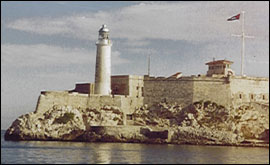
Eventually I made my way out on to the main drag and took a stroll along the Paseo Marti. This attractive marble boulevard runs almost half the length of Old Havana. As I reached the seafront I was rewarded with a magnificent view of the Castillo (Castle) de Los Tres Santos Reyes Magnos del Morro. This rather splendid castle was built between 1589 and 1630. It was designed to protect the harbour entrance and was once captured by British troops in 1762. The lighthouse (Cubas first) was added in 1845. Eventually I made my way out on to the main drag and took a stroll along the Paseo Marti. This attractive marble boulevard runs almost half the length of Old Havana. As I reached the seafront I was rewarded with a magnificent view of the Castillo (Castle) de Los Tres Santos Reyes Magnos del Morro. This rather splendid castle was built between 1589 and 1630. It was designed to protect the harbour entrance and was once captured by British troops in 1762. The lighthouse (Cubas first) was added in 1845. To my left I was able to catch a glimpse of Havanas imposing skyline, looking every bit the modern capital. But as I walked down the Malecon (Seafront) towards the centre I couldnt disguise my disappointment. Even more beautiful buildings crumbling into dereliction. Just ahead of me I caught a glimpse of a rather bizarre mural, featuring the words, Senores Imperialistas, No Les Tenemos Absolutemente Ninguno Miedo! (Dear Imperialists, we have absolutely no fear of you!) This unusual poster was clearly intended as an upturned middle finger to American interests. Not surprisingly the mural lay just a few yards from the former US Embassy. By now the ocean was crashing into the sea wall defences and I was getting sprayed so I turned left into the heart of modern Havana. Once more the streets were busy with tourists and locals. But by comparison the buildings were much smarter, shiny new Korean taxis buzzed through the streets and the general atmosphere seemed much more upbeat. In the distance I could see one building dominating the skyline, the Hotel Havana Libre. This was where Fidel Castro first set up his interim government after the 1959 revolution. It is now one of Havanas smartest hotels and has a great deal to offer the visitor-banks, shops, travel agencies and nightly shows. Further down my attention was drawn to a local flea market, selling carvings, beads and other interesting artefacts. The nice thing about this market was that stall holders were not in your face and the prices seemed like good value for money. But as I perused the stalls I could feel an aching in my legs and a growing desire to be somewhere quiet, feet up and a good cup of tea. As my hotel was about two miles away I decided it was time to catch a bus, Cuban style. To be honest, nothing could have really prepared me for this. It was only as time went by that I was able to make any sense of this bizarre ritual. It goes something like this; When you arrive at the bus stop you shout el ultimo (The last). This helps to identify who is before you; Cubans are far too laid back to bother forming an orderly queue. When the bus arrives you should stick to your marker like glue and fight your way on. Invariably the bus is already fit to bursting and you envisage no hope whatsoever of finding a place. But somehow, contrary to the law of physics you find yourself squeezed in. Now comes the tricky bit
how to move down a severely overcrowded bus and end up at the back doors just as it reaches your stop. This was the bit I never mastered and found myself shelled out prematurely on countless occasions. Mind you, how much of this was a subconscious act of survival, a need for fresh air and personal space, Ill never know. Modern commuters, you dont know how lucky you are. Back at the hotel I decided Old Havana was too aggressive and commercial, so perhaps it was time to move on. Over supper I perused some travel guides and was entranced by the idea of catching a ferry to the largest island belonging to Cuba, La Isla De Juventud. The book promised white sands, lapis waters and an entirely un-commercial experience for the visitor. Climbing into bed I felt excited and encouraged by what lay ahead. un-commercial experience for the visitor. Climbing into bed I felt excited and encouraged by what lay ahead. Part Three of Pete's journey follows next week. The views expressed on this page are those of the contributor and the opinions expressed are not necessarily those of the BBC. |