Today was going to be a long journey so Id asked the Casa proprietor - known affectionately as Mama, to get me up for 7.30 am. Mama lives with her son Rudolpho. He works as a doctor in Havana and the Casa business helps them pay the bills. Unlike the apartment I rented off Lazaro, the facilities here were shared and only cost $15 a night. Today was going to be a long journey so Id asked the Casa proprietor - known affectionately as Mama, to get me up for 7.30 am. Mama lives with her son Rudolpho. He works as a doctor in Havana and the Casa business helps them pay the bills. Unlike the apartment I rented off Lazaro, the facilities here were shared and only cost $15 a night. I staggered into the kitchen and chewed on a bit of old pineapple for breakfast. I washed it down with liberal amounts of coffee and cigarettes. Before the taxi arrived Mama asked me where I was going, and how long I was staying in Cuba. I told her my plan was to get to Santiago in two or three trips. I would stay in Cienfuegos for a while and maybe take in Trinidad as well. She then gave me a card for a Casa business in Ciengfuegos and promised to telephone the owners with my arrival time. That way there would be someone to meet me off the coach and it saved me the bother of trawling about for somewhere to stay. We hugged each other and I promised to call back when I returned to Havana in a couple of weeks time. Outside the sun was burning off a recent downpour. The air smelled sweet and clean, it put me in good spirits. Downtown at the bus station, now known to me affectionately as Tension Central I called into the café. The owner recognised me and joined me at the table. What followed was an intensive history lesson about Cuban culture, heritage and religion. I managed to get the name of a few good historical authors to check out when I return to the UK. Outside the Astro Bus driver indicated that he was ready to leave. I got up and followed him to the bus stop. I made my way to the back seat and got comfortable. The bus soon filled up and I found myself talking to Carlos, a Mexican artist on his way to meet his bride. They married eighteen months ago - I think with the intention of getting her out of the country but it seems she has struggled to get the appropriate paperwork sorted out. Carlos goes on to tell me that he is actually Cuban by birth; his parents emigrated to Mexico when he was seven. Hes a very intelligent and thoughtful person who makes an otherwise boring journey very interesting. 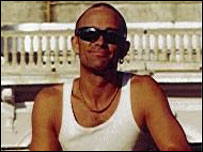 | Pete Keane |
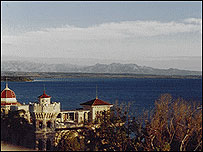
We arrive in Cienfuegos some time later and I arrange to meet up with Carlos for a drink. Meanwhile outside the station I see a man holding a piece of card that has my name written on it. We introduce ourselves and head off through the hot and busy streets of Cienfuegos. The city is located on the edge of a beautiful expanse of water that feeds into the Caribbean sea. It was largely unpopulated until the arrival of French colonists in the 1800s. Originally known as Fernandina De Jagua, it was renamed in 1830 after Captain General Jose Cienfuegos. By 1850, a railway had been laid all the way from Havana and many of the ferry passengers bound for Santiago in the south now found themselves having to make connections here. By the late 1890s as much as 15% of Cubas sugar crops were being exported from Cienfuegos. Nowadays, the main industries here are fertilizers, paper mills, oil refining and shipbuilding. In 1982, the Soviets began construction of a giant nuclear reactor just south of the city. However, they pulled out of the project before completion. An estimated US$750 million needs to be found before the reactor can be operational. Regular maintenance is still carried out on the facility to stop the plant deteriorating. There have also been rumours of a cover up by Cuban officials regarding defective welding on the cooling system. cover up by Cuban officials regarding defective welding on the cooling system.
The views expressed on this page are those of the contributor and the opinions expressed are not necessarily those of the BBC. |