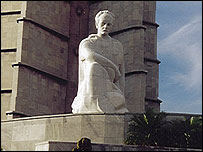
The next morning I rolled out of bed and prepared myself for a days sightseeing. A twenty-minute walk from the apartment took me to the pride of Vedado - the Plaza De Revolution. The next morning I rolled out of bed and prepared myself for a days sightseeing. A twenty-minute walk from the apartment took me to the pride of Vedado - the Plaza De Revolution. This wide thoroughfare was used during the 1960s for political rallies. An incredible 17m high marble statue of Jose Marti dominates the whole area. Behind this stands a most unusually styled Cleopatras needle, standing at an impressive 142m in height. Marti is unquestionably Cubas most favourite of national heroes. Born in Havana to Spanish parents in 1853 he became well known as a political activist by opposing Spanish colonial rule. He was deported for his beliefs but continued to actively campaign from abroad. In 1895 he joined rebel forces and landed in the east of the island, hoping to launch a second war of independence. Sadly, Marti was killed early on in hostile fighting. The rebels would continue to fight for another three years with victory in sight-only to have it snatched form them by American intervention. Marti is best remembered for his writings that espoused a free Cuba, in particular his eloquent use of poetry. He is still regarded as the founding father of Modernist Latin American poetry, with extracts of his writing to be found in Cubas best-known song, Guajira Guantananmera. Im a sincere man
from the land of the Palm tree
and before I die
I wish to sing these heartfelt verses
with the poor of this land
I want to share a fate
and the mountain stream pleases me
more than the sea  | Pete Keane |
Directly opposite the Jose Marti memorial stands Ministry of the Interior, famous for the enormous Che Guevera mural. I decided to make the Cristobal Colon Cematatio my next point of call, before calling it a day. The cemetery itself was only half a kilometre from my apartment so I could wander it at my leisure. The cemetery is enormous and has more than one million people interred here. The complex is laid out in streets and avenues making it easy to find particular monuments. After an hour of wandering I came across the tomb of Eduardo Chibas, the Orthodox party leader. Chibas committed suicide in 1951 during a radio broadcast as a personal protest against corruption. But it was during his burial ceremony that a young bearded rebel jumped on to his tomb and began to rail against the old order. His name? Fidel Castro. Thus began the political career of Cubas most renowned politician. On the way home I called in to the local supermarket and bought some provisions for tomorrow's journey, bread, cheese, butter and crisps. The bill was just shy of six dollars. That had to be at least 30% more expensive than back in the UK. It was a wonder that these shops did any business at all, but seeing as they had an absolute monopoly on all western goods, they could hardly fail. was a wonder that these shops did any business at all, but seeing as they had an absolute monopoly on all western goods, they could hardly fail. Share your travel stories and pics. Email them in to lancashire@bbc.co.uk. David Hughlock added this...
"How interesting that I, along with three of my soccer playing friends, having just toured Cuba, I find one of your correspondents 'doing' the island. We had some great experiences, and some harrowing moments too. We had a great time, we hired a mini van and a Cuban driver for the week and we covered quite a bit of the island. Needless to say, it is a poverty stricken island, with most buildings not having seen a splash of paint since the Castro invasion in 1959, not to mention the state of the vehicles, mostly late fifty models, or Ladas, from the old USSR, bicycles and mopeds are the main source of transportation. We stayed in some lovely 'tourist' hotels, at very reasonable prices, one as low as $13 US a night, and we stayed some nights at B&B's, arranged by our Cuban driver. At one place we were fortunate enough to meet one of the 'original' eighty members of the Castro invasion force from back in 1959. He was 65 years old now, but had all kinds of certificates of ' valor and some great photos of himself with Castro. He was very interesting to listen to. But even he is under the strain of life in a communist country, where the 'ordinary' folk aren't allowed to mix with the tourists. Our driver for instance was not allowed to come into some of the restaurants that we visited, and we visitors were not allowed to ride the public transport... it was rental car, or taxi, or walk it! Old Havana is in a state of disrepair that most of us couldn't envision. There are very few stores with anything worth buying, even souvenirs are hard to come by. The interesting thing about the monetary system is that it runs on the American dollar, with change being given in the Cuban peso, which the tourist is not allowed to use! How's that for a nifty way of charging you the full dollar! Here's an interesting bit of life... most Cuban public toilets are cleane, by women who park themselves outside of the toilet and demand a small 'tip' for the service.. .fair enough eh? Trouble is, you have to tell them just what you intend to do while in the toilet... they hand out the toilet paper! Very interesting situation eh?
We carried our own with us ;-)) Clever eh ? We did manage to get about with our driver and like he said, we probably saw more of the island than 90% of the people that have lived there all their lives, travel is very restricted for the Cubans, the cost alone is a massive deterrent to them, and as you probably guessed, they aren't allowed to leave the island.. .sad eh?
Anyway, all in all, it was very interesting, but it was nice to get back to civilization."
The views expressed on this page are those of the contributor and the opinions expressed are not necessarily those of the BBC. |