
The changing of a channel symbol is a crucial event and not one to be undertaken without more than usual thought and careful preparatory work.
At the start of the 1960s, the BBC was keen to show that it was a modern organisation, well placed to compete with its commercial rival ITV. By then the various regional companies that made up ITV had had five successful years, which each contributing station feeding into a national Independent Television network.
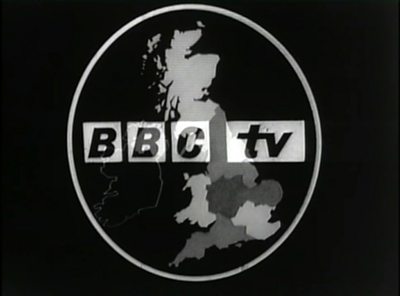
To coincide with the re-branding of the BBC Television Service to BBC tv in 1960, the BBC's new on-screen identity set out to prove that the Corporation was just as well placed to serve the UK's regions and different nations as ITV.
The BBC's encircled seven region map for three years, with the intention of showing that the BBC was also, in part, regional and should be thought of like ITV, a regional broadcaster under a national umbrella.
Globes
Not content with just the UK, the BBC's designers took on the world in 1963 when the seven region map was replaced by a spinning globe.
These early black and white globes were regularly refreshed; the initial design of 1963 had the globe split by a diagonal line, replaced by a cut out white backing within black circle between 1964-1966.
BBC tv became BBC1, and a new ident used from 1966-1968 had the globe spinning within a 'watch-strap'. This was replaced by a short-lived 'floating globe’ from 1968-1969.
Mirror globes
BBC1 went to colour in November 1969, and a new ident ('Symbol C') was introduced. This mechanical device, which became known as the "mirror globe", was created by filming a lit mechanical model in black and white in front of a concave mirror, which created a distinctive stretched world behind the globe. The model was always broadcast live and colour was added electronically.
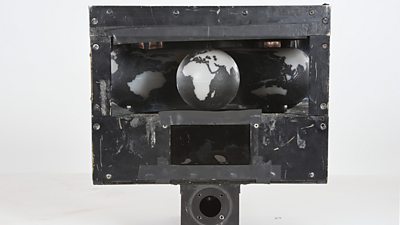
This device required little in the way of maintenance year in year out, and with the exception of a few changes to the BBC logo underneath, this design lasted virtually unchanged from 1969 to 1984; the most significant change was to a blue and yellow colour scheme in 1974, designed by Sid Sutton.
Computer Originated World
Talk of a computerised network symbol, or in the language of the day 'electronic solutions of generating a symbol' began sometime in January 1974.
A discussion paper was circulated by Rex Moorfoot, then Head of Presentation, Television, entitled New Symbols for Network and Regional Use. In it, three different approaches are suggested. By today's standards the options seem primitive, one even suggesting the use of a punched tape computer system, which even in 1974 must have been somewhat outmoded.
Progress was slow and by May 1974, new BBC 1 and 2 Controllers were involved in the decision to modify the network symbols. Rex Moorfoot reported that: "Controller, BBC-1 is cautious about changing the symbol. Controller, BBC-2 has ideas of changing his symbol."
Later that month Moorfoot met the controllers and only minor modifications were recommended to the on screen look. BBC-2 was to go entirely electronic, animated and with music by 1979, but BBC-1, because of the continuing popularity of the globe idea, remained little altered.
It took until 1985 to harness enough computing power at a reasonable cost to produce an entirely electronic globe device. It now sported a rich gold and blue combination, with Times New Roman font, coupled with a computerised clock. The 'Computer Originated World' became known as the 'COW globe'.
The Final Globe
By 1990s, the world of marketing and television identity had matured to the extent that a market could be created in the field – offering an entire package of corporate identity solutions to large companies.
Martin Lambie-Nairn was quick to capitalise on the potential, and was one of the first designers to set up a bespoke design service for television. His breakthrough came with partner Celia Chapman who was responsible for directing the entire BBC corporate identity programme.
This included a redesign of all the BBC terrestrial and commercial channel identities, national and local radio networks, online, corporate centre and personnel identities. But it was with their package of clever and ever changing BBC-2 symbols that Lambie-Nairn took the TV design world by storm.
BBC1 was to enjoy a second, and final version of the traditional globe image. An ethereal swirling and ever changing image was created for network announcements, with a large figure 1 taking centre stage.
Public reaction was positive, although it did take some getting used to! One could see sections of the globe seemingly spinning off into outer space and not returning, then a few seconds later a different continent might come into view – in short the effect was mesmerising. Technically this was the most advanced globe, and operated from a modified Sony laser disc based system.
Designer Daniel Barber came up with the concept, and had to rely on relatively new systems to produce a faultless image. After much argument, the accompanying network clock, normally seen before news broadcasts was modified too. With similar dimensions as the new globe, the result was an elegant and functional solution, but originally the changes were to be much more radical.
Martin Lambie-Nairn recalls what was proposed:
Engineering had come up with a design for a clock face that resembled the clock face of Big Ben. The engineering was a breakthrough at the time. For the first time the second hand was smooth rather that the second by second movement. I rejected it because I did not want a clock face with historic or classical features and because the smooth action didn't help the countdown required by Presentation. There were a lot of tears at the time.
The BBC globe was not quite cast into outer space forever with the demise of the laser disc globe. It was to have one final breath of life in 1997, when the BBC balloon took off...
BBC idents
Early Identities
The Television Service's visual branding, 1936-1953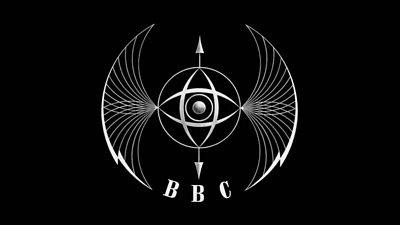
Abram Games and the Television Symbol
The story of the bat's wings logo used between 1953 and 1960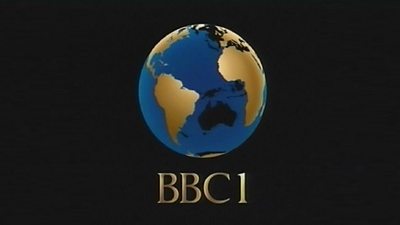
Global Ambition
BBC One's visual identity 1960-1997
Into the New Millennium
BBC One idents from 1997 to the present day
BBC Two 1991
How BBC 2 was rebranded in 1991
BBC Two 2018 idents
The first new identity for BBC Two in 20 years
BBC Christmas idents
40 years of Christmas idents on BBC One and BBC Two


BBC Motion Graphic Archive
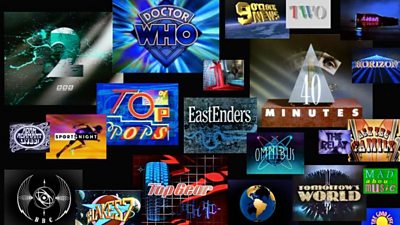
BBC Motion Graphics Archive at Ravensbourne University London
The BBC Motion Graphics Archive is a showcase of the history and development of motion graphics across the BBC and includes examples of opening titles, promotion trailers, stings, idents and programme content sequences.
