Within months of the BBC starting a television service, the Corporation faced its first design dilemma. What do you do to alert people that a transmission is about to start? What do you put up on screen when a programme ends and another is about to begin? Above all, how does the public know it is the BBC and no one else providing a TV service? This was a question of 'network identity', a notion never before dreamt of by any organisation, anywhere before.
When regular a BBC Television Service began in November 1936, producers and managers were so enamoured with making the technology work, and so overwhelmed with the creative possibilities of the medium, that serious thought about an on screen identity only emerged ten months later.
There had been caption cards produced for individual shows, copying the techniques seen in cinema, and there were a variety of stills with the words 'B.B.C. Television Service' written in various ways, but nothing that could be called an identity.
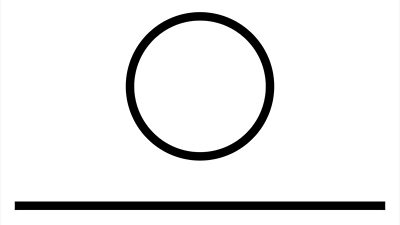
The Tuning Symbol (later to be known as the test card), became the first piece of the design jigsaw. It was merely a circle and a line, occasionally followed by the words 'BBC Television Service'.
Then something a little more elaborate, using a daring combination of words and design.
This was created, not as a result of any ponderous bureaucratic decision making nor the product of ‘blue sky thinking’. Instead, it came about during an outside broadcast from the radio industry exhibition of the day, 'RadiOlympia'.
Engineer William (Paff) Paffard was responsible for its creation, alongside a programme slide for the coverage of the exhibition:
Gerald Cock, our TV boss, wanted a caption urgently, with Radiolympia in large letters. Could I draw or paint it by 3pm? Without thinking, I said 'yes' and dashed over to WH Smiths, Muswell Hill, to get a large white card, ink and brush. It took me all morning doing large black letters on the white board.
So, that's how it started. Not in a boardroom, not in a focus group, but with a paint brush and card from WH Smiths.
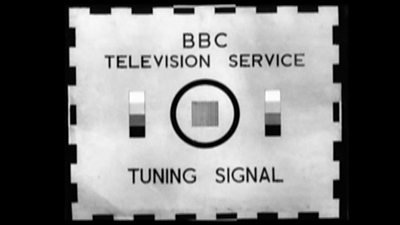
For today's media sophisticates the design seems crude and says nothing about an organisation’s values, something that channel identity must do today. But it achieved a certain following, and was commented on in the press in the week of its first airing. The Observer thought it was very much of the moment, but also explained its practical side:
The new tuning signal picture, which was brought into use last week, looks as if a BBC artist had tried to outdo the most modern of the moderns. Actually its grouping of cubes and circles is designed to allow the picture in the receiver to be correctly proportioned. It is transmitted for five minutes before each programme.
The press barely mentioned the BBC's identity again. In fact it was not until the early 1950s that brand awareness really took hold in the Corporation.
The image that was to grab the public's attention this time was a curious mix of an all seeing eye and the wing of a bat; Abram Games's 'Television Symbol' of 1953.
BBC idents
Early Identities
The Television Service's visual branding, 1936-1953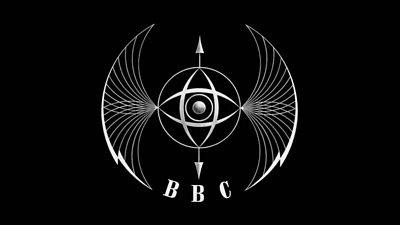
Abram Games and the Television Symbol
The story of the bat's wings logo used between 1953 and 1960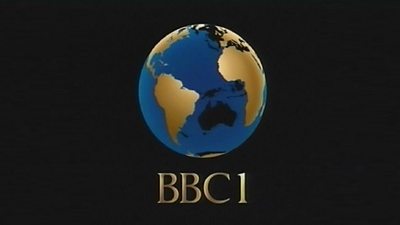
Global Ambition
BBC One's visual identity 1960-1997
Into the New Millennium
BBC One idents from 1997 to the present day
BBC Two 1991
How BBC 2 was rebranded in 1991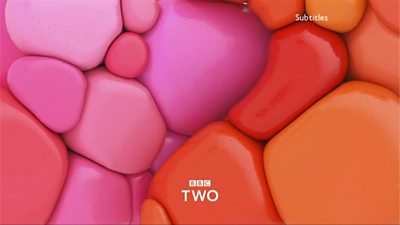
BBC Two 2018 idents
The first new identity for BBC Two in 20 years
BBC Christmas idents
40 years of Christmas idents on BBC One and BBC Two


BBC Motion Graphic Archive
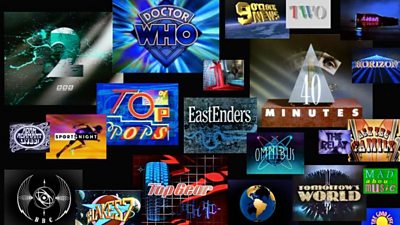
BBC Motion Graphics Archive at Ravensbourne University London
The BBC Motion Graphics Archive is a showcase of the history and development of motion graphics across the BBC and includes examples of opening titles, promotion trailers, stings, idents and programme content sequences.
