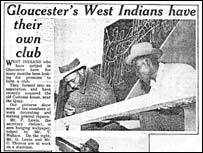
A Gloucestershire West Indian Association was formed in 1962, with Philip Pedro Lewis, Daddy West (Austin Westcarr) and Bernard Westcarr, among others, on the committee. Meeting at the Old Custom House in Quay Street, it attempted to draw the community together and began raising funds for a building. A successful Independence Ball was held in August 1962, inviting the Mayor and other local dignitaries. Social events
On the social front, things began to improve as the wives, sweethearts and children who had been left at home came to Britain. There were birthdays, weddings and christenings to celebrate.
By 1970, the Jamaicans were to have their own Sports and Social Club, situated at Chase Lane, off Eastern Avenue, where they were able to host their own events, as well as sporting activities for young and old. The first committee The first committee consisted of: Austin (Daddy West) Westcarr, Kenneth Johnson, Byron Thompson, Dudley Davis, Philip (Pedro) Lewis, Michael Douglas, John Daley and Lesley Daley, with many others joining later. However, in the mid-1970s, there was a need to form yet another organisation - The West Indian United Action Group (WIUAG). The founder members of this group were Cliff Richards, Bernard Westcarr and an Englishman, Trevor Knight, also known as Skip. 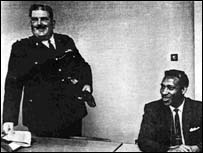 | Astley Lloyd Blair aged 27 was Britain's first black policeman |
Skip was a scout leader, with many of the young, first generation, British-born, African-Caribbean boys in his group. They met at a number of venues over the years - at members homes, St Marks School, a Methodist Church building in Belgrave Road and finally a property they purchased at 49a Derby Road. The formation of this group was in response to a number of issues that arose within the community at this time. There were perceived problems around police harassment and there were concerns about the housing of black people on certain council estates in the city, which was viewed as discrimination and segregation. Education
In particular, there were concerns about the education of young black children. A national report at this time had highlighted the under-achievement of black children. Many children in Gloucester were being allocated places in secondary schools and the group monitored the outcomes of allocations and assisted many families in the appeals system. They were also to set up many subsidiary groups, such as the Saturday School, providing supplementary education and black history, and the Ladies Circle, providing a focus for women in the community, which still exist today. In the 1980s, this group merged with another group, the Afro-Caribbean Association, which among other achievements had developed a Black Luncheon Club. This organisation now has premises on Barton Street and represents the interests of the community on many committees in the city. It now also runs The Shining Star Out of School/Kids Club and the Homework and Study Support Group. »See 'Building a community' |  |