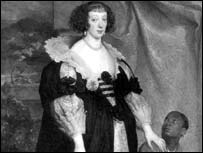
The very first known record in Gloucestershire relates to John Davies ye black who was buried in the parish of Bisley on 22 November 1603. Many were registered as 'servants' and 'slaves', although there is very little else known about them. 
There was also a growing problem of poverty and destitution amongst the black population, which led to the formation of the Committee for the Relief of the Black Poor. | | Our Untold Stories |
Others are merely recorded as persons 'of colour' or 'negro'. Their owners may have owned estates in the Caribbean and brought them over to Britain, or purchased them by auction at a slave port such as nearby in Bristol. Some were most obviously free, even before the abolition of slavery in 1834. James Turtle at the Gloucestershire County Records Office has compiled a list of references over a number of years. At Driffield on 5 June 1687 Jacob the servant of George Hanger Esq. 'a moore' was baptised and at Newnham-on-Severn in the Easter 1715 John Prince 'a black boy lately bought into England' was apprenticed to John Trigge, an Attorney at Law. However until the mid 18th century there remains only occasional mentions of 'blacks'. This may be because of the rural nature of the county. However it remains very difficult to trace 'blacks' from the records unless specific mention is made of their 'color'. It is likely there remains much evidence to be discovered.
Anglo-Saxon names
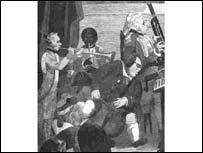 | | Black people were commonly being bought and sold as property |
Owners had the frequent habit of giving their slaves Anglo-Saxon names - notably in Gloucester in August 1731 when 'John Prince a black boy lately brought into England was baptised'. Others simply had the name of the village in which they lived. William Frocester an 11-year old from Barbados was baptised in Frocester in 1790. Elsewhere names such as Mingo (Cheltenham 1817) and Dido (Tidenham 1805) were probably thought by their owners to be the sort of names they may have had 'back home'. A more detailed reference gives light on the way the slaves and former slaves were treated and referred to. A record from Gloucester dated 24 August 1731 states: "Charles Powell, a lusty, black fellow, said to be born in Monmouth. Ran away the 16th inst. from the service of Mr Viney of the City of Gloucester, with a blue Livery lined with yellow
and a dark brown wig: These are therefore to caution all Gentlemen and others from hiring him
"
Advertisements, which were very common in newspapers throughout the late 17th and 18th centuries, are evidence of the fact that black people were commonly being bought and sold as property. 20,000 'Negro servants It is estimated that there may have been as many as 20,000 Negro servants in London in 1764. However, not all were slaves. There were many free black people. Some had gained their freedom on the death of their owner, while others had been able to purchase their own freedom or have someone purchase it for them. Others had simply run away. »See 'History'
»See 'The World Wars'
»See 'Slavery and abolition' |