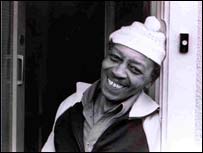
An early newcomer to Gloucestershire was Claude Correia, from Guyana. He joined the RAF, arriving in Greenock in Scotland in the spring of 1945. 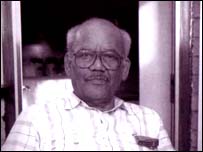 | | Claude joined the RAF and arrived in the UK in1945 |
After basic training in Melksham, Wiltshire, and a brief posting to Credenhill in Herefordshire, he was stationed at Gloucester, moving between both RAF Innsworth and the RAF Records Office in Eastern Avenue. Like Stan, Claude married a local girl, Brenda and still lives in Gloucester. Claude recalls there being many other people of Caribbean origin at the bases, but they eventually moved away or returned home when they were demobbed. He and Stan were therefore probably the first African-Caribbean men to settle in Gloucester. Vivian Blake
Vivian Blake also came to Britain during the war. In fact, he travelled to Britain on the same ship as Stan Boreland, although they did not get to know each other until they were in England. Whilst in Virginia, USA, at Camp Patrick Henry, Vivian experienced segregation. The camp was in effect two camps; a white one and a black one. The Jamaican recruits were treated as 'honorary whites', placed in the white camp and were forbidden to mix with the black Americans. However, the white Americans were not pleased with this arrangement. 
Vivian recalls a white American officer reminding his men, "These aint Uncle Sams Niggers, these are King Georges Niggers". He worked in the commissary and had charge of a group of AWOL white American recruits, one of who claimed to be Dillingers brother. | | Vivian Blake |
Vivian recalls a white American officer reminding his men, "These aint Uncle Sams Niggers, these are King Georges Niggers. He worked in the commissary and had charge of a group of AWOL white American recruits, one of who claimed to be Dillingers brother. Liverpool Upon arrival in Liverpool, the troops were taken to Lime Street Station, where Vivian recalls they were greeted with cheers from the local people. Following his basic training, he went to Causwall in Scotland, to undertake three months' training in air-sea rescue. He was then posted to Ilfracombe in Devon, and later Pembroke Docks in Wales, followed by a number of postings to other bases until he left the forces in 1948. It had been his intention to return to Jamaica to resume his studies, but by this time he had become accustomed to Britain and saw the opportunities available. He moved around the country for a while, living and working in Liverpool, Manchester, Leeds and Bradford. He worked for British Rail for a while and then took up a career in engineering. He moved to Gloucester in 1960 with his wife, who had relatives in the area, working at the Hawker-Siddeley plant in Hucclecote. He left Gloucester for a few years to work in Birmingham, but returned in 1966. |