Friday 19th October 2001, 1200 BST
Walks and scenery in New Zealand's beautiful South Island | | 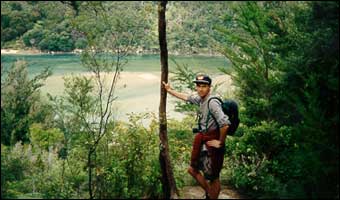
The Abel Tasman walk is one of several fantastic treks through the beautiful South Island scenery | | Being in the Southern Hemisphere, New Zealand's
South Island is generally cooler than the North Island.
Its climate varies greatly with small distances, but not so greatly with the seasons.
As it is the larger of the two islands, the locals call it the mainland, despite the fact that the capital is on the North Island along with nearly three quarters of the population.
Its climate is dominated by the New Zealand alps which run more or less parallel to the west coast.
The prevailing westerly winds ensure that the western slopes of the mountains are the wettest part of the Island.
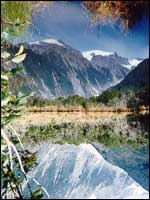 | | Reflecting on the glaciers at Franz Josef |
The peaks of the alps provide the island with around 300 glaciers such as at Franz Josef, and its many ski fields.
In the southern part of the alps, lies the popular tourist resort of Queenstown. This beautiful town on the shores of Lake Wakatipu is known as the action and adventure capital of New Zealand, with opportunities for skiing, white water rafting and bungy-jumping.
As the winds rise over the mountains, they dry out. This means the eastern side of the alps is noticeably warmer and drier, and the snow here melts more readily.
This is know as a Föhn wind, and examples of this are seen across the world. In North America it is known as a ‘Chinook’ wind, a native American term meaning ‘snow eater’.
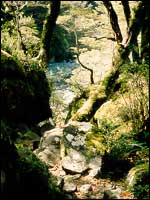 | | The beautiful scenery of Arthur's Pass |
There are some wonderful walks throughout the South Island, and some absolutely stunning scenery.
A comfortable train ride to Arthur's Pass for example will take you past some of the island's most beautiful landscapes, and if you venture off the train you will be well rewarded with some fantastic woodland walks.
The high plains to the east of the mountains are the driest part of the island. This is where the country’s greatest extremes of daily and seasonal temperatures are found and the climate is nearly continental.
This makes it one of many places in New Zealand which is excellent for growing wine, a tourist attraction that has really taken off in the last 10 years.
It is bringing in many wine connoisseurs from overseas, who wish to experience something quite different to France or California.
Further south the local accent picks up a real ‘burr’, which originates from the Scottish settlers who moved there in the 19th century.
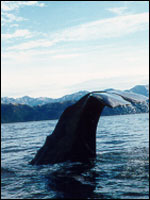 | | Whale watching at Kaikoura |
Some of the towns have Scottish names including Invercagill and Dunedin.
Here the climate once again becomes more strongly influenced by the ocean. It is wetter and the summer and winters are both milder.
And of course anyone visiting the South Island has to stop off and see the seals and whales at Kaikoura.
Like the North Island, the South Island does not really suffer from extreme weather conditions, but the weather can change as unexpectedly as the British weather.
It is wise to keep an eye on it to prevent being caught unawares. |
|