Wednesday 20th June 2001, 1700 BST
Thailand: home of The Beach | | 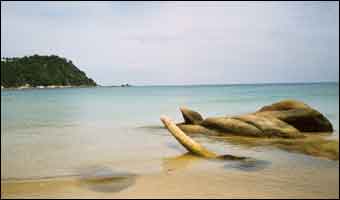
Blue skies and a beautiful sandy beach on Ko Pha Ngan (photos: Tony Arnese) | | The Kingdom of Thailand is about the same size as France.
It stretches around 1770 kilometres (1100 miles) north to south, from Chiang Rai on the Myanmar border in the north, to more than halfway down the Malay Peninsula in the south. Consequently there are large variations in its climate.
Thailand’s climate is equatorial in the extreme south, but much of the rest of the county is tropical.
 | | Part of the Death Railway at Kanchanaburi | | |
It is dominated by the two monsoon seasons.
The build-up of heat and humidity during February, March and April produces very uncomfortable conditions.
Average April temperatures in Bangkok of 36 Celsius (108F) are accompanied by an afternoon humidity of 60 per cent.
With the onset of the southwesterly monsoon temperatures drop by a couple of degrees but increasing humidity means that conditions remain very oppressive. Winds blowing in off the Indian Ocean bring much cloud and a good deal of rain.
During these months daily sunshine averages around four hours, compared with nine to ten hours through the rest of the year. But even at the height of the monsoon season (generally September) rainfall is not usually excessive.
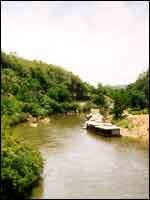 | | Lush vegetation along the banks of the River Kwai Yai | | |
Between November (October in the north) and April the northeastern monsoon sees much drier winds blowing overland across Indo-China.
October through until February sees the most comfortable conditions for the western traveller with temperatures around 30 Celsius (86F) and lower humidities.
Whilst this might seem the ideal time to visit Thailand, those planning to enjoy the beautiful beaches on the islands that flank the Kra Isthmus, such as Phuket and Ko Samui should note that this northeasterly monsoon can bring further rain in off the Gulf of Siam and the South China Sea.
Thailand generally experiences less extreme weather conditions than some of its Southeast Asian neighbours. The extensive flooding that can affect much of Indo-China is less frequent here.
Temperatures and humidities, whist giving very uncomfortable conditions at times, are perhaps somewhat less stressful than in Laos or Cambodia. |
|